

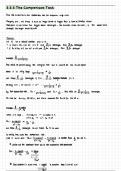
3.3.3 The Comparison Test
This testis similar to the comparison testfor imposer intge rals
Roughly put, we know asum of larger terms is
bigger than a sum of smaller terms
therefore ifwe know the bigger some converges, the smaller as
must well, ifthe small term
diverges, the larger must as well
Theorem:
Let N be a natural number and k <0
if lan1 KC, for all n = N
and non converges then can converges
if AnrKan>0 for all n<-N and Eodn diverges, then an diverges
example: Ein2 2n +
3
+
this could be found using the integral testbutitwould be too mucheffort
when n is
very large n+ 2n+3*t n2
we known, no converges if 421, nin coverges because 42
=
prtcnt3*n'
2
for any nx1, n2+ 2n+3 > n ...
by the comparisontest, an
n2+ 2n +3
=
and Cr =
,
this tells us
intents converges
Its rare for an by for all n, but more common for an=Kbn for all n
example:, n+cos(n)
n3 V3
-
When his large, ncsosal'ntcos(n)=n
n3xbz -n -
z=n3
An n+ cos(n)
=n
=
=
n3 -
13
we know
it converges so we expecton to as well
to verify this with the comparison test:
lan1= Intcos(n))
find K such that n+cos(r) is smaller than
I for alln.
=
n3 -
73 13 -
Vz
①
factor out the dominantterm outof the numerator and dominator
an n cos(n) +cos(n)
3
= +
=
n
13 -
13
1
1 -
Y3n3
② find constant K such that
Itcosm) is smaller than K for all har
1 -
3n3
This testis similar to the comparison testfor imposer intge rals
Roughly put, we know asum of larger terms is
bigger than a sum of smaller terms
therefore ifwe know the bigger some converges, the smaller as
must well, ifthe small term
diverges, the larger must as well
Theorem:
Let N be a natural number and k <0
if lan1 KC, for all n = N
and non converges then can converges
if AnrKan>0 for all n<-N and Eodn diverges, then an diverges
example: Ein2 2n +
3
+
this could be found using the integral testbutitwould be too mucheffort
when n is
very large n+ 2n+3*t n2
we known, no converges if 421, nin coverges because 42
=
prtcnt3*n'
2
for any nx1, n2+ 2n+3 > n ...
by the comparisontest, an
n2+ 2n +3
=
and Cr =
,
this tells us
intents converges
Its rare for an by for all n, but more common for an=Kbn for all n
example:, n+cos(n)
n3 V3
-
When his large, ncsosal'ntcos(n)=n
n3xbz -n -
z=n3
An n+ cos(n)
=n
=
=
n3 -
13
we know
it converges so we expecton to as well
to verify this with the comparison test:
lan1= Intcos(n))
find K such that n+cos(r) is smaller than
I for alln.
=
n3 -
73 13 -
Vz
①
factor out the dominantterm outof the numerator and dominator
an n cos(n) +cos(n)
3
= +
=
n
13 -
13
1
1 -
Y3n3
② find constant K such that
Itcosm) is smaller than K for all har
1 -
3n3


