Dynamics -
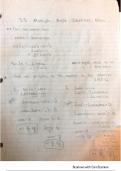
Fundamental Forces
> relative strength, strongestbeing assigned to 1, smaller numbers represented by fractions
>effective how far can itreach?
range
-
carrier/exchange particle "communicates"force
> force between objects
Strong Nuclear force
a
strongest force in nature (strength of 1) SNFL
>responsible for binding the nucleus
>limited range sets a limitto nuclear
max
size, this to the
length ofthe
PT
ifitdidn'texist, we wouldn'thave any elements above
Hydrogen
>
Electromagnetic force
> binds matter
together emEMae -
be 2 distinctforces:
originally thought to
>
James
electrostatic:force of attraction/repulsion between charges
Maxwell,
1864 *
magnetic:force ofattraction/repulsion between
magnets/magnetic material
these I forces were "flavors"of the same force
> force of at
> infinite range
Weak Nuclear Force
>binds neutrons together
I
responsible for Beta decay
a for stellar fusion through transmutation ofneutrons
necessary
6
I
strength of
-
10
range of10-18m
>
a)
a i
Gravitational Force
r
>
weakestof fundamental forces
> force attraction between all objects with mass
I force of6 x 10-39
> infinite
range
,Newton's Laws
> 1687 Newton publishes Principia Mathematica
-
lays relating force, mass
> he out 3 laws -
acceleration
First Law
> inertial law a =
directly related to,
& resistance to acceleration
inertia -
proportional to
& inertia a mass
>
unbalanced/net force causes acceleration
> if no fret, no
i) if F= 0 then TF = 0
-
ii) it F; to then Ff =
V;
Third Law
S action-reaction law
FAB-FBA GERDest
Second Law
E, m, a mathematically =
act f
-|
> relates =
&
experiments:
i) holding me constant, determine how a relates to E force, f IN=11gm/s2
->
ff Units: Newtons, N
ii) holding constant, determine how a relates to m
xM
Fact: ME
If = ma (rector sums, use this)
, Freebody Diagrams
>used to indicate relative direction of all forces
magnitude acting on an object
+
ContactForces
I
>applied force fa or FA
push ofan object
>
tension, Fr
pull of objectthrough a
rope/cable
·
an
I normal force, Fr
·perpendicular to 2 surfaces in contact
reaction force electromagnetic
·
a
force
"How hard I surfaces squeezed together
·
"
are
>
friction. It
parallel to 2 surfaces in contact
opposes relative motion between I surfaces
spring force, Is
>
return force opposite the direction you pull on a
spring
Non-Contact/Action-at-a-Distance force
>
weight/ gravitational force W or
Eg Fg W
=
mg
=
>
electrostatic/electric/covlomb force
>magnetic force, FB
Friction facts
> friction is due to electrostatic attraction between atoms ofthe
objects in contact
> friction creates waste heat
I can turn
speed you up, slow
you
down or make you
<
allows
you
to walk, turn a corner on
your bike, warm your hands in the winter, see meteor
showers.
you push harder/longer
> to attain a acceleration
makes given
I like
any force, italways has an action-reaction pair
Fundamental Forces
> relative strength, strongestbeing assigned to 1, smaller numbers represented by fractions
>effective how far can itreach?
range
-
carrier/exchange particle "communicates"force
> force between objects
Strong Nuclear force
a
strongest force in nature (strength of 1) SNFL
>responsible for binding the nucleus
>limited range sets a limitto nuclear
max
size, this to the
length ofthe
PT
ifitdidn'texist, we wouldn'thave any elements above
Hydrogen
>
Electromagnetic force
> binds matter
together emEMae -
be 2 distinctforces:
originally thought to
>
James
electrostatic:force of attraction/repulsion between charges
Maxwell,
1864 *
magnetic:force ofattraction/repulsion between
magnets/magnetic material
these I forces were "flavors"of the same force
> force of at
> infinite range
Weak Nuclear Force
>binds neutrons together
I
responsible for Beta decay
a for stellar fusion through transmutation ofneutrons
necessary
6
I
strength of
-
10
range of10-18m
>
a)
a i
Gravitational Force
r
>
weakestof fundamental forces
> force attraction between all objects with mass
I force of6 x 10-39
> infinite
range
,Newton's Laws
> 1687 Newton publishes Principia Mathematica
-
lays relating force, mass
> he out 3 laws -
acceleration
First Law
> inertial law a =
directly related to,
& resistance to acceleration
inertia -
proportional to
& inertia a mass
>
unbalanced/net force causes acceleration
> if no fret, no
i) if F= 0 then TF = 0
-
ii) it F; to then Ff =
V;
Third Law
S action-reaction law
FAB-FBA GERDest
Second Law
E, m, a mathematically =
act f
-|
> relates =
&
experiments:
i) holding me constant, determine how a relates to E force, f IN=11gm/s2
->
ff Units: Newtons, N
ii) holding constant, determine how a relates to m
xM
Fact: ME
If = ma (rector sums, use this)
, Freebody Diagrams
>used to indicate relative direction of all forces
magnitude acting on an object
+
ContactForces
I
>applied force fa or FA
push ofan object
>
tension, Fr
pull of objectthrough a
rope/cable
·
an
I normal force, Fr
·perpendicular to 2 surfaces in contact
reaction force electromagnetic
·
a
force
"How hard I surfaces squeezed together
·
"
are
>
friction. It
parallel to 2 surfaces in contact
opposes relative motion between I surfaces
spring force, Is
>
return force opposite the direction you pull on a
spring
Non-Contact/Action-at-a-Distance force
>
weight/ gravitational force W or
Eg Fg W
=
mg
=
>
electrostatic/electric/covlomb force
>magnetic force, FB
Friction facts
> friction is due to electrostatic attraction between atoms ofthe
objects in contact
> friction creates waste heat
I can turn
speed you up, slow
you
down or make you
<
allows
you
to walk, turn a corner on
your bike, warm your hands in the winter, see meteor
showers.
you push harder/longer
> to attain a acceleration
makes given
I like
any force, italways has an action-reaction pair