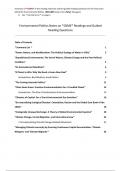
Summary of *SOME* of the reading materials and the guided reading questions for the final exam
(2023) for Environmental Politics. INCLUDES notes from (Total: 26 pages):
● See * Summary List * on page 1.
Environmental Politics Notes on *SOME* Readings and Guided
Reading Questions
Table of Contents
* Summary List * 1
“Power, Nature, and Neoliberalism: The Political Ecology of Water in Chile” 2
“Depoliticized Environments: The End of Nature, Climate Change and the Post-Political
Condition” 4
“An Ecomodernist Manifesto” 6
“A Planet to Win: Why We Need a Green New Deal” 9
Introduction: Bad Weather, Good Politics 9
“The Coming Avocado Politics” 11
“China Goes Green: Coercive Environmentalism for a Troubled Planet” 14
Introduction: The Rise of Authoritarian Environmentalism 14
“Climates of Capital: For a Trans-Environmental Eco-Socialism” 16
“De-naturalizing Ecological Disaster: Colonialism, Racism and the Global Dust Bowl of the
1930s” 18
“Ecologically Unequal Exchange: A Theory of Global Environmental Injustice” 20
“Climate Change, Forced Migration, and International Law” 22
1 Conceptualizing Climate Change-Related Movement 22
“Managing Climate Insecurity by Ensuring Continuous Capital Accumulation: ‘Climate
Refugees’ and ‘Climate Migrants’” 24
, 1
* Summary List *
These notes include a summary of each of the following readings:
● Jessica Budds’ journal article (2004) “Power, Nature, and Neoliberalism: The Political Ecology
of Water in Chile”, pp. 322-337.
● Erik Swyngedouw’s journal article (2011) “Depoliticized Environments: The End of Nature,
Climate Change and the Post-Political Condition”, pp. 253-274.
● Asafu-Adjaye, et al. (2015) “An Ecomodernist Manifesto”.
● Aronoff, et al. (2019) “A Planet to Win: Why We Need a Green New Deal”, introduction.
● Nils Gilman’s article (2020) “The Coming Avocado Politics”.
● Yifei Li and Judith Shapiro’s textbook (2020) “China Goes Green: Coercive Environmentalism
for a Troubled Planet”, introduction.
● Nancy Fraser’s journal article (2021) “Climates of Capital: For a Trans-Environmental
Eco-Socialism”.
● Hannah Holleman’s journal article (2017) “De-naturalizing Ecological Disaster: Colonialism,
Racism and the Global Dust Bowl of the 1930s”.
● Jennifer E. Givens, Xiaorui Huang, and Andrew K. Jorgenson’s journal article (2019)
“Ecologically Unequal Exchange: A Theory of Global Environmental Injustice”.
● Jane McAdam’s chapter (2012) “1 Conceptualizing Climate Change-Related Movement” in
“Climate Change, Forced Migration, and International Law”.
● Romain Felli’s journal article (2013) “Managing Climate Insecurity by Ensuring Continuous
Capital Accumulation: 'Climate Refugees' and 'Climate Migrants’”.
, 2
“Power, Nature, and Neoliberalism: The Political Ecology of Water in
Chile”
Water Regime: Set of rules, institutions & practices that govern the water resource management in
a given society/region. Can vary widely depending on cultural, political & environmental factors.
Water management in Chile in the context of neoliberal policies & globalisation:
● Crucial resource in the shifting economic & political landscape (commodified & privatised).
● Challenges → state’s role, water rights distribution & neoliberalism’s environmental impact.
➔ Neoliberalism: Political & economic ideology emphasising the importance of free
markets, individual freedoms, limited government intervention = characterised by
privatisation, deregulation & trade liberalisation.
Water Commodification: Process of treating water as a marketable commodity that can be
bought/sold → leads to the privatisation of water resources, with ownership rights granted to those
who can afford to purchase them. “Political ecology” issue in Chile:
● Various actors (e.g., state, private companies, civil society) compete for control.
● Historical roots:
○ Water has always been a scarce resource → management has been the subject of
various legal & institutional arrangements over the years.
○ Commodification/privatisation of water in Chile has been a key feature of the
country’s neoliberal economic policies = sought to reduce state involvement in
various sectors of the economy.
■ Pinochet’s dictatorship 1970s = current water management system’s origins.
■ 1980s/90s = institutionalisation of the system.
○ Water is viewed as a commodity (bought/sold on the open market) > public good
that should be managed in the interests of all citizens.
● Power relations shape water’s distribution → water is a physical, social & political resource.
➔ Neoliberal model has reinforced this, as access to water is largely determined by
market mechanisms > social/political ones.
➔ Privatisation of water has further entrenched these power structures.
Market-based water management = water as a natural resource that is managed/conserved →
legitimises its commodification/privatisation of water (obscures the social/political dimensions of
water management & naturalises existing power relations).
➔ Number of consequences:
◆ Access to water is determined by market forces > by need (hierarchy → exacerbates
existing power imbalances & reinforces social inequalities):
● Water rights are concentrated in the hands of a few powerful actors (e.g.,
large corporations & wealthy individuals).
● Small farmers & other marginalised groups have limited access to water,
while large agribusinesses & mining companies can use vast amounts of
water with little oversight or regulation.
, 3
◆ Negative environmental impacts from the over-extraction of water resources & a
lack of investment in infrastructure to manage water use → depletion of aquifers,
pollution of bodies of water, drying up of rivers.
➔ Chilean government’s role = inconsistent policies & tensions between the demands of
various stakeholders. Under pressure from:
◆ Neoliberal advocates → reduce government’s involvement in the water sector &
allow market forces to determine the allocation of water rights.
◆ Civil society groups & environmental activists → protect water resources + ensure
that they are managed in the public interest.
➔ Perspectives (e.g., farmers, environmental activists, government officials):
◆ While some farmers have been able to adapt to the new market-based system,
others have struggled to secure water rights & face economic & social challenges.
◆ While environmental activists have been successful in raising awareness about the
negative impacts of neoliberal water policies, they have faced significant challenges
in changing government policies & promoting alternative approaches.
Guided Reading Questions
1. What is political ecology? What, according to Budds, are its key concepts and claims?
● Political Ecology: Interdisciplinary field on the interactions between social, political,
economic & ecological processes + how they shape natural resources’ use & management.
● Key concepts & claims are:
○ Nature as a social construct influenced by human values, beliefs, power relations
→ water in Chile is conceptualised, managed & allocated by ecological, social &
political processes. Nature is ≠ fixed/objective.
○ Political economy of natural resource management → political (neoliberal
policies) & economic (market-oriented reforms) factors shape Chilean water
governance. Prioritising economic efficiency & private sector participation.
○ Power relations → power’s role in shaping water governance in Chile (central to
who has access to/controls/decides on water resources). Operates through
formal institutions (e.g., laws, policies) & informal practices (e.g., social norms).
2. How does Budds deploy a political ecological perspective in her analysis of water use in Chile?
● Examines how social, political, economic & ecological processes (e.g., neoliberal policies,
market-oriented reforms, political/economic factors) intersect to shape the governance of
water resources.
● Understanding Chile’s political ecology of water requires analysing the social, economic, &
political dimensions of water use > treating it as solely an ecological or technical issue.
3. Where is power located in Budds’ study? Who or what exercises power on her reading of the
Chilean case?
● Power is located within the social, political & economic processes shaping Chile’s water
governance.
● Various actors exercise power in different ways:
○ State = sets policies & laws related to water allocation & management.
○ Private companies = have significant influence in their control over water
resources & infrastructure.
○ Local communities.
● Complex/multifaceted power exercised through formal & informal processes shapes who
accesses/benefits from water management decisions.
(2023) for Environmental Politics. INCLUDES notes from (Total: 26 pages):
● See * Summary List * on page 1.
Environmental Politics Notes on *SOME* Readings and Guided
Reading Questions
Table of Contents
* Summary List * 1
“Power, Nature, and Neoliberalism: The Political Ecology of Water in Chile” 2
“Depoliticized Environments: The End of Nature, Climate Change and the Post-Political
Condition” 4
“An Ecomodernist Manifesto” 6
“A Planet to Win: Why We Need a Green New Deal” 9
Introduction: Bad Weather, Good Politics 9
“The Coming Avocado Politics” 11
“China Goes Green: Coercive Environmentalism for a Troubled Planet” 14
Introduction: The Rise of Authoritarian Environmentalism 14
“Climates of Capital: For a Trans-Environmental Eco-Socialism” 16
“De-naturalizing Ecological Disaster: Colonialism, Racism and the Global Dust Bowl of the
1930s” 18
“Ecologically Unequal Exchange: A Theory of Global Environmental Injustice” 20
“Climate Change, Forced Migration, and International Law” 22
1 Conceptualizing Climate Change-Related Movement 22
“Managing Climate Insecurity by Ensuring Continuous Capital Accumulation: ‘Climate
Refugees’ and ‘Climate Migrants’” 24
, 1
* Summary List *
These notes include a summary of each of the following readings:
● Jessica Budds’ journal article (2004) “Power, Nature, and Neoliberalism: The Political Ecology
of Water in Chile”, pp. 322-337.
● Erik Swyngedouw’s journal article (2011) “Depoliticized Environments: The End of Nature,
Climate Change and the Post-Political Condition”, pp. 253-274.
● Asafu-Adjaye, et al. (2015) “An Ecomodernist Manifesto”.
● Aronoff, et al. (2019) “A Planet to Win: Why We Need a Green New Deal”, introduction.
● Nils Gilman’s article (2020) “The Coming Avocado Politics”.
● Yifei Li and Judith Shapiro’s textbook (2020) “China Goes Green: Coercive Environmentalism
for a Troubled Planet”, introduction.
● Nancy Fraser’s journal article (2021) “Climates of Capital: For a Trans-Environmental
Eco-Socialism”.
● Hannah Holleman’s journal article (2017) “De-naturalizing Ecological Disaster: Colonialism,
Racism and the Global Dust Bowl of the 1930s”.
● Jennifer E. Givens, Xiaorui Huang, and Andrew K. Jorgenson’s journal article (2019)
“Ecologically Unequal Exchange: A Theory of Global Environmental Injustice”.
● Jane McAdam’s chapter (2012) “1 Conceptualizing Climate Change-Related Movement” in
“Climate Change, Forced Migration, and International Law”.
● Romain Felli’s journal article (2013) “Managing Climate Insecurity by Ensuring Continuous
Capital Accumulation: 'Climate Refugees' and 'Climate Migrants’”.
, 2
“Power, Nature, and Neoliberalism: The Political Ecology of Water in
Chile”
Water Regime: Set of rules, institutions & practices that govern the water resource management in
a given society/region. Can vary widely depending on cultural, political & environmental factors.
Water management in Chile in the context of neoliberal policies & globalisation:
● Crucial resource in the shifting economic & political landscape (commodified & privatised).
● Challenges → state’s role, water rights distribution & neoliberalism’s environmental impact.
➔ Neoliberalism: Political & economic ideology emphasising the importance of free
markets, individual freedoms, limited government intervention = characterised by
privatisation, deregulation & trade liberalisation.
Water Commodification: Process of treating water as a marketable commodity that can be
bought/sold → leads to the privatisation of water resources, with ownership rights granted to those
who can afford to purchase them. “Political ecology” issue in Chile:
● Various actors (e.g., state, private companies, civil society) compete for control.
● Historical roots:
○ Water has always been a scarce resource → management has been the subject of
various legal & institutional arrangements over the years.
○ Commodification/privatisation of water in Chile has been a key feature of the
country’s neoliberal economic policies = sought to reduce state involvement in
various sectors of the economy.
■ Pinochet’s dictatorship 1970s = current water management system’s origins.
■ 1980s/90s = institutionalisation of the system.
○ Water is viewed as a commodity (bought/sold on the open market) > public good
that should be managed in the interests of all citizens.
● Power relations shape water’s distribution → water is a physical, social & political resource.
➔ Neoliberal model has reinforced this, as access to water is largely determined by
market mechanisms > social/political ones.
➔ Privatisation of water has further entrenched these power structures.
Market-based water management = water as a natural resource that is managed/conserved →
legitimises its commodification/privatisation of water (obscures the social/political dimensions of
water management & naturalises existing power relations).
➔ Number of consequences:
◆ Access to water is determined by market forces > by need (hierarchy → exacerbates
existing power imbalances & reinforces social inequalities):
● Water rights are concentrated in the hands of a few powerful actors (e.g.,
large corporations & wealthy individuals).
● Small farmers & other marginalised groups have limited access to water,
while large agribusinesses & mining companies can use vast amounts of
water with little oversight or regulation.
, 3
◆ Negative environmental impacts from the over-extraction of water resources & a
lack of investment in infrastructure to manage water use → depletion of aquifers,
pollution of bodies of water, drying up of rivers.
➔ Chilean government’s role = inconsistent policies & tensions between the demands of
various stakeholders. Under pressure from:
◆ Neoliberal advocates → reduce government’s involvement in the water sector &
allow market forces to determine the allocation of water rights.
◆ Civil society groups & environmental activists → protect water resources + ensure
that they are managed in the public interest.
➔ Perspectives (e.g., farmers, environmental activists, government officials):
◆ While some farmers have been able to adapt to the new market-based system,
others have struggled to secure water rights & face economic & social challenges.
◆ While environmental activists have been successful in raising awareness about the
negative impacts of neoliberal water policies, they have faced significant challenges
in changing government policies & promoting alternative approaches.
Guided Reading Questions
1. What is political ecology? What, according to Budds, are its key concepts and claims?
● Political Ecology: Interdisciplinary field on the interactions between social, political,
economic & ecological processes + how they shape natural resources’ use & management.
● Key concepts & claims are:
○ Nature as a social construct influenced by human values, beliefs, power relations
→ water in Chile is conceptualised, managed & allocated by ecological, social &
political processes. Nature is ≠ fixed/objective.
○ Political economy of natural resource management → political (neoliberal
policies) & economic (market-oriented reforms) factors shape Chilean water
governance. Prioritising economic efficiency & private sector participation.
○ Power relations → power’s role in shaping water governance in Chile (central to
who has access to/controls/decides on water resources). Operates through
formal institutions (e.g., laws, policies) & informal practices (e.g., social norms).
2. How does Budds deploy a political ecological perspective in her analysis of water use in Chile?
● Examines how social, political, economic & ecological processes (e.g., neoliberal policies,
market-oriented reforms, political/economic factors) intersect to shape the governance of
water resources.
● Understanding Chile’s political ecology of water requires analysing the social, economic, &
political dimensions of water use > treating it as solely an ecological or technical issue.
3. Where is power located in Budds’ study? Who or what exercises power on her reading of the
Chilean case?
● Power is located within the social, political & economic processes shaping Chile’s water
governance.
● Various actors exercise power in different ways:
○ State = sets policies & laws related to water allocation & management.
○ Private companies = have significant influence in their control over water
resources & infrastructure.
○ Local communities.
● Complex/multifaceted power exercised through formal & informal processes shapes who
accesses/benefits from water management decisions.