CRIMINAL LAW: NON-FATAL OFFENCES AGAINST THE PERSON
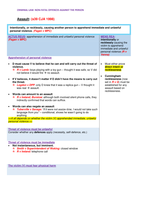
Assault: (s39 CJA 1998)
Intentionally, or recklessly, causing another person to apprehend immediate and unlawful
personal violence. (Fagan v MPC)
ACTUS REUS: apprehension of immediate and unlawful personal violence MENS REA:
(Fagan v MPC) intentionally or
recklessly causing the
victim to apprehend
immediate and unlawful
personal violence (R v
Venna)
Apprehension of personal violence
D must cause V to believe that he can and will carry out the threat of Must either prove
violence. direct intent or
R v Lamb: boys playing with a toy gun – thought it was safe, so V did recklessness
not believe it would fire no assault.
Cunningham
If V believes, it doesn’t matter if D didn’t have the means to carry out recklessness (now
the threat. set in R v G) must be
Logdon v DPP: only D knew that it was a replica gun – V thought it established for any
was real assault. assault based on
recklessness.
Words can amount to an assault
R v Ireland; Burstow: although both involved silent phone calls, they
indirectly confirmed that words can suffice.
Words can also negate an assault
Tuberville v Savage: “if it were not assize-time, I would not take such
language from you” – conditional, shows he wasn’t going to do
anything.
>>It all depends on whether the victim (V) apprehended immediate, unlawful
personal violence.<<
Threat of violence must be unlawful
Consider whether any defences apply (necessity, self-defence, etc.)
Threat of violence must be immediate
Not instantaneous, but imminent.
Smith v Superintendent of Woking: closed window
R v Ireland: telephone call
The victim (V) must fear physical harm
Assault: (s39 CJA 1998)
Intentionally, or recklessly, causing another person to apprehend immediate and unlawful
personal violence. (Fagan v MPC)
ACTUS REUS: apprehension of immediate and unlawful personal violence MENS REA:
(Fagan v MPC) intentionally or
recklessly causing the
victim to apprehend
immediate and unlawful
personal violence (R v
Venna)
Apprehension of personal violence
D must cause V to believe that he can and will carry out the threat of Must either prove
violence. direct intent or
R v Lamb: boys playing with a toy gun – thought it was safe, so V did recklessness
not believe it would fire no assault.
Cunningham
If V believes, it doesn’t matter if D didn’t have the means to carry out recklessness (now
the threat. set in R v G) must be
Logdon v DPP: only D knew that it was a replica gun – V thought it established for any
was real assault. assault based on
recklessness.
Words can amount to an assault
R v Ireland; Burstow: although both involved silent phone calls, they
indirectly confirmed that words can suffice.
Words can also negate an assault
Tuberville v Savage: “if it were not assize-time, I would not take such
language from you” – conditional, shows he wasn’t going to do
anything.
>>It all depends on whether the victim (V) apprehended immediate, unlawful
personal violence.<<
Threat of violence must be unlawful
Consider whether any defences apply (necessity, self-defence, etc.)
Threat of violence must be immediate
Not instantaneous, but imminent.
Smith v Superintendent of Woking: closed window
R v Ireland: telephone call
The victim (V) must fear physical harm