Book: When digital becomes human
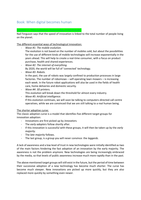
Chapter 1: ‘The customer relationship of the future’.
Nail Ferguson says that the speed of innovation is linked to the total number of people living
on the planet.
The different essential ways of technological innovation:
- Wave #1: The mobile evolution.
The evolution is not based on the number of mobiles sold, but about the possibilities
for the use of different kinds of mobile technologies will increase exponentially in the
years ahead. This will help to create a real-time consumer, with a focus on product
purchase, health and shared experiences.
- Wave #2: The internet of everything.
By 2020, the world will be full of ‘connected’ technology.
- Wave #3: Robots.
In the past, the use of robots was largely confined to production processes in large
factories. The number of robomows – self-operating lawn mowers – is increasing
each week. In the future robot applications will also be used in the fields of health
care, home deliveries and domestic security.
- Wave #4: 3D printers.
This evolution will break down the threshold for almost every industry.
- Wave #5: Artificial intelligence.
If this evolution continues, we will soon be talking to computers-directed call centre
operatives, while we are convinced that we are still talking to a real human being.
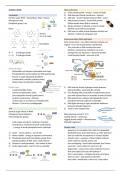
The shorter adoptive curve:
The classic adoption curve is a model that identifies five different target groups for
innovation adoption:
- Innovations are first picked up by innovators.
- The early adopters follow shortly after.
- If this innovation is successful with these groups, it will then be taken up by the early
majority.
- The late majority follows.
- The last group, is a group you will never convince: the laggards.
A lack of awareness and a low level of trust in new technologies were initially identified as two
of the main factors hindering the fast adoption of an innovation by the early majority. The
awareness is not the problem anymore. New technologies are being increasingly embraced
by the media, so that levels of public awareness increase much more rapidly than in the past.
The above mentioned target groups will still exist in the future, but the period of time between
their successive adoption of a new technology has become much shorter. The curve has
become much steeper. New innovations are picked up more quickly, but they are also
replaced more quickly by something even newer.
Chapter 1: ‘The customer relationship of the future’.
Nail Ferguson says that the speed of innovation is linked to the total number of people living
on the planet.
The different essential ways of technological innovation:
- Wave #1: The mobile evolution.
The evolution is not based on the number of mobiles sold, but about the possibilities
for the use of different kinds of mobile technologies will increase exponentially in the
years ahead. This will help to create a real-time consumer, with a focus on product
purchase, health and shared experiences.
- Wave #2: The internet of everything.
By 2020, the world will be full of ‘connected’ technology.
- Wave #3: Robots.
In the past, the use of robots was largely confined to production processes in large
factories. The number of robomows – self-operating lawn mowers – is increasing
each week. In the future robot applications will also be used in the fields of health
care, home deliveries and domestic security.
- Wave #4: 3D printers.
This evolution will break down the threshold for almost every industry.
- Wave #5: Artificial intelligence.
If this evolution continues, we will soon be talking to computers-directed call centre
operatives, while we are convinced that we are still talking to a real human being.
The shorter adoptive curve:
The classic adoption curve is a model that identifies five different target groups for
innovation adoption:
- Innovations are first picked up by innovators.
- The early adopters follow shortly after.
- If this innovation is successful with these groups, it will then be taken up by the early
majority.
- The late majority follows.
- The last group, is a group you will never convince: the laggards.
A lack of awareness and a low level of trust in new technologies were initially identified as two
of the main factors hindering the fast adoption of an innovation by the early majority. The
awareness is not the problem anymore. New technologies are being increasingly embraced
by the media, so that levels of public awareness increase much more rapidly than in the past.
The above mentioned target groups will still exist in the future, but the period of time between
their successive adoption of a new technology has become much shorter. The curve has
become much steeper. New innovations are picked up more quickly, but they are also
replaced more quickly by something even newer.