BIOS 242 WEEK 5 QUIZ
Question 1
pts
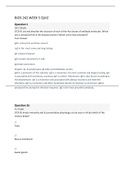
(TCO 9) List and describe the structure of each of the five classes of antibody molecules. Which
one is produced first in the disease process? Which is the most prevalent?
Your Answer:
IgM comes first and then convert
I gG is the most come and long lasting
IgE release histamen
IgD remains attached to b cells
IgA body secrections
Chapter 16, B Lymphocytes (B cells) and Antibodies section
IgM is a pentamer of five subunits. IgG is a monomer, the most common and longest lasting. IgA
is associated with secretions; secretory IgA is a dimer. Monomeric IgA is also found circulating in
the bloodstream. IgE is a monomer and associated with allergic reactions and helminth
infections. IgD is a monomer and often membrane bound. Its function is not known. IgM is
produced first during the infection response. IgG is the most prevalent antibody.
Question 1b
pts
(TCO 9) Innate immunity and its preventative physiology can be seen in all but which of the
choices below?
Tears
Mucus membrane
Sweat glands
, Correct!
Keratin of fingernails
Sebum
Question 2
pts
( TCO 9) The complement system is involved in all the following except _____
triggering of fever
chemotaxis
Correct!
production of antibodies
triggering of inflammatory reactions
opsonization
Question 3
pts
( TCO 9) A response to inflammatory mediators could be _____.
coughing
forcible expulsion
Question 1
pts
(TCO 9) List and describe the structure of each of the five classes of antibody molecules. Which
one is produced first in the disease process? Which is the most prevalent?
Your Answer:
IgM comes first and then convert
I gG is the most come and long lasting
IgE release histamen
IgD remains attached to b cells
IgA body secrections
Chapter 16, B Lymphocytes (B cells) and Antibodies section
IgM is a pentamer of five subunits. IgG is a monomer, the most common and longest lasting. IgA
is associated with secretions; secretory IgA is a dimer. Monomeric IgA is also found circulating in
the bloodstream. IgE is a monomer and associated with allergic reactions and helminth
infections. IgD is a monomer and often membrane bound. Its function is not known. IgM is
produced first during the infection response. IgG is the most prevalent antibody.
Question 1b
pts
(TCO 9) Innate immunity and its preventative physiology can be seen in all but which of the
choices below?
Tears
Mucus membrane
Sweat glands
, Correct!
Keratin of fingernails
Sebum
Question 2
pts
( TCO 9) The complement system is involved in all the following except _____
triggering of fever
chemotaxis
Correct!
production of antibodies
triggering of inflammatory reactions
opsonization
Question 3
pts
( TCO 9) A response to inflammatory mediators could be _____.
coughing
forcible expulsion