
Question A
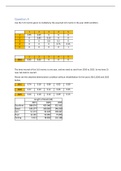
Use the 5 x5 metrics given to multiply by the assumed 1x5 matrix in the year 2020 condition.
1 2 3 4 5
1 0.95 0.05 0 0 0
2 0 0.85 0.15 0 0
3 0 0 0.8 0.2 0
4 0 0 0 0.75 0.25
5 0 0 0 0 1
1 2 3 4 5
2010 0.95 0.05 0 0 0
The time interval of the 1x5 matrics is one year, and we need to start from 2010 to 2025. So we have 15
new 1x6 matrics overall.
Please see the attached deterioration condition without rehabilitation for the years 2015,2020 and 2025
below.
2015 0.74 0.18 0.06 0.02 0.00
2020 0.57 0.20 0.12 0.06 0.05
2025 0.44 0.18 0.14 0.09 0.15
Length of Road (kM)
2015 2020 2025
Excellent 588.074 455.040 352.101
Good 143.177 160.583 146.350
Fair 51.173 95.428 109.467
Poor 14.165 50.092 75.893
Failing 3.413 38.858 116.188
, Question B
First, I collect the given rehabilitation strategy into a 3x3 matrix below.
Policy A B C
Fair 20% 10% 2%
Poor 5% 10% 5%
Failing 2% 10% 20%
Secondly, according to the lecture's example, I input each policy's percentage distribution of the fair to
falling condition to the original 5x5 matrix. Then I get a fundamental 5x5 matrix for the first-year
transition.
N=1
Policy A
1 2 3 4 5
1 0.950 0.050 0.000 0.000 0.000
2 0.000 0.850 0.150 0.000 0.000
3 0.200 0.000 0.640 0.160 0.000
4 0.050 0.000 0.000 0.713 0.238
5 0.020 0.000 0.000 0.000 0.980
Thirdly, I multiple the 5x5 matrix above itself four times, then I get the 5-year transition of the
probability matrices for policy A as shown below. The probability matrics represent the deterioration
transition in 2015 for policy A.
N=5
Policy A
1 2 3 4 5
1 0.785 0.165 0.041 0.007 0.001
2 0.172 0.454 0.241 0.096 0.036
3 0.473 0.057 0.117 0.169 0.183
4 0.157 0.017 0.002 0.184 0.640
5 0.087 0.008 0.001 0.000 0.904
Use the 5 x5 metrics given to multiply by the assumed 1x5 matrix in the year 2020 condition.
1 2 3 4 5
1 0.95 0.05 0 0 0
2 0 0.85 0.15 0 0
3 0 0 0.8 0.2 0
4 0 0 0 0.75 0.25
5 0 0 0 0 1
1 2 3 4 5
2010 0.95 0.05 0 0 0
The time interval of the 1x5 matrics is one year, and we need to start from 2010 to 2025. So we have 15
new 1x6 matrics overall.
Please see the attached deterioration condition without rehabilitation for the years 2015,2020 and 2025
below.
2015 0.74 0.18 0.06 0.02 0.00
2020 0.57 0.20 0.12 0.06 0.05
2025 0.44 0.18 0.14 0.09 0.15
Length of Road (kM)
2015 2020 2025
Excellent 588.074 455.040 352.101
Good 143.177 160.583 146.350
Fair 51.173 95.428 109.467
Poor 14.165 50.092 75.893
Failing 3.413 38.858 116.188
, Question B
First, I collect the given rehabilitation strategy into a 3x3 matrix below.
Policy A B C
Fair 20% 10% 2%
Poor 5% 10% 5%
Failing 2% 10% 20%
Secondly, according to the lecture's example, I input each policy's percentage distribution of the fair to
falling condition to the original 5x5 matrix. Then I get a fundamental 5x5 matrix for the first-year
transition.
N=1
Policy A
1 2 3 4 5
1 0.950 0.050 0.000 0.000 0.000
2 0.000 0.850 0.150 0.000 0.000
3 0.200 0.000 0.640 0.160 0.000
4 0.050 0.000 0.000 0.713 0.238
5 0.020 0.000 0.000 0.000 0.980
Thirdly, I multiple the 5x5 matrix above itself four times, then I get the 5-year transition of the
probability matrices for policy A as shown below. The probability matrics represent the deterioration
transition in 2015 for policy A.
N=5
Policy A
1 2 3 4 5
1 0.785 0.165 0.041 0.007 0.001
2 0.172 0.454 0.241 0.096 0.036
3 0.473 0.057 0.117 0.169 0.183
4 0.157 0.017 0.002 0.184 0.640
5 0.087 0.008 0.001 0.000 0.904


