Name: ________________________________________
CORNELL NOTES
Class: Public Law & Community
SHEET Date: 5/18/2016
Period ______
QUESTIONS NOTES
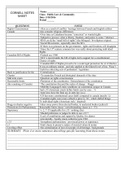
Rights Consciousness >Also as a result of conflict / heritage between French and English settlers
Canada Also consider religious differences
>Over time as Canadians became “conscious” or wanted rights
>Subjective process: what is liberty, freedom, and justice to some ? abstract.
>BNA act & the “small bill of rights” (the bilingual / bi-religious origins)
>Social Movements , especially since the 60’s
>If there is no pressure on the government , rights and freedoms will disappear
>Since the 13th century common law was really about protecting individual
Rights
Canadian Bill of Rights >Federal act, 1960.
>SCC’s record under the bill of rights led to support for a constitutional
Charter of rights
>Canadian Bill of Rights proved to be a weak legal protection for civil liberties
It was an ordinary statute , and only applied to the federal level of law. Wasn’t
Useful in criticizing acts of parliament / legislature
Back to justification for the >Centralization
Charter >To neutralize French and aboriginal demands of the time
Mid term exam >Question on rights consciousness
Reasonable limits >Patriation of the constitution / Entrenchment of the constitution
(the remaking of Canada) >The constitution (beyond the realm of change – Hogg)
>Mobility/Language/Limits conditions on constitution unique in Canada;
And s.33 (American courts define limits case by case…?)
>state laws have the final say in state law (u.s.)
>US has more constitutional cases (half) compared to canada (maybe ¼)
>Canadian rights were more collective prior to ’82 , which shifted things
To individual rights (American style / inspired)
Hogg on charter negative >takes away power from elected bodies, to unelected bodies (judicial)
Protections for Parliamentary Reasonable limits clause / notwithstanding clause (s.)
Supremacy >s. 2, 7-15 (applicable for s.33 / nothing else)
>Should politicians or judges be able to use s.33 ?
>Lack of contribution and support by Quebec for charter
>provincially / locally (more collective) pre 1982.
s.33 >strengthens parliamentary / provincial power or supremacy
s.1 >limit clause to preserve nature of societal values & norms
Leveling effect >the centralization of laws for people of all heritage / baclgrounds
SUMMARY: Write 4 or more sentences describing specific learning from these notes.
__________________________________________________________________________________________
__________________________________________________________________________________________
__________________________________________________________________________________________
__________________________________________________________________________________________
__________________________________________________________________________________________
CORNELL NOTES
Class: Public Law & Community
SHEET Date: 5/18/2016
Period ______
QUESTIONS NOTES
Rights Consciousness >Also as a result of conflict / heritage between French and English settlers
Canada Also consider religious differences
>Over time as Canadians became “conscious” or wanted rights
>Subjective process: what is liberty, freedom, and justice to some ? abstract.
>BNA act & the “small bill of rights” (the bilingual / bi-religious origins)
>Social Movements , especially since the 60’s
>If there is no pressure on the government , rights and freedoms will disappear
>Since the 13th century common law was really about protecting individual
Rights
Canadian Bill of Rights >Federal act, 1960.
>SCC’s record under the bill of rights led to support for a constitutional
Charter of rights
>Canadian Bill of Rights proved to be a weak legal protection for civil liberties
It was an ordinary statute , and only applied to the federal level of law. Wasn’t
Useful in criticizing acts of parliament / legislature
Back to justification for the >Centralization
Charter >To neutralize French and aboriginal demands of the time
Mid term exam >Question on rights consciousness
Reasonable limits >Patriation of the constitution / Entrenchment of the constitution
(the remaking of Canada) >The constitution (beyond the realm of change – Hogg)
>Mobility/Language/Limits conditions on constitution unique in Canada;
And s.33 (American courts define limits case by case…?)
>state laws have the final say in state law (u.s.)
>US has more constitutional cases (half) compared to canada (maybe ¼)
>Canadian rights were more collective prior to ’82 , which shifted things
To individual rights (American style / inspired)
Hogg on charter negative >takes away power from elected bodies, to unelected bodies (judicial)
Protections for Parliamentary Reasonable limits clause / notwithstanding clause (s.)
Supremacy >s. 2, 7-15 (applicable for s.33 / nothing else)
>Should politicians or judges be able to use s.33 ?
>Lack of contribution and support by Quebec for charter
>provincially / locally (more collective) pre 1982.
s.33 >strengthens parliamentary / provincial power or supremacy
s.1 >limit clause to preserve nature of societal values & norms
Leveling effect >the centralization of laws for people of all heritage / baclgrounds
SUMMARY: Write 4 or more sentences describing specific learning from these notes.
__________________________________________________________________________________________
__________________________________________________________________________________________
__________________________________________________________________________________________
__________________________________________________________________________________________
__________________________________________________________________________________________