

Question 1
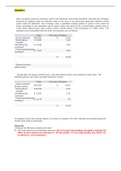
Helix Company produces costumes used in the television and movie industries. Recently the company
received an ongoing order for Samurai robes to be worn in an upcoming Japanese historical action
series made for television. The company uses a standard costing system to assist in the control of
costs. According to the standards set for these robes, the factory has a denominator activity level of
1,160 direct labour-hours each month, which should result in the production of 2,900 robes. The
standard costs associated with this level of production are as follows:
Total Per Unit of Product
Direct materials $49,300 $ 17.00
Direct labour $ 9,280 3.20
Variable
manufacturing $ 4,640 1.60
overhead*
Fixed manufacturing
$ 2,320 0.80
overhead*
$ 22.60
*Based on direct
labour-hours
During April, the factory worked only 1,140 direct labour-hours and produced 3,100 robes. The
following actual costs were recorded during the month:
Total Per Unit of Product
Direct materials
$52,080 $ 16.80
(6,600 metres)
Direct labour $10,540 3.40
Variable
manufacturing $ 9,920 3.20
overhead
Fixed manufacturing
$ 2,170 .70
overhead
$ 24.10
At standard, each robe should require 2.0 metres of material. All of the materials purchased during the
month were used in production.
Required:
Compute the following variances for April:
1. The materials price and quantity variances. (Do not round intermediate calculation. Indicate the
effect of each variance by selecting "F" for favourable, "U" for unfavourable, and "None" for
no effect (i.e., zero variance).)
,2. The labour rate and efficiency variances. (Do not round intermediate calculation. Indicate the
effect of each variance by selecting "F" for favourable, "U" for unfavourable, and "None" for
no effect (i.e., zero variance).)
3. The variable manufacturing overhead spending and efficiency variances. (Do not round
intermediate calculation. Indicate the effect of each variance by selecting "F" for favourable,
"U" for unfavourable, and "None" for no effect (i.e., zero variance).)
4. The fixed manufacturing overhead budget and volume variances. (Do not round intermediate
calculation. Indicate the effect of each variance by selecting "F" for favourable, "U" for
unfavourable, and "None" for no effect (i.e., zero variance).)
Explanation:
1.
Standard
Quantity
Actual Quantity of Actual Quantity of Allowed for
Inputs, at Inputs, at Output, at
Actual Price Standard Price Standard Price
(AQ × AP) (AQ × SP) (SQ × SP)
$52,080 6,600 metres × 6,200 metres** ×
$8.50 per metre* $8.50 per metre*
= $56,100 = $52,700
Price Variance, Quantity Variance,
-$4,020 F $3,400 U
Total Variance, -$620 F
*$17.00 ÷ 2.0 metres = $8.50 per metre.
**3,100 units × 2.0 metres per unit = 6,200 metres
, Alternative Solution:
Materials Price Variance = AQ (AP – SP)
6,600 metres ($7.89 per metre* – $8.50 per metre) = -$4,020 F
*$52,080 ÷ 6,600 metres = $7.89 per metre
Materials Quantity Variance = SP (AQ – SQ)
$8.50 per metre (6,600 metres – 6,200 metres) = $3,400 U
2.
Standard Hours
Allowed for
Actual Hours of Actual Hours of Output,
Input, at the Input, at the at the Standard
Actual Rate Standard Rate Rate
(AH × AR) (AH × SR) (SH × SR)
$10,540 1,140 hours × 1,240 hours** ×
$8 per hour* $8 per hour*
= $9,120 = $9,920
Rate Variance, Efficiency Variance,
$1,420 U -$800 F
Total Variance, $620 U
*1,160 standard hours ÷ 2,900 robes = 0.4 standard hour per robe. $3.20 standard cost per robe ÷ 0.4
standard hours = $8 standard rate per hour. Or alternatively $9,280 ÷ 1,160 hours = $8/hr.
**3,100 robes × 0.4 standard hour per robe = 1,240 standard hours.
Alternative Solution:
Labour Rate Variance = AH (AR – SR)
1,140 hours ($9.25 per hour* – $8 per hour) = $1,420 U
*$10,540 ÷ 1,140 hours = $9.25 per hour
Labour Efficiency Variance = SR (AH – SH)
$8 per hour (1,140 hours – 1,240 hours) = -$800 F
3.
Standard Hours
Actual Hours of Actual Hours of Allowed for
Input, Input, at the Output, at the
at the Actual Rate Standard Rate Standard Rate
(AH × AR) (AH × SR) (SH × SR)
$9,920 1,140 hours × 1,240 hours ×
$4 per hour* $4 per hour*
= $4,560 = $4,960
Spending Variance, Efficiency Variance,
$5,360 U -$400 F
Total Variance, $4,960 U
*$1.60 standard cost per robe ÷ 0.4 standard hours = $4 standard rate per hour.
Alternative Solution:
Variable Overhead Spending Variance = AH (AR – SR)
1,140 hours ($8.70 per hour* – $4 per hour) = $5,360 U
*$9,920 ÷ 1,140 hours = $8.70 per hour
Variable Overhead Efficiency Variance = SR (AH – SH)
$4 per hour (1,140 hours – 1,240 hours) = -$400 F
4. Fixed overhead variances:
Actual Fixed Budgeted Fixed Fixed Overhead
Overhead Cost Overhead Cost Cost Applied to
Helix Company produces costumes used in the television and movie industries. Recently the company
received an ongoing order for Samurai robes to be worn in an upcoming Japanese historical action
series made for television. The company uses a standard costing system to assist in the control of
costs. According to the standards set for these robes, the factory has a denominator activity level of
1,160 direct labour-hours each month, which should result in the production of 2,900 robes. The
standard costs associated with this level of production are as follows:
Total Per Unit of Product
Direct materials $49,300 $ 17.00
Direct labour $ 9,280 3.20
Variable
manufacturing $ 4,640 1.60
overhead*
Fixed manufacturing
$ 2,320 0.80
overhead*
$ 22.60
*Based on direct
labour-hours
During April, the factory worked only 1,140 direct labour-hours and produced 3,100 robes. The
following actual costs were recorded during the month:
Total Per Unit of Product
Direct materials
$52,080 $ 16.80
(6,600 metres)
Direct labour $10,540 3.40
Variable
manufacturing $ 9,920 3.20
overhead
Fixed manufacturing
$ 2,170 .70
overhead
$ 24.10
At standard, each robe should require 2.0 metres of material. All of the materials purchased during the
month were used in production.
Required:
Compute the following variances for April:
1. The materials price and quantity variances. (Do not round intermediate calculation. Indicate the
effect of each variance by selecting "F" for favourable, "U" for unfavourable, and "None" for
no effect (i.e., zero variance).)
,2. The labour rate and efficiency variances. (Do not round intermediate calculation. Indicate the
effect of each variance by selecting "F" for favourable, "U" for unfavourable, and "None" for
no effect (i.e., zero variance).)
3. The variable manufacturing overhead spending and efficiency variances. (Do not round
intermediate calculation. Indicate the effect of each variance by selecting "F" for favourable,
"U" for unfavourable, and "None" for no effect (i.e., zero variance).)
4. The fixed manufacturing overhead budget and volume variances. (Do not round intermediate
calculation. Indicate the effect of each variance by selecting "F" for favourable, "U" for
unfavourable, and "None" for no effect (i.e., zero variance).)
Explanation:
1.
Standard
Quantity
Actual Quantity of Actual Quantity of Allowed for
Inputs, at Inputs, at Output, at
Actual Price Standard Price Standard Price
(AQ × AP) (AQ × SP) (SQ × SP)
$52,080 6,600 metres × 6,200 metres** ×
$8.50 per metre* $8.50 per metre*
= $56,100 = $52,700
Price Variance, Quantity Variance,
-$4,020 F $3,400 U
Total Variance, -$620 F
*$17.00 ÷ 2.0 metres = $8.50 per metre.
**3,100 units × 2.0 metres per unit = 6,200 metres
, Alternative Solution:
Materials Price Variance = AQ (AP – SP)
6,600 metres ($7.89 per metre* – $8.50 per metre) = -$4,020 F
*$52,080 ÷ 6,600 metres = $7.89 per metre
Materials Quantity Variance = SP (AQ – SQ)
$8.50 per metre (6,600 metres – 6,200 metres) = $3,400 U
2.
Standard Hours
Allowed for
Actual Hours of Actual Hours of Output,
Input, at the Input, at the at the Standard
Actual Rate Standard Rate Rate
(AH × AR) (AH × SR) (SH × SR)
$10,540 1,140 hours × 1,240 hours** ×
$8 per hour* $8 per hour*
= $9,120 = $9,920
Rate Variance, Efficiency Variance,
$1,420 U -$800 F
Total Variance, $620 U
*1,160 standard hours ÷ 2,900 robes = 0.4 standard hour per robe. $3.20 standard cost per robe ÷ 0.4
standard hours = $8 standard rate per hour. Or alternatively $9,280 ÷ 1,160 hours = $8/hr.
**3,100 robes × 0.4 standard hour per robe = 1,240 standard hours.
Alternative Solution:
Labour Rate Variance = AH (AR – SR)
1,140 hours ($9.25 per hour* – $8 per hour) = $1,420 U
*$10,540 ÷ 1,140 hours = $9.25 per hour
Labour Efficiency Variance = SR (AH – SH)
$8 per hour (1,140 hours – 1,240 hours) = -$800 F
3.
Standard Hours
Actual Hours of Actual Hours of Allowed for
Input, Input, at the Output, at the
at the Actual Rate Standard Rate Standard Rate
(AH × AR) (AH × SR) (SH × SR)
$9,920 1,140 hours × 1,240 hours ×
$4 per hour* $4 per hour*
= $4,560 = $4,960
Spending Variance, Efficiency Variance,
$5,360 U -$400 F
Total Variance, $4,960 U
*$1.60 standard cost per robe ÷ 0.4 standard hours = $4 standard rate per hour.
Alternative Solution:
Variable Overhead Spending Variance = AH (AR – SR)
1,140 hours ($8.70 per hour* – $4 per hour) = $5,360 U
*$9,920 ÷ 1,140 hours = $8.70 per hour
Variable Overhead Efficiency Variance = SR (AH – SH)
$4 per hour (1,140 hours – 1,240 hours) = -$400 F
4. Fixed overhead variances:
Actual Fixed Budgeted Fixed Fixed Overhead
Overhead Cost Overhead Cost Cost Applied to


