Over
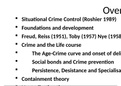
Situational Crime Control (Roshier 1989)
Foundations and development
Freud, Reiss (1951), Toby (1957) Nye (1958
Crime and the Life course
The Age-Crime curve and onset of deli
Social bonds and Crime prevention
Persistence, Desistance and Specialisati
Containment theory
, The beginnings Of Control theory
•Sigmund Freud (1856-1939) advanced a
psychoanalytical theory of personality in 1923.
He presents three concepts, the id (motivated
by pleasure, characterized by unbridled
desire), the ego (controlled, beholden to
reality), and the superego (the family’s dour
conscience)
•B. F. Skinner (1904-1990) proposed a theory of
learning involving what he described as 'the
operant conditioning process' and the notion
of schedules of reinforcement. Operant
,The beginnings Of Control theory
•Emile Durkheim (1858-1917) proposed rules of
sociological method in 1895 describes egotistic
Suicide ( detachment from social life and no control
over individual conduct due to disorganised
social groups) and anomic suicide ( weak
conformance and deviance as a result of weakened
self resolve,
‘neutralized’ internal and external controls )
•Albert Reiss (1870-1940) proposed the theory of
failure in 1951. He asserts that non-
,The beginnings Of Control theory
•Matza advanced ‘drift theory’ in 1964,
linking it with neutralisation theory.
Asserting that offenders drift because of
weakened controls i.e., moral bind of the
law is not enough to preserve conformity,
rather individuals have free will to choose
not to conform and engage in tactics
such as neutralization to justify their
drift.
•Travis Hirschi (1870-1940) proposed Social
, Crime and the Life-Cou
Key changes occur in individuals lives at certa
may help explain why some individuals turn
Risk factors:
focus on a range of factors that increase the p
Focus on between individual and within-indiv
Farrington 1973; Farrington 1986; Sampson &
Key terminologies
The Age-Crime curve
, Human Nature?
Hobbes: Man is inherently egotistical and con
all against all’.
Aristotle: in Politics spoke of the greatest c
not necessity.
Tacitus: All humans are greedy and selfish.
St Augustine: We are born pure but society co
Situational Crime Control (Roshier 1989)
Foundations and development
Freud, Reiss (1951), Toby (1957) Nye (1958
Crime and the Life course
The Age-Crime curve and onset of deli
Social bonds and Crime prevention
Persistence, Desistance and Specialisati
Containment theory
, The beginnings Of Control theory
•Sigmund Freud (1856-1939) advanced a
psychoanalytical theory of personality in 1923.
He presents three concepts, the id (motivated
by pleasure, characterized by unbridled
desire), the ego (controlled, beholden to
reality), and the superego (the family’s dour
conscience)
•B. F. Skinner (1904-1990) proposed a theory of
learning involving what he described as 'the
operant conditioning process' and the notion
of schedules of reinforcement. Operant
,The beginnings Of Control theory
•Emile Durkheim (1858-1917) proposed rules of
sociological method in 1895 describes egotistic
Suicide ( detachment from social life and no control
over individual conduct due to disorganised
social groups) and anomic suicide ( weak
conformance and deviance as a result of weakened
self resolve,
‘neutralized’ internal and external controls )
•Albert Reiss (1870-1940) proposed the theory of
failure in 1951. He asserts that non-
,The beginnings Of Control theory
•Matza advanced ‘drift theory’ in 1964,
linking it with neutralisation theory.
Asserting that offenders drift because of
weakened controls i.e., moral bind of the
law is not enough to preserve conformity,
rather individuals have free will to choose
not to conform and engage in tactics
such as neutralization to justify their
drift.
•Travis Hirschi (1870-1940) proposed Social
, Crime and the Life-Cou
Key changes occur in individuals lives at certa
may help explain why some individuals turn
Risk factors:
focus on a range of factors that increase the p
Focus on between individual and within-indiv
Farrington 1973; Farrington 1986; Sampson &
Key terminologies
The Age-Crime curve
, Human Nature?
Hobbes: Man is inherently egotistical and con
all against all’.
Aristotle: in Politics spoke of the greatest c
not necessity.
Tacitus: All humans are greedy and selfish.
St Augustine: We are born pure but society co