

Lymphatic system
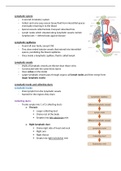
- A second circulatory system
- Collect and carry easy excess tissue fluid from interstitial spaces
eventually returning it to the blood
- Special vessels called lacteals transport absorbed fats
- Lymph nodes which situated along lymphatic vessels contain
lymphocytes -> defend body against disease
Lymphatic capillaries
- Found all over body, except CNS
- Tiny close ended tubular vessels that extend into interstitial
spaces, paralleling the blood capillaries
- Once inside a lymphatic capillary, fluid is called lymph
Lymphatic vessels
- Walls of lymphatic vessels are thinner than those veins
- Constructed with the same three layers
- Have valves on the inside
- Larger lymphatic vessels pass through organs call lymph nodes and then merge form
larger lymphatic trunks
Lymphatic trunks and collecting ducts
Lymphatic trunks:
- Drain lymph from the lymphatic vessels
- Named for the regions they drain
Collecting ducts:
- Trunks empty into 1 of 2 collecting ducts
o Thoracic
Larger collecting duct
Drains rest of the body
Empties into left subclavian vein
o Right lymphatic duct
Drains right side of head and neck
Right arm
Right thorax
Empty into right subclavian vein
, Tissue fluid and Lymph
Lymph
- Tissue fluid that has entered a lymphatic capillary
- Lymph formation depends on tissue fluid formation
Tissue fluid formation:
- Made up of water and dissolved substances that leave blood capillaries by filtration and
diffusion
- Does not contain large plasma protein
- plasma colloid osmotic pressure draws most of the fluid back into the capillaries
- Fluid that does not return to the capillaries becomes tissue fluid
Lymph formation and function
- Filtration from the plasma usually occurs to a greater extent than reabsorption -> tissue
fluid formation
- Osmotic pressure increase in tissues interferes with the return of fluids to the
bloodstream
- Fluid into lymphatic capillaries -> lymph
o Most substances including small proteins are returned to blood via the lymph
o Also transport foreign particles including bacteria and viruses to the lymph nodes
for recognition and destruction
Lymph movement
- Hydrostatic pressure of tissue fluid drives entry fluid into lymphatic capillaries, now
called lymph
- Muscular activity moves lymph through lymphatic vessels:
o Skeletal muscle contraction
o Breathing movement
o Valves prevent backflow
- Edema
o Accumulation of lymph in the interstitial spaces, due to interference with the
flow of lymph
Lymphatic tissues and organs
- Contain lymphocytes, macrophages and other cells
- Mucosa-associated lymphoid tissue (MALT)
o Digestive
o Respiratory
o Urinary
o Reproductive systems
- A second circulatory system
- Collect and carry easy excess tissue fluid from interstitial spaces
eventually returning it to the blood
- Special vessels called lacteals transport absorbed fats
- Lymph nodes which situated along lymphatic vessels contain
lymphocytes -> defend body against disease
Lymphatic capillaries
- Found all over body, except CNS
- Tiny close ended tubular vessels that extend into interstitial
spaces, paralleling the blood capillaries
- Once inside a lymphatic capillary, fluid is called lymph
Lymphatic vessels
- Walls of lymphatic vessels are thinner than those veins
- Constructed with the same three layers
- Have valves on the inside
- Larger lymphatic vessels pass through organs call lymph nodes and then merge form
larger lymphatic trunks
Lymphatic trunks and collecting ducts
Lymphatic trunks:
- Drain lymph from the lymphatic vessels
- Named for the regions they drain
Collecting ducts:
- Trunks empty into 1 of 2 collecting ducts
o Thoracic
Larger collecting duct
Drains rest of the body
Empties into left subclavian vein
o Right lymphatic duct
Drains right side of head and neck
Right arm
Right thorax
Empty into right subclavian vein
, Tissue fluid and Lymph
Lymph
- Tissue fluid that has entered a lymphatic capillary
- Lymph formation depends on tissue fluid formation
Tissue fluid formation:
- Made up of water and dissolved substances that leave blood capillaries by filtration and
diffusion
- Does not contain large plasma protein
- plasma colloid osmotic pressure draws most of the fluid back into the capillaries
- Fluid that does not return to the capillaries becomes tissue fluid
Lymph formation and function
- Filtration from the plasma usually occurs to a greater extent than reabsorption -> tissue
fluid formation
- Osmotic pressure increase in tissues interferes with the return of fluids to the
bloodstream
- Fluid into lymphatic capillaries -> lymph
o Most substances including small proteins are returned to blood via the lymph
o Also transport foreign particles including bacteria and viruses to the lymph nodes
for recognition and destruction
Lymph movement
- Hydrostatic pressure of tissue fluid drives entry fluid into lymphatic capillaries, now
called lymph
- Muscular activity moves lymph through lymphatic vessels:
o Skeletal muscle contraction
o Breathing movement
o Valves prevent backflow
- Edema
o Accumulation of lymph in the interstitial spaces, due to interference with the
flow of lymph
Lymphatic tissues and organs
- Contain lymphocytes, macrophages and other cells
- Mucosa-associated lymphoid tissue (MALT)
o Digestive
o Respiratory
o Urinary
o Reproductive systems


