

Lecture 3
Metabolic Reactions (Reversible)
**Anabolism + Catabolism = Metabolism**
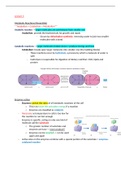
Anabolic reaction -> larger molecules are synthesized from smaller one
Anabolism: provide the biochemicals for growth and repair
- Occurs by dehydration synthesis: removing water to join two smaller
molecules with a bond
Catabolic reactions -> larger molecules broken down = produce energy and heat
Catabolism: breaks apar larger molecules into smaller one (the building blocks)
- These reactions occur by hydrolysis, a process by which a molecule of water is
split
- Hydrolysis is responsible for digestion of dietary nutrition: CHO, lipids and
protein
Enzymes action
- Enzymes control the rates of all metabolic reactions of the cell
o This is to lower the activation energy if a reaction
o Enzymes are classified as catalysts
- Necessary as temperature in cells is too low for
the reaction to run fact enough
- Enzymes is specific; acting on only one kind of
molecule call the substrate
o The greater number of substrate and
enzymes we have -> more product!!
o Enzymes can be recycled -> can be used
again and again
- Active sites on the enzymes combine with a special portion of the substrate = enzymes-
catalyzed reaction
Metabolic Reactions (Reversible)
**Anabolism + Catabolism = Metabolism**
Anabolic reaction -> larger molecules are synthesized from smaller one
Anabolism: provide the biochemicals for growth and repair
- Occurs by dehydration synthesis: removing water to join two smaller
molecules with a bond
Catabolic reactions -> larger molecules broken down = produce energy and heat
Catabolism: breaks apar larger molecules into smaller one (the building blocks)
- These reactions occur by hydrolysis, a process by which a molecule of water is
split
- Hydrolysis is responsible for digestion of dietary nutrition: CHO, lipids and
protein
Enzymes action
- Enzymes control the rates of all metabolic reactions of the cell
o This is to lower the activation energy if a reaction
o Enzymes are classified as catalysts
- Necessary as temperature in cells is too low for
the reaction to run fact enough
- Enzymes is specific; acting on only one kind of
molecule call the substrate
o The greater number of substrate and
enzymes we have -> more product!!
o Enzymes can be recycled -> can be used
again and again
- Active sites on the enzymes combine with a special portion of the substrate = enzymes-
catalyzed reaction


