

Lecture 10
Major aspects of Nervous system
- Sensory input
- Integration
- Processing
- Major output (response)
Main cell types in the NS
- Neurons – cells that communicate, via electrical impulses with other neurons or other
tissues
- Neuroglia – cells that support, nourish, protect and insulate neurons
- Neurotransmitters – chemical messengers in a synapse that convey an electrical
impulse from a neuron to another cell
Nervous system organization
- CNS
o Made up of the brain and spinal cord
o Responsible for integration of information and decision
making
- PNS
o Made up of cranial and spinal nerves that connect the
CNS to the rest of the body
o Contain sensory (afferent) and motor (efferent)
o Somatic NS – control voluntary skeletal
o Autonomic NS – controls involuntary effectors
Neurons
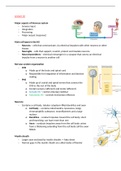
- Contains a cell body, tubular cytoplasm-filled dendrites and axon
o Cell body – contains mitochondria. lysosomes, Golgi,
chromatophilic substance, neurofilaments and a large
nucleus
o Dendrites – conduct impulses toward the cell body; short
and branching; can have more than one
o Axon – conducts impulses away from the cell body; arises
from a thickening extending from the cell body call the axon
hillock
Myelin sheath
- Larger axon enclosed by myelin sheaths -> fatty sheet
- Narrow gaps in the myelin sheath are called nodes of Ranvier
Major aspects of Nervous system
- Sensory input
- Integration
- Processing
- Major output (response)
Main cell types in the NS
- Neurons – cells that communicate, via electrical impulses with other neurons or other
tissues
- Neuroglia – cells that support, nourish, protect and insulate neurons
- Neurotransmitters – chemical messengers in a synapse that convey an electrical
impulse from a neuron to another cell
Nervous system organization
- CNS
o Made up of the brain and spinal cord
o Responsible for integration of information and decision
making
- PNS
o Made up of cranial and spinal nerves that connect the
CNS to the rest of the body
o Contain sensory (afferent) and motor (efferent)
o Somatic NS – control voluntary skeletal
o Autonomic NS – controls involuntary effectors
Neurons
- Contains a cell body, tubular cytoplasm-filled dendrites and axon
o Cell body – contains mitochondria. lysosomes, Golgi,
chromatophilic substance, neurofilaments and a large
nucleus
o Dendrites – conduct impulses toward the cell body; short
and branching; can have more than one
o Axon – conducts impulses away from the cell body; arises
from a thickening extending from the cell body call the axon
hillock
Myelin sheath
- Larger axon enclosed by myelin sheaths -> fatty sheet
- Narrow gaps in the myelin sheath are called nodes of Ranvier


