

Lecture 9
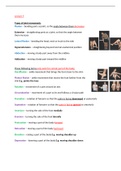
Types of joint movements
Flexion – bending parts as joint, so the angle between them decreases
Extension – straightening parts as a joint, so that the angle between
them increase
Lateral flexion – bending the head, neck or truck to the side
Hyperextension – straightening beyond normal anatomical position
Abduction – moving a body part away from the midline
Adduction – moving a body part toward the midline
These following terms only work for certain part of the body:
Dorsiflexion – ankle movement that brings the foot closer to the shin
Plantar flexion – ankle movement that moves the foot farther from the
shin E.g. points the toes
Rotation – movement of a part around an axis
Circumduction – movement of a part so its end follows a circular path
Pronation – rotation of forearm so that the palm is facing downward or posteriorly
Supination – rotation of forearm so that the palm is facing upward or anteriorly
Inversion – turning the sole of the foot medially
Eversion – turning the sole of the foot laterally
Protraction – moving a part of the body forward
Retraction – moving a part of the body backward
Elevation – raising a part of the body E.g. moving shoulder up
Depression – lowering a part of the body E.g. moving shoulder down
, Muscular system
- Muscles are organs that generate force to cause all types of movement
o E.g. walking, breathing, pumping blood and moving food in digestive tract
o Three type of muscle:
Skeletal
Smooth
Cardiac
Skeletal muscle
- 600 skeletal muscle
- Connective tissues covering over muscle
o layer dense connective tissues – Fascia
o extends beyond the ends of the muscle and gives rise to
tendon that are fused to the periosteum of bones
o Sometimes muscle is connected to each other by broad
sheets of connective tissue call aponeuroses
- Fascia blends with the epimysium, the layer of connective tissue
around each skeletal muscle
- The perimysium extends inward from the epimysium, its surround bundles of skeletal
muscle fibers call fascicles
- Each muscle cell (fiber) is covered by a connective tissue layer called endomysium
Skeletal muscle fibers
- Long and cylindrical
- Multi nuclei, control by the motor neuron -> Voluntary control
- Striations muscle -> b/c we have these strips seen under the microscope
- Cell membrane muscle fiber is the sarcolemma
- Cytoplasm of a muscle cell is the sarcoplasm -> contain mitochondria and nuclei
o Thick filament
consist of the protein Myosin
o Thin filament
Composed of the protein actin
Also contain troponin and tropomyosin
The sarcomeres of Myofibrils
- Extend from one Z-line to the next
- I band (light band) contain the Z line and made up of
actin filament
- A band (dark band) made up of overlapping thick and
thin filaments
Types of joint movements
Flexion – bending parts as joint, so the angle between them decreases
Extension – straightening parts as a joint, so that the angle between
them increase
Lateral flexion – bending the head, neck or truck to the side
Hyperextension – straightening beyond normal anatomical position
Abduction – moving a body part away from the midline
Adduction – moving a body part toward the midline
These following terms only work for certain part of the body:
Dorsiflexion – ankle movement that brings the foot closer to the shin
Plantar flexion – ankle movement that moves the foot farther from the
shin E.g. points the toes
Rotation – movement of a part around an axis
Circumduction – movement of a part so its end follows a circular path
Pronation – rotation of forearm so that the palm is facing downward or posteriorly
Supination – rotation of forearm so that the palm is facing upward or anteriorly
Inversion – turning the sole of the foot medially
Eversion – turning the sole of the foot laterally
Protraction – moving a part of the body forward
Retraction – moving a part of the body backward
Elevation – raising a part of the body E.g. moving shoulder up
Depression – lowering a part of the body E.g. moving shoulder down
, Muscular system
- Muscles are organs that generate force to cause all types of movement
o E.g. walking, breathing, pumping blood and moving food in digestive tract
o Three type of muscle:
Skeletal
Smooth
Cardiac
Skeletal muscle
- 600 skeletal muscle
- Connective tissues covering over muscle
o layer dense connective tissues – Fascia
o extends beyond the ends of the muscle and gives rise to
tendon that are fused to the periosteum of bones
o Sometimes muscle is connected to each other by broad
sheets of connective tissue call aponeuroses
- Fascia blends with the epimysium, the layer of connective tissue
around each skeletal muscle
- The perimysium extends inward from the epimysium, its surround bundles of skeletal
muscle fibers call fascicles
- Each muscle cell (fiber) is covered by a connective tissue layer called endomysium
Skeletal muscle fibers
- Long and cylindrical
- Multi nuclei, control by the motor neuron -> Voluntary control
- Striations muscle -> b/c we have these strips seen under the microscope
- Cell membrane muscle fiber is the sarcolemma
- Cytoplasm of a muscle cell is the sarcoplasm -> contain mitochondria and nuclei
o Thick filament
consist of the protein Myosin
o Thin filament
Composed of the protein actin
Also contain troponin and tropomyosin
The sarcomeres of Myofibrils
- Extend from one Z-line to the next
- I band (light band) contain the Z line and made up of
actin filament
- A band (dark band) made up of overlapping thick and
thin filaments


