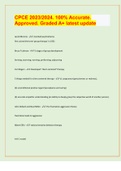
CPCE 2023/2024. 100% Accurate.
Approved. Graded A+ latest update
Jacob Moreno - ✔✔-invented psychodrama
first coined the term 'group therapy' in 1931
Bruce Tuckman - ✔✔-5 stages of group development
forming, storming, norming, performing, adjourning
Carl Rogers - ✔✔-Developed "client-centered" therapy
3 things needed for client centered therapy - ✔✔-1) congruence (genuineness or realness),
(2) unconditional positive regard (acceptance and caring)
(3) accurate empathic understanding (an ability to deeply grasp the subjective world of another person).
John Dollard and Neal Miller - ✔✔-The frustration-aggression theory
frustration leads to aggression
Albert Elllis - ✔✔-rational emotive behavior therapy
A-B-C model
,coun identifies irrational thoughts, helps client change them
Fritz Perls - ✔✔-Gastalt therapy; here-and-now; 5 layers of neurosis
Eric Bernes - ✔✔-Transactional analysis; child, adult, parent
Super's Life Span Theory - ✔✔-Growth (0-15): Focus on physical growth, forming the self-concept, and
exploring early interests and abilities.
• Exploration (15-25): Explore different areas of work, begin to focus on a specific career direction, get
specialized training, and begin engaging in work
• Establishment (25-45): Settling into a career field, making contributions to the field, and achieving
higher levels of responsibility
• Maintenance (45-65): Maintaining a job position, updaing skills as needed to stay competitive, and
planning for retirement
• Disengagement (65+): Gradually separating from work, engaging in other projects such as leisure, time
with family, and community activities
Trait and Factor Theory - ✔✔-focused on identifying the characteristics of the individual (i.e., traits) and
the environment or job requirements (i.e., factors)
job seekers can find a career that closely aligned with their personal characteristics
Myers-Briggs Type Theory - ✔✔-Not originally intended as a career development theory; it is considered
a personality theory derived from Jung.
, 4 dichotomous dimensions shape what individuals pay attention to in the world and how they make
decisions. Yields 16 different types.
Personality type can be matched with compatible occupation.
Vocational Choice Theory - ✔✔-John L. Holland
categorizing careers into six major types and examined the people who chose jobs within each category
• Realistic (R) - prefer concrete tasks such as physical or mechanical work including skilled trades and
engineering.
• Investigative (I) - favor independent and task-oriented work that may be more analytical, intellectual,
or abstract, such as science and computer programming careers
• Artistic (A) - desire self-expression and imaginative, creative, and introspective work as in a fine arts or
writing career
• Social (S) - an interest in people and community service, and possess good interpersonal skills like
teachers, nurses, and counselors
• Enterprising (E) - ambitious and persuasive and they often seek leadership and influential positions in
sales or management
• Conventional (C) - practical, conservative, and controlled; they like routine and structure such as
clerical and accounting work
John L. Holland - ✔✔-vocational choice theory
Approved. Graded A+ latest update
Jacob Moreno - ✔✔-invented psychodrama
first coined the term 'group therapy' in 1931
Bruce Tuckman - ✔✔-5 stages of group development
forming, storming, norming, performing, adjourning
Carl Rogers - ✔✔-Developed "client-centered" therapy
3 things needed for client centered therapy - ✔✔-1) congruence (genuineness or realness),
(2) unconditional positive regard (acceptance and caring)
(3) accurate empathic understanding (an ability to deeply grasp the subjective world of another person).
John Dollard and Neal Miller - ✔✔-The frustration-aggression theory
frustration leads to aggression
Albert Elllis - ✔✔-rational emotive behavior therapy
A-B-C model
,coun identifies irrational thoughts, helps client change them
Fritz Perls - ✔✔-Gastalt therapy; here-and-now; 5 layers of neurosis
Eric Bernes - ✔✔-Transactional analysis; child, adult, parent
Super's Life Span Theory - ✔✔-Growth (0-15): Focus on physical growth, forming the self-concept, and
exploring early interests and abilities.
• Exploration (15-25): Explore different areas of work, begin to focus on a specific career direction, get
specialized training, and begin engaging in work
• Establishment (25-45): Settling into a career field, making contributions to the field, and achieving
higher levels of responsibility
• Maintenance (45-65): Maintaining a job position, updaing skills as needed to stay competitive, and
planning for retirement
• Disengagement (65+): Gradually separating from work, engaging in other projects such as leisure, time
with family, and community activities
Trait and Factor Theory - ✔✔-focused on identifying the characteristics of the individual (i.e., traits) and
the environment or job requirements (i.e., factors)
job seekers can find a career that closely aligned with their personal characteristics
Myers-Briggs Type Theory - ✔✔-Not originally intended as a career development theory; it is considered
a personality theory derived from Jung.
, 4 dichotomous dimensions shape what individuals pay attention to in the world and how they make
decisions. Yields 16 different types.
Personality type can be matched with compatible occupation.
Vocational Choice Theory - ✔✔-John L. Holland
categorizing careers into six major types and examined the people who chose jobs within each category
• Realistic (R) - prefer concrete tasks such as physical or mechanical work including skilled trades and
engineering.
• Investigative (I) - favor independent and task-oriented work that may be more analytical, intellectual,
or abstract, such as science and computer programming careers
• Artistic (A) - desire self-expression and imaginative, creative, and introspective work as in a fine arts or
writing career
• Social (S) - an interest in people and community service, and possess good interpersonal skills like
teachers, nurses, and counselors
• Enterprising (E) - ambitious and persuasive and they often seek leadership and influential positions in
sales or management
• Conventional (C) - practical, conservative, and controlled; they like routine and structure such as
clerical and accounting work
John L. Holland - ✔✔-vocational choice theory