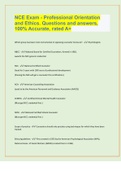
NCE Exam - Professional Orientation
and Ethics. Questions and answers,
100% Accurate, rated A+
Which group has been most instrumental in opposing counselor licensure? - ✔✔-Psychologists
NBCC - ✔✔-National Board for Certified Counselors, formed in 1982,
awards the NCC generic credential.
NCC - ✔✔-National Certified Counselor
Good for 5 years with 100 hours of professional development.
(Passing the NCE will get a counselor this certification.)
ACA - ✔✔-American Counseling Association
(used to be the American Personnel and Guidance Association [AACD])
CCMHA - ✔✔-Certified Clinical Mental Health Counselor
(Must get NCC credential first.)
NCSC - ✔✔-National Certified School Counselor
(Must get NCC credential first.)
Scope of practice - ✔✔-Counselors should only practice using techniques for which they have been
trained.
Ethical guidelines - ✔✔-First created in 1953 by the American Psychological Association (APA),
National Assoc. of Social Workers (NASW) created theirs in 1960,
, ACA created theirs in 1961.
Ethics always describe standards of conduct imposed by ____ and ______. - ✔✔-ACA and NBCC.
Ethics define standards of behavior set forth by organizations and certification bodies, they are not
usually - ✔✔-state or federally mandated laws.
Most ethical dilemmas are related to ______. - ✔✔-Confidentiality
Confidentiality - ✔✔-implies the counselor will not reveal anything about a client unless he is given
specific authorization to do so.
(Confidentiality is relative to the situation as far as counselors go [legally].)
Most ethical dilemmas are related to _________. - ✔✔-confidentiality
ACA indicates counselors have an obligation to protect the confidentiality of the deceased and this
should be stated clearly in your ______ ______ document given to the client at the beginning of
treatment. - ✔✔-informed consent
Should counselors attend a funeral of a client? - ✔✔-Ask self if whether beneficial (same as attending a
wedding), and if attending, document date, time, basis for decision.
Tarasoff v. Board of Regents of the Univ. of California - ✔✔-'Duty to Warn' someone in imminent
danger.
(Case where client threatened in session, later killed her - her family sued, state court denied [Tarasoff I]
but appealed and won in Supreme Court [Tarasoff II].)
Duty to warn - ✔✔-Counselors have a responsibility to warn those who appear in serious and
foreseeable harm due to statements made during a session.
Defamation - ✔✔-revealing information that is damaging to a client's reputation.
and Ethics. Questions and answers,
100% Accurate, rated A+
Which group has been most instrumental in opposing counselor licensure? - ✔✔-Psychologists
NBCC - ✔✔-National Board for Certified Counselors, formed in 1982,
awards the NCC generic credential.
NCC - ✔✔-National Certified Counselor
Good for 5 years with 100 hours of professional development.
(Passing the NCE will get a counselor this certification.)
ACA - ✔✔-American Counseling Association
(used to be the American Personnel and Guidance Association [AACD])
CCMHA - ✔✔-Certified Clinical Mental Health Counselor
(Must get NCC credential first.)
NCSC - ✔✔-National Certified School Counselor
(Must get NCC credential first.)
Scope of practice - ✔✔-Counselors should only practice using techniques for which they have been
trained.
Ethical guidelines - ✔✔-First created in 1953 by the American Psychological Association (APA),
National Assoc. of Social Workers (NASW) created theirs in 1960,
, ACA created theirs in 1961.
Ethics always describe standards of conduct imposed by ____ and ______. - ✔✔-ACA and NBCC.
Ethics define standards of behavior set forth by organizations and certification bodies, they are not
usually - ✔✔-state or federally mandated laws.
Most ethical dilemmas are related to ______. - ✔✔-Confidentiality
Confidentiality - ✔✔-implies the counselor will not reveal anything about a client unless he is given
specific authorization to do so.
(Confidentiality is relative to the situation as far as counselors go [legally].)
Most ethical dilemmas are related to _________. - ✔✔-confidentiality
ACA indicates counselors have an obligation to protect the confidentiality of the deceased and this
should be stated clearly in your ______ ______ document given to the client at the beginning of
treatment. - ✔✔-informed consent
Should counselors attend a funeral of a client? - ✔✔-Ask self if whether beneficial (same as attending a
wedding), and if attending, document date, time, basis for decision.
Tarasoff v. Board of Regents of the Univ. of California - ✔✔-'Duty to Warn' someone in imminent
danger.
(Case where client threatened in session, later killed her - her family sued, state court denied [Tarasoff I]
but appealed and won in Supreme Court [Tarasoff II].)
Duty to warn - ✔✔-Counselors have a responsibility to warn those who appear in serious and
foreseeable harm due to statements made during a session.
Defamation - ✔✔-revealing information that is damaging to a client's reputation.