100% satisfaction guarantee Immediately available after payment Both online and in PDF No strings attached 4.6 TrustPilot
logo-home
Exam (elaborations)

NCE / CPCE study sets Questions prepping. Rated A+. verified.

Rating
-
Sold
1
Pages
77
Grade
A+
Uploaded on
17-02-2023
Written in
2022/2023

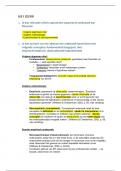
NCE / CPCE study sets Questions prepping. Rated A+. verified. continuous development - -view that development is a cumulative process: gradually improving on existing skills discontinuous development - -view that development takes place in unique stages, which happen at specific times or ages Nature vs. Nurture - -Do genes (nature) or environmental factors (nurture) contribute more to a person's being? prenatal - -conception to birth Infancy / Child - -Birth to 2 years- Changes in the brain and body, motor skills, perceptual, intellectual strengthens, 1st intimate ties to other people early childhood - -2-6 years, Play years, refined motor skills, thought and language expand quickly, sense or morality strengthens, build ties with other children. middle childhood - -6-11 years, improved athletic ability, more logical thought processes, mastery of basic literacy skills, advancing in self-understanding, morality, friendship, begin peer-group relationships. adolescence - -the transition period from childhood to adulthood, extending from puberty to independence from family, sexual maturity, abstract thinking, school achievement is important, defining personal values/goals. - Parietal lob develops around age 16 - Death rates by injury between ages 15-19 are six times higher than between ages of 10 -14 - The adolescent brain is about 80% developed early Adulthood - -18 - 40 years, leave home, complete education, full time work, concerns are developing around career, forming intimate partnership, marrying, and rearing children. middle adulthood - -40-65 years, height of careers, help children being independent lives, awareness of mortality arises. Late Adulthood - -65+, death looms, retirement, decrease in health Charles Darwin () - -1. British biologist who wrote "On the Origin of Species" 2. Challenged the idea of special creation by proposing a revolutionary theory of biological evolution 3. Concluded that every living plant and animal takes a part in a constant "struggle for existence" in which only the "fittest" survive 4. Argued that the fittest are determined by a process of natural selection G. Stanley Hall () - -Set up first psychological laboratory in North America; focused on development and education. Founded the American Journal of Psychology and pioneered the study of child development normative approach - -Launched by G. Stanley Hall and Arnold Greseli. Measures of behavior are taken on large numbers of individuals and age-related averages are computed to represent typical development. PROVIDES A TIMETABLE OF EXPECTED DEVELOPMENTAL EVENTS AT CERTAIN AGES. psychosexual stages of development (Freud) - -four distinct stages of the development of the self between birth and adulthood, according to Freud; personality quirks are a result of being fixated, or stuck, at any stage: Oral, Anal, Phallic, Latency, Genital. Sigmund Freud () - -founder of psychoanalysis, a controversial theory about the workings of the unconscious mind: Id, Ego, Superego Id (Pleasure-pain principle) - -a reservoir of unconscious psychic energy that, according to Freud, strives to satisfy basic sexual and aggressive drives. The id operates on the pleasure principle-pain, demanding immediate gratification. Ego (Reality principle) - -the largely conscious, "executive" part of personality that, according to Freud, mediates among the demands of the id, superego, and reality. The ego operates on the reality principle, satisfying the id's desires in ways that will realistically bring pleasure rather than pain. The fulcrum in the seesaw metaphor, balancing the id and the superego. Superego (Ego Ideal, Conscience) - -the part of personality that, according to Freud, represents internalized ideals and provides standards for judgment (the conscience) and for future aspirations Oral Stage (0-18 months) - -stage focuses on pleasure on the mouth- sucking, biting, chewing (attachment is a major factor) Anal Stage (18-36 months) - -pleasure focuses on bowel and bladder elimination; coping with demands for control Phallic Stage (3-6 years) - -stage focuses on pleasure zone in the genitals, coping with incestuous sexual feelings (Oedipus Complex) identification - -the process by which, according to Freud, children incorporate their parents' values into their developing superegos Latency Stage (6-puberty) - -A phase of dormant sexual feelings, superego strengthens as the child acquires new social values from adults and same-sex partners. Genital Stage (puberty on) - -sexual feelings re-emerge and are oriented toward others Erik Erikson () - -Erikson is an Ego Psychologist (Believes that man 's powers of reasoning can control behavior) and is the only psychoanalyst whose developmental theory encompasses that WHOLE LIFE SPAN. Described eight developmental stages, each characterized by a challenging developmental crisis Proposed five psychosocial stages build on Freud's theory, but added three adult stages Frued's Psychodynamic Theory - -Focus on the unconscious process of the id, ego, and superego. ego defense mechanisms - -largely unconscious distortions of thoughts or perceptions that act to reduce anxiety Psychosocial Theory (Erikson) - -emphasized that in addition to mediating between id impulses and superego demands, the ego makes a positive contribution to development, acquiring attitudes and skills that make the individual an active, contributing member of society Erik son's Psychosocial Theory believes that ... - -the stages are universal and occurring similarly regardless of culture, these stages built upon one another and no stages can be missed, and some stages may never be reached. Erikson's Psychosocial Stages - -1. Trust vs. Mistrust (birth-1 year) 2. Autonomy vs. Shame and Doubt (2-3 years) 3. Initiative vs. Guilt (3-6 years) 4. Industry vs. Inferiority (6-11 years) 5. Identity vs. Identity Diffusion (12-18 years) 6. Intimacy vs. Isolation (early adulthood: 19-mid 20s) 7. Generativity vs. Stagnation/Self-Absorbtion (middle age: late 20s-50s) 8. Integrity vs. Dispair (old age: 60s and beyond) Generativity Types - - Trust vs. Mistrust (Erikson) - -0-1 years. Erikson's first stage during the first year of life, infants learn to trust when they are cared for in a consistent warm manner Autonomy vs. Shame and Doubt (Erikson) - -1-3 years: Children become self-sufficient in activities (toilieting, feeding, walking, talking) or doubt themselves. Parents should allow safe free choice and restrain from shaming. Initiative vs. Guilt (Erikson) - -3-6 Years: Children want to undertake adult like activities through make believe play or internalize limits set by parents (demand too much self- control). They feel adventurous or guilty. Beginning to develop SELF-CONCEPT Industry vs. Inferiority (Erikson) - -6-11 years - Children busily learn to be competent and productive or feel inferior and unable to do anything well. identity vs. role confusion (Erikson) - -Adolescence - Erikson's stage during which teenagers and young adults search for and become their true selves Intimacy vs. Isolation (Erikson) - -20-40 yrs, good: love, intimate relationships, commitment. bad: avoidance of commitment, alienation, distancing oneself Gernerativity vs. Stagnation (Erikson) - -Generativity means giving to the next generation through child rearing, caring for others, or productive work. Failure in this stage results in an absence of meaningful accomplishment. integrity vs despair (Erikson) - -Resolved in mature adulthood, determining how well one has lived Jean Piaget () - -Pioneer in the study of developmental psychology who introduced a stage theory of cognitive development that led to a better understanding of children's thought processes. Critics of Jean Piaget - -His findings were based on research performed on his own children. cognitive development theory - -children actively construct knowledge as they manipulate and explore their world: Piaget's stages of cognitive development - -1. sensorimotor- Birth to 2 years 2. pre-operational- 2 to 7 years 3. concrete operational - 7 - 11 years 4. formal operational - 11 years + sensorimotor stage (Piaget) - -in Piaget's theory, the stage (from birth to about 2 years of age) during which infants know the world mostly in terms of their sensory impressions and motor activities preoperational stage (Piaget) - -in Piaget's theory, the stage (from about 2 to 6 or 7 years of age) during which a child learns to use language but does NOT yet comprehend the mental operations of concrete logic, make believe play, play is less self-centered, SOCIODRAMATIC PLAY (make believe play with others is representational; "You pretend to be an astronaut") concrete operational stage (Piaget) - -in Piaget's theory, the stage of cognitive development (from about 6 or 7 to 11 years of age) during which children gain the mental operations that enable them to think logically about concrete events, organize objects into categories, and master the concept of CONSERVATION (they understand lemonade stays the same even if the glass is only half full). formal operational stage (Piaget) - -in Piaget's theory, the stage of cognitive development (normally beginning about age 12) during which people begin to think logically about abstract concepts (time, distance) hypothetico-deductive thinking - -A form of formal logic achieved during the formal operational stage Piaget identified as the ability to generate and test hypotheses in a logical and systematic matter and follow it with deductive reasoning. schemes (sensorimotor stage) - -Piaget - specific psychological structures-organized ways of making sense of experience. Schemes change with age organization of schemes (sensorimotor stage) - -once children form new schemes they rearrange them, linking them with other schemes to create a strongly interconnected cognitive system. adaptation (sensorimotor stage) - -involves building schemes through direct interaction with the environment; consists of two complimentary activities, assimilation and accommodation. assimilation (sensorimotor stage) - -we use our current schemes to interpret the external world; if Timmy drops an object he was assimilating it into his "dropping scheme". or when a child sees only similarities between objects but can't discern their differences accommodation (sensorimotor stage ) - -we create new schemes or adjust old ones after noticing that our current ways of thinking do not capture the environment completely; when Timmy drops objects in different ways, he modifies his dropping scheme to take account of the varied properties of objects object permanence (sensorimotor stage) - -the awareness that things continue to exist even when not perceived Egocentrism ( Piaget Pre operational Stage) - -failure to distinguish other's symbolic viewpoints as different from one's own. Three Mountains Experiment. Conservation ( Piaget Pre Operational Stage) - -that certain physical characteristics of objects remain the same, even when their outward appearance changes. (Kids do not understand this concept until Concrete Operational Stage) Piaget and Moral Development - -theorized how thinking about moral issues was stimulated. Children go through 2 distinct stages of how they think about morality. Heteronomous - morality occurs between ages 4 and 7, when the child views rules as absolutes that result in punishment. Autonomous - morality is characterized by the child's perception that rules are relative and can be altered or changed. sociocultural theory (Vygotsky) - -Vygotsky's theory that children's cognitive growth depends on their interactions with adults and more knowledgeable peers, which in turn are based on broad cultural values. Zone of Proximal Development (Vygotsky) - -In Vygotsky's theory, the range between children's present level of knowledge and their potential knowledge state if they recieve proper guidance and instruction Ecological Systems Theory (Bronfenbrenner) - -views the person as developing within a complex system of relationships affected by multiple levels of the surrounding environment Urie Bronfenbrenner () - -Outlined layers of environment that affect a child's development, such as the child's own biology, family/community environment, and society. Microsystems (Bronfenbrenner) - -development happens within elements of the person's immediate surroundings, such as family and peer group Mesosystem (Bronfenbrenner) - -in the bioecological model, the interconnections among immediate, or microsystem, settings ( ex: a child's academic progress depends not just on activities that take place in classrooms but also on parent involvement in school life...) Exosystem (Bronfenbrenner) - -The concept of social settings that do not contain the developing person but nevertheless affect experiences in immediate settings that indirectly influence the child. Ex: Extended family macrosystems (Bronfenbrenner) - -Consists of cultural values, laws, customs, and resources individualistic culture - -A culture in which people believe that their primary responsibility is to themselves. collectivist cultures - -cultures in which the self is regarded as embedded in relationships, and harmony with one's group is prized above individual goals and wishes. Classical Conditioning (Pavlov) - -a type of learning in which one learns to link two or more stimuli and anticipate events. The dog learns that food will come when the bell is rang and starts salivating. So despite the presence of food, when the bell is rung, the dog will start drooling Operant Conditioning (Pavlov) - -the subject will operate on the environment, and stimuli that follow their behavior change the probability that the behavior will occur again. reinforcer (operant conditioning) - -In operant conditioning the reinforcer is a stimulus that increases the occurrence of a response. Punishment (operant conditioning) - -in operant conditioning the punishment occurs when removing a desirable stimulus or presenting an unpleasant one to decrease the occurrence of a response. Habituation (Operant Conditioning) - -refers to a gradual reduction in the strength of a response due to repetitive stimulation. Adding a new stimulus- a change in the environment- causes responsiveness to return to a high level. This is called recovery. John Bowlby's Ethological Theory of Attachment (1969) - -recognizes the infant's emotional tie to the caregiver as an evolved response that promotes survival (the infant has innate signals that have evolved over time to keep the parent figure attached emotionally). Bowlby's 4 phases of attachment development - -1. Attachment Phase (birth to 6 weeks) 2. "Attachment in the making" Phase (6 weeks to 8 months) 3. "Clear-Cut" Attachment Phase (6-8 months to 18 months) 4. Formation of a reciprocal relationship (18 months to 2 years) Bowlby's Preattachment phase - -Built in signals, grasping, smiling, gazing, crying. Babies recognize mother but have not attached yet. Bowlby's "Attachment-in-the-making" phase - -infants repsond differently to familiar caregiver than to a stranger, develop a sense of trust but do not have an issue when passed to the stranger In Bowlby's "clear-cut" attachment phase - -babies display separation anxiety Bowlby's formation of a reciprocal relationship - -language development promotes understanding, separation protests decrease, negotiation begins Bowlby's internal working model has been described as, " a cognitive framework comprising mental representations for understanding the world, self and others." Which of the following is NOT one of the three ain features of the internal working model? -a model of others being trustworthy - a model of the family being a safe place - a model of the self as valuable - a model of the self as effective when interacting with others. - -A model of the family being a safe place is not apart of the INTERNAL working model. Bowl by stated that the term ____________________ is "the attachment conceptualized as being a vital and close bond with just one attachment figure." - -Monotropy gender schema theory - -The theory that gender-role development is influenced by the formation of schemas, or mental representations, of masculinity and femininity. Explains how the environmental pressures and the child's cognition work together to shape gender role development. Sternberg's Triarchic Theory - -Robert Sternberg - our intelligence is best classified into three areas that predict real-world success: analytical, creative, and practical Gardner's Theory of Multiple Intelligences - -Howard Gardner ()- Theory defines intelligence in terms of distinct sets of processing operations that merit individuals to engage in a wide range of culturally valued activities. 1. Linguistic 2. Logico-mathamatical 3. Musical 4. Spatial 5. Bodily-Kinesthetic 6. Naturalist 7. Interpersonal 8. Intrapersonal identity development principle - -People seek to develop a stable sense of whom they are and then strive to act consistently with this self-view. Identity Achievement (Marcia - 1980) - -commitment to values, beliefs, and goals following a period of exploration Identity Moratorium (Marcia - 1980) - -exploration without having reached commitment Identity Foreclosure (Marcia - 1980) - -commitment in the absence of exploration Identity Diffusion (Marcia - 1980) - -an apathetic state characterized by lack of both exploration and commitment Kohlber's theory of moral development - -Kohlberg expands on Piaget's conceptualization of moral development; used a clinical interviewing procedure in which he presented a sample of 10- to 16-year old BOYS with hypothetical moral dilemmas. They were re-interviewed at 3- to 4- year intervals over the next 20 years. The best know dilemma is the "Heinz dilemma" (pits the value of obeying the law (not stealing the drugs) against the value of human life (saving his dying wife). Kohlberg emphasized that moral maturity is determined by the way we reason about the dilemma not the content of the response. Kohlberg's stages of moral development - -pre conventional, conventional, post conventional ( it is believed that most people never reach this level) epigenetic principle - -Erikson, Kohlberg, and Maslow's theories are epigenetic, which means that each stage emerges from the one before it. The process follows a given order and is systematic. Labouvie-Vief's Theory - --In early adulthood, individuals move from hypothetical to pragmatic thought--an advance in which logic is a tool for solving real-world problems -From adolescence to middle adulthood, people gain in cognitive-affective complexity--the ability to integrate objective thoughts and subjective feelings into an organized structure Levison's Seasons of Life - -Levison () depicted adult development as a sequence of qualitatively distinct eras ( or "seasons") coinciding with Erikson's stages and separated by transitions. Yale research by Daniel Levinson - -Found that 80% of men experienced moderate "midlife crises", and an "age 30 crisis" occurred in men if they felt it would soon be too late to make changes in their lives Vaillant's Adaptation to Life - -20s - intimacy concerns 30s - career consolidation 40s - generative 50s-60s - "keepers of meaning" 70s - spiritual and reflective Follows Erikson's stages but fills in the gaps (Vaillant focused on only men during this study) Robert Sternberg's Triangular Theory of Love () - -The 3 components of love are passion, commitment, and intimacy Kubler-Ross stages of dying - -denial and isolation, anger, bargaining, depression, acceptance Harry Stack Sullivan's Interpersonal Theory - -The purpose of all behavior is to get needs met through interpersonal interactions and to decrease or avoid anxiety. (Stages from infancy to later adulthood) Maturation Theory - -Frued and Erikson are consider to be maturationists: Behavior is guided exclusively via heredity factors until the necessary stimuli are present in the environment. An individual's neural development must be at a certain level of maturity for the behavior to unfold. Margaret Mahler - -A psychologist who described early development as a sequential process of separation of the child from the mother or primary caregiver Separation-Individual Theory of child development - -child's absolute dependence on the female caretaker is called "symbiosis". Difficulties in the symbiotic relationship can result in adult psychosis. Harry Harlow's attachment research - -studied infant attachment using rhesus monkey's Sentence: In the 1950s, researcher Harry Harlow raised baby monkeys with two artificial wire frame figures made to resemble mother monkeys. Elenor Maccoby and Carol Jacklin - -reviewed literature and found that males only outperformed females in mathematics around high school and college age. This may come from child-rearing patterns rather than bodily chemistry. Eleanor Gibson - -The "visual cliff" experiment. Showed that depth perception cues are innate. Empiricists - -philosophical belief that knowledge is gained from experience of senses ( evidence can be measured) A mother hides a toy behind her back and a young child does not believe the toy exists anymore. The child has not mastered... - -Object permanence (object constancy) or representational thought The schema (i.e. mental representation of the real world) of permanency and constancy of objects occurs in the... - -sensorimotor stage - birth to 2 years Ethology (Konrad Lorenz / geese and imprinting/natural aggression) - -the study of animals in their natural environment Critical Periods (Lorenz) - -certain behaviors must be learned at an early time in development or they will never be learned The sequence of object loss, which goes from protest to despair to detachment, best describes the work of - -Bowlby (Babies and Bonding) Primal Scene - -the infant's or the child's witnessing of parental sex sibling rivalry - -the competition between brothers or sisters for parents' affection and attention BASIC ID (holistic approach) - -Idea from Lazarus, who feels that counseling is multimodal (using a variety of techniques) an acronym meaning B= behaviors A= affective S= sensations I= images C=cognitions I=interpersonal D= drugs A preschool child's concept of causality is said to be animistic. This means the child attributes human characteristics to inanimate objects. This concept is best related to... - -Piaget's pre operational period, 2 - 7 years Freud's wish-fulfillment theory - -slips of the tongue or dreams preserve sleep and provide a "psychic safety valve"—expressing otherwise unacceptable feelings; contain manifest (remembered) content and a deeper layer of latent content (a hidden meaning). Which theorist was most concerned with maternal deprivation? - -H. Harlow - rhesus monkey experiment with surrogate wire monkeys./ Konrad Lorenz () - -ethology (animal behavior); studied imprinting and critical periods in geese, and natural aggression Martin E. P. Seligman - -experimented with learned helplessness on dogs by giving them electric shocks while in a harness until they stopped trying to escape. (memory: 'Selig' sounds like 'sick' like the dogs must've been) The statement, "bad behavior is punished, good behavior is not" is most closely associated with... - -Kohlberg's premolar stage at the pre conventional level. Imprinting - rapid learning during a critical period of development, is an instinct in which a newborn will follow a moving object. The primary work in this area was done by... - -Konrad Lorenz ( baby goslings, imprinting, natural aggression, species specific behavior) Maslow's Hierarchy of Needs - -(level 1) Physiological Needs, (level 2) Safety and Security, (level 3) Relationships, Love and Affection, (level 4) Self Esteem, (level 5) Self Actualization To research the dilemma of self-actualization, Maslow... - -interviewed the best people he could find who escaped the "psychology of the average" Piaget is... - -a structuralist who believes stage changes are qualitative. Piaget referred to the balance between assimilation and accommodation as... - -equilibration FAP - -fixed action patterns by sign stimuli - ritualistic behaviors which are common to all members of a species. Robert Kegan speaks of a "holding environment" in counseling in which - -the client can make meaning in the face of a crisis and can find new direction. Alfred Adler () - -Worked with Freud, FATHER OF INDIVIDUAL PSYCHOLOGY. Inferiority Complex: fixation on feelings of personal inferiority that can lead to emotional and social paralysis. Compensation: our efforts to overcome real or perceived weaknesses. BIRTH ORDER DETERMINES PARTS OF OUR PERSONALITY. Carl Gustav Jung () - -FOUNDER OF ANALYTIC PSYCHOLOGY Eric Berne - -Father of Transactional Analysis (TA), suggested the group is held together by a bond between the leader and the group members. Eric Berne's transactional analysis (TA) posits three ego states: the Child, the Adult, and the Parent. These roughly correspond to Freud's structural theory that includes - -id, ego, superego. Note: Berne's Child, Adult, Parent are hypothetical constructs used to explain the function of the personality. Freud felt that successful resolution of the Oedipus complex led to the development of the superego. This is accomplished by... - -identification with the aggressor, the parent of the SAME SEX. Transference - -(psychoanalysis) the process whereby emotions are passed on or displaced from one person to another Freudians refer to the ego as - -the executive administrator of the personality and the reality principle. The ego is the police officer controlling the impulses of the id (instincts) and the superego (the conscience) Eros (Freudian concept): - -the instinct toward life Thanatos (Freudian concept): - -an instinctual drive toward death, leading to aggressive action. Freud stated, "It is at work in every living being and is striving to bring it to ruin..." Joseph Wolpe () - -Systematic Desensitization: individuals gradually exposed to fears (usually through imagination) while practicing relaxation exercises Most scholars would assert that Freud's 1900 work entitled The Interpretation of Dreams was his most influential work. Dreams have... - -manifest content (surface meaning), and latent content (hidden meaning) Little Hans - -Cites PSYCHOANALYTIC theory; Hans was a small child who had difficulty going into streets and was afraid of horses biting him. Freud used psychoanalytic constructs such as the Oedipus complex and castration to anxiety to explain it. Little Albert ( Study by John Broadus Watson) - -BEHAVIOR CONDITIONING-Little Albert learns to make associations between stimuli in the environment and reflexes; Albert shows little fear with dog, monkey, or burning newspaper, neutral stimuli since he hasn't learned to fear anything; Shows Albert a white rat while making loud clanging noise, which upsets Albert, who eventually associates white rat with being upset; Proves fear is learned. Anna O. Case - -First PSYCHOANALYTIC patient. Famous case of hysteria treated by Breuer and reported by Breuer and Freud in Studies on Hysteria; gave Freud the insight that hysterics suffer from their memories of traumatic events; details distorted over the years. Daniel Paul Schreber Case - -PSYCHOANALYTIC-Wrote an autobiography of personal dealings with paranoia. Freud wrote about Schreber's unconscious issues of homosexuality. (Wanted to breed with God as a woman and create a new race) Catharsis - -the process of releasing, and thereby providing relief from, strong or repressed emotions. Topographical theory of the mind (Freud) - -ICEBERG metaphor. Conscious, preconscious, unconscious Structural Theory of the personality - -id, ego, superego precocious mind (Freud) - -thoughts and feelings that individuals are unaware of, and can easily be accessed Conscious Mind (Freud) - -Aware of the immediate environment Unconscious mind (Freud) - -level of the mind in which thoughts, feelings, memories, and other information are kept that are not easily or voluntarily brought into consciousness Subconciousness - -is a store of information that was registered in memory without being consciously attended. ego ideal (superego) - -part of the superego that contains the standards for moral behavior ( we judge ourselves against this ideal) Repression (defense mechanism) - -- Involuntary blocking of unpleasant feelings and experiences from ones awareness. EX: An accident victim can remember nothing about the accident reaction formation (defense mechanism) - -switching unacceptable impulses into their opposites EX: Spending all of your time caring for an elderly parent when you unconsciously would like to see them die. Denial (defense mechanism) - -refusing to believe or even perceive painful realities sublimation (defense mechanism) - -- Rechanneling of drives or impulses that are personally or socially unacceptable into activities that are constructive. EX: Mom of son killed by drunk driver, becomes president of MADD. EX: aggressive person becomes a professional boxer Introjection: Defense Mechanism - -- Integrating the beliefs and values of another individual into ones own ego structure. EX: Children integrate their parents value system into the process of conscience formation. displacement (defense mechanism) - -discharging impulses from a threatening object to a safer object EX: The man who is mad at his boss but is afraid to show it so he comes home and kicks the family dog. Rationalization (defense mechanism) - -- Attempting to make excuses or formulate logical reasons to justifying unacceptable feelings or behaviors. EX: John tells the rehab nurse, "I drink because its the only way I can deal with my bad marriage and awful job." EX: I'm glad that I didn't get good grades, only nerds get good grades (*SOUR GRAPES RATIONALIZATION*) EX: I'm really glad that my brother died, now I can have his room (*SWEET LEMONS RATIONALIZATION*) Identification (defense mechanism) - -imitating central figure in one's life (act like boss, dress like parents, etc.) (identify as someone better to be better) EX: Jane is the president of the board at a homeless shelter. When she is asked to introduce herself in any situation, she responds with "I'm the president of the board..." projection (defense mechanism) - -- Attributing feelings or impulses unacceptable to ones self to another person. EX: Sue feels a strong sexual attraction to her track coach and tells her friend, "Hes coming on to me!" Compensation : Defense Mechanism - -- Covering up a real or perceived weakness by emphasizing a trait one considers more desirable. EX: A handicapped boy is unable to participate in football, so he compensates by becoming a great scholar. EX: A man feels intellectually inferior so he becomes a body builder Rationalization, compensation, repression, projection, reaction formation, identification, introjection, denial, and displacement are ego defense mechanisms. According to Freudians, the most important defense mechanism is.... - -Repression Suppression differs from repression in that a) suppression is stronger b) repression only occurs in children c) repression is automatic or involuntary d) all of the above - -repression is automatic or involuntary ___________________ is like looking in the mirror but THINKING that you are looking out the window. - -Projection A client who has incorporated his father's values into his thought patterns is a product of... - -Introjection (Think "injection" like a needles injects a substance) Organ Inferiority (Alfred Adler individual psychology) - -everyone is born with some physical weakness or unique quality C.G. Jung the founder of analytic psychology, said men operate on logic or the ______ principle, while women are intuitive operating on the ______ principle - -Logos (appeal to the logic); Eros (intuitive, will to live) Jung used drawings balanced around a center point to analyze himself, his clients, and dreams. What are these called? - -mandalas Mandalas - -geometric designs that are symbols of the universe and aid in meditation projective drawing - -memory or vision we imagine, exists only in our minds. eidetic imagery (photographic memory) - -the ability to remember the most minute details of a scene or a picture for an extended period of time "eidetikers" Constructivist Therapists - -stress that it is imperative that we as helpers understand the client's view (also known as constructs) to explain his/her problems. Two popular classes of constructivist therapy, include brief therapy, which examines what worked for a client in the past, and narrative therapy, which looks at the stories in the client's life and attempts to rewrite or reconstruct the stories when necessary. _________________ emphasized the drive for superiority. - -Alfred Adler The statement "Sibling interaction may have more impact than parent-child interaction" describes... - -Alfred Adler's theory Constructivist Theory (Piaget) - -Piaget's theory, in which cognitive development results from children's active construction of reality, based on their experiences with the world In contrast with Freud, the neo-Freudians emphasized - -social factors Neo-Freudians, Alfred Adler, Karen Horney, Erik Erikson, Harry Stack Sullivan, and Erich Fromm stressed the importance of cultural (social) issues, and interpersonal (social) relations. Baseline Measures - -Behaviorist term that indicates the frequency that a behavior is manifested prior to, or in the absence of, treatment. Unconditional Positive Regard - -a caring, accepting, nonjudgmental attitude, which CARL ROGERS believed would help clients to develop self-awareness and self-acceptance Carl Rogers - -Developed "client-centered" therapy, unconditional positive regard / warmth / empathy are cornerstones in the therapy, no diagnosis, The terms introversion and extroversion are associated with.... - -C.G. Jung (Think about a band name THE YOUNG INTROVERTS!) The personality types of the Myers-Briggs Type Indicator (MBTI) are associated with the work of.... - -Carl G. Jung ( Extroversion, Introversion; sensing/intuition; thinking/feeling; judging/perceiving Ralph Dreikurs (Student of Adler) - -The first to discuss the use of group therapy in private practice TAT (Thematic Apperception Test) - -a projective test in which subjects look at and tell a story about ambiguous pictures Adler emphasized that people wish to belong. This is known as - -social connectedness Adler believed that the_________________was the mainstay of personality development. - -UNCONCSIOUS animus (male)/anima (female) JUNG - -The biological and psychological aspects of masculinity and femininity, which are thought to coexist in both sexes. Adler was one of the first therapists who relied on paradox. Using this strategy, a client (who was a student in a counselor preparation program) who was afraid to give a presentation in front of his counseling class for fear he might shake and embarrass himself would be instructed to... - -exaggerate the behavior and really do a thorough job shaking in front of the class. Paradoxical Intervention - -direct antithesis of common sense directives. Viktor Frankl () - -Created Logotherapy, a form of existential treatment. The clients not only seek to understand their own existence, they seek a meaning to their lives". Uses paradoxical intention, dereflection, and attitude modification Jung spoke of a collective unconscious common to all men and women. The material that makes up the collective unconscious, which is passed from generation to generation, is known as - -archetypes Jung's ARCHETYPES - -persona, anima, animus, shadow (similar to Freud's id), self During a professional staff meeting, a counselor says he is worried that if techniques are implemented to stop a 6-year-old boy from sucking his thumb, then he will begin biting his nails or stuttering. The counselor - -is most likely an analytically trained counselor concerned about behavior substitution. ACT - -The goal of this therapy is to perceive feelings and thoughts as harmless, albeit uncomfortable. ACT suggests that struggling with negative feelings makes them worse. Eclecticism - -The pragmatic and integrated use of techniques from different psychotherapies on a case to case basis determined by what they feel the client needs. The word 'eclectic' is most associated with - -Frederick C. Thorne (felt true eclecticism was more a 'hodgepodge of facts') -preferred the term 'psychological case handling' rather than psychotherapy) Countertransference - -Circumstances in which a psychoanalyst develops personal feelings about a client because of perceived similarity of the client to significant people in the therapist's life. Transference - -in psychoanalysis, the patient's transfer to the analyst of emotions linked with other relationships (such as love or hatred for a parent) positive transference - -Phenomenon that occurs during therapy, in which the patient redirects toward the therapist unconscious feelings of love and affection retained from experiences with authority figures (usually the parents) in early childhood. Lifestyle, birth order, and family constellation are emphasized by _____. - -Alfred Adler A counselor who remarks that firstborn children are usually conservative but display leadership qualities is most likely - -an Adlerian who believes behavior must be studied in a social context; never in isolation Existentialism is to logotherapy as ________ is to behaviorism. - -Associationism - is the theory that the mind contains a variety of elements, such as ideas and sensations, that organize themselves by physical or mental associations. B.F. Skinner () - -Developed the fundamental principles and techniques of operant conditioning and devised ways to apply them in the real world B.F. Skinner's Reinforcement Theory elaborated on what other theory? - -Edward Thorndike's law of effect Law of Effect (Edward Thorndike) - -Thorndike's principle that behaviors followed by favorable consequences become more likely, and that behaviors followed by unfavorable consequences become less likely. Classical conditioning relates to the work of... - -Ivan Pavlov Ivan Pavlov () - -Performed pioneering conditioning experiments on dogs. These experiments led to the development of the classical conditioning model of learning. Dog/Bell/Food/Salivation test E.G. Williamson - -father of the trait-factor approach/Minnesota viewpoint. Expanded counseling beyond vocational orientation. An association that naturally exists, such as an animal salivating (an unconditioned response known as a UR or UCR) when food is presented, is called... - -An unconditioned stimulus (UCS) Skinner's operant conditioning is also referred to as - -instrumental conditioning (SkINner = INstrument) Respondent behavior refers to - -reflexes (R for Respondent and R for Reflexes) All reinforcers - -tend to increase the probability that an antecedent (prior) behavior will occur [reinforcers are both positive/negative]. positive reinforcement - -INCREASING behaviors by presenting positive reinforcers. A positive reinforcer is any stimulus that, when presented after a response, strengthens the response. Negative Reinforcement - -INCREASES the strength of a given response by removing or preventing a painful stimulus when the response occurs. This is not the same as punishment. Punishment - -an event that DECREASES the behavior that it follows positive punishment - -addition of something unpleasant to decrease the behavior negative punishment - -the removal of a stimulus following a given behavior in order to decrease the frequency of that behavior William Glasser - -Father of Reality Therapy -individuals strive to meet basic physiological needs and the need to be worthwhile to self and others. -brain as control system tries to meet needs In Pavlov's famous experiment using dogs, the bell was the__________ and the meat was the ___________ - -CS; UCS (US) Think " in the US (UCS) we eat a lot of meat" The most effective time interval (temporal relation) between the CS and the US (UCS) is... - -.5 or half a second stimulus generalization / second order conditioning - -the tendency to respond to a stimulus that is only similar to the original conditioned stimulus with the conditioned response stimulus discrimination - -a differentiation between two similar stimuli when only one of them is consistently associated with the unconditioned stimulus experimental neurosis - -A pattern of erratic behavior resulting from a demanding discrimination learning task, typically one that involves aversive stimuli. Classical extinction - -Disappearance of a conditioned response through disassociation of the conditioned and unconditioned response A dog is conditioned to salivate to a bell paired with fast food burgers. The researcher then kept ringing the bell without giving the dog the burger. The salivation will disappear but return, weakly, after rest. operant extinction - -Disappearance of a behavior through removal of reinforcers (ex. if a dog learns to sit down in order to receive a treat, and treats are no longer given, the "sit down" behavior will eventually disappear) John B. Watson - -behaviorism; emphasis on external behaviors of people and their reactions on a given situation; famous for Little Albert study in which baby was taught to fear a white rat John B. Watson's name is associated with - -Little Albert, a case that was significant because it demonstrated that fears were "learned" and not the result of some unconscious conflict. During a family counseling session, a 6-year-old girl repeatedly sticks her tongue out at the counselor. The counselor ignores the behavior. The counselor is practicing... - -Extinction - the behavior will get worse (extinction burst) before it gets better/Neal Operants - -voluntary (and generally goal-directed) behaviors emitted by a person or an animal Neal Miller - -Conducted the first studies which demonstrated that animals could be conditioned to control autonomic processes.(heart rate, blood pressure, intestinal contractions) The first studies, which demonstrated that animals could indeed be conditioned to control autonomic processes, were conducted by... - -Neal Miller and Ali Banuazizi The significance of the Little Albert experiment by John B. Watson and Rosalie Rayner was that... - -A phobia could be learned John B Watson is to cause as Mary Cover Jones is to - -cure. Mary Cover Jones demonstrated that "learning" could serve as a treatment for a phobic reaction. Mary Cover Jones - -"mother of behavior therapy"; used classical conditioning to help "Peter" overcome fear of rabbits A counselor who says he or she practices depth psychology technically bases his or her treatments on - -Freud's topographic hypothesis (think "depth" of the ice berg from the theory) Counseling paradigm is a - -a treatment model A man says, "My life has been lousy for the past six months." The counselor replies, "Can you tell me specifically what has made life so bad for the last six months?" The counselor is - -concreteness or "specificity" The counselor attempts to eliminate vague language from the client. Biofeedback - -the use of an external monitoring device to obtain information about a bodily function and possibly gain control over that function Weight Scale Mirror Genuineness, or congruence is really - -the counselor's ability to be himself or herself. Empathy is - -the ability to understand the client's world and to communicate this to the client. higher-order conditioning - -a procedure in which the conditioned stimulus in one conditioning experience is paired with a new neutral stimulus, creating a second (often weaker) conditioned stimulus. For example, an animal that has learned that a tone predicts food might then learn that a light predicts the tone and begin responding to the light alone. (Also called second-order conditioning.) The Premack Principle - -The concept, developed by David Premack, that a more-preferred activity can be used to reinforce a less-preferred activity. We'll get to go to the park if you finish your chores. HBP- High Probability Behavior LBP - Low Probability Behavior "Grandmas' Law" EEG - -electroencephalogram; an amplified recording of the waves of electrical activity that sweep across the brain's surface. These waves are measured by electrodes placed on the scalp The two basic classes of intermittent reinforcement schedules are the ________, based on the number of responses and the _______, based on the time elapsed. - -ration; interval ( AKA...fixed; variable) The most difficult intermittent schedule to extinguish is the - -variable ratio SUDS (Joseph Wolpe) - -Subjective Units of Disturbance Scale 0= relaxed 100= most anxiety producing state possible Back-up reinforcer - -Tangible objects, activities, or privileges that serve as reinforcers and that can be purchased with tokens. I have earned enough tokens to buy a candy bar at the commissary. systematic desensitization (Wolpe) - -A type of exposure therapy that associates a pleasant relaxed state with gradually increasing anxiety-triggering stimuli. Commonly used to treat phobias. Stages: Relaxation training Construction of anxiety hierarchy Desensitization in imagination In Vivo desensitization aversive conditioning - -a type of counterconditioning that associates an unpleasant state (such as nausea) with an unwanted behavior (such as drinking

Show more Read less
Institution
NCE / CPCE

Content preview

NCE / CPCE study sets Questions
prepping. Rated A+. verified.

continuous development - ✔✔-view that development is a cumulative process: gradually improving on
existing skills


discontinuous development - ✔✔-view that development takes place in unique stages, which happen at
specific times or ages


Nature vs. Nurture - ✔✔-Do genes (nature) or environmental factors (nurture) contribute more to a
person's being?


prenatal - ✔✔-conception to birth


Infancy / Child - ✔✔-Birth to 2 years- Changes in the brain and body, motor skills, perceptual,
intellectual strengthens, 1st intimate ties to other people


early childhood - ✔✔-2-6 years, Play years, refined motor skills, thought and language expand quickly,
sense or morality strengthens, build ties with other children.


middle childhood - ✔✔-6-11 years, improved athletic ability, more logical thought processes, mastery of
basic literacy skills, advancing in self-understanding, morality, friendship, begin peer-group relationships.


adolescence - ✔✔-the transition period from childhood to adulthood, extending from puberty to
independence from family, sexual maturity, abstract thinking, school achievement is important, defining
personal values/goals.

- Parietal lob develops around age 16

- Death rates by injury between ages 15-19 are six times higher than between ages of 10 -14

- The adolescent brain is about 80% developed

,early Adulthood - ✔✔-18 - 40 years, leave home, complete education, full time work, concerns are
developing around career, forming intimate partnership, marrying, and rearing children.


middle adulthood - ✔✔-40-65 years, height of careers, help children being independent lives, awareness
of mortality arises.


Late Adulthood - ✔✔-65+, death looms, retirement, decrease in health


Charles Darwin (1809-1882) - ✔✔-1. British biologist who wrote "On the Origin of Species"

2. Challenged the idea of special creation by proposing a revolutionary theory of biological evolution

3. Concluded that every living plant and animal takes a part in a constant "struggle for existence" in
which only the "fittest" survive

4. Argued that the fittest are determined by a process of natural selection


G. Stanley Hall (1844-1924) - ✔✔-Set up first psychological laboratory in North America; focused on
development and education. Founded the American Journal of Psychology and pioneered the study of
child development


normative approach - ✔✔-Launched by G. Stanley Hall and Arnold Greseli. Measures of behavior are
taken on large numbers of individuals and age-related averages are computed to represent typical
development.

PROVIDES A TIMETABLE OF EXPECTED DEVELOPMENTAL EVENTS AT CERTAIN AGES.


psychosexual stages of development (Freud) - ✔✔-four distinct stages of the development of the self
between birth and adulthood, according to Freud; personality quirks are a result of being fixated, or
stuck, at any stage: Oral, Anal, Phallic, Latency, Genital.


Sigmund Freud (1856-1939) - ✔✔-founder of psychoanalysis, a controversial theory about the workings
of the unconscious mind: Id, Ego, Superego

,Id (Pleasure-pain principle) - ✔✔-a reservoir of unconscious psychic energy that, according to Freud,
strives to satisfy basic sexual and aggressive drives. The id operates on the pleasure principle-pain,
demanding immediate gratification.


Ego (Reality principle) - ✔✔-the largely conscious, "executive" part of personality that, according to
Freud, mediates among the demands of the id, superego, and reality. The ego operates on the reality
principle, satisfying the id's desires in ways that will realistically bring pleasure rather than pain. The
fulcrum in the seesaw metaphor, balancing the id and the superego.


Superego (Ego Ideal, Conscience) - ✔✔-the part of personality that, according to Freud, represents
internalized ideals and provides standards for judgment (the conscience) and for future aspirations


Oral Stage (0-18 months) - ✔✔-stage focuses on pleasure on the mouth- sucking, biting, chewing
(attachment is a major factor)


Anal Stage (18-36 months) - ✔✔-pleasure focuses on bowel and bladder elimination; coping with
demands for control


Phallic Stage (3-6 years) - ✔✔-stage focuses on pleasure zone in the genitals, coping with incestuous
sexual feelings (Oedipus Complex)


identification - ✔✔-the process by which, according to Freud, children incorporate their parents' values
into their developing superegos


Latency Stage (6-puberty) - ✔✔-A phase of dormant sexual feelings, superego strengthens as the child
acquires new social values from adults and same-sex partners.


Genital Stage (puberty on) - ✔✔-sexual feelings re-emerge and are oriented toward others


Erik Erikson (1902-1994) - ✔✔-Erikson is an Ego Psychologist (Believes that man 's powers of reasoning
can control behavior) and is the only psychoanalyst whose developmental theory encompasses that
WHOLE LIFE SPAN. Described eight developmental stages, each characterized by a challenging
developmental crisis

, Proposed five psychosocial stages build on Freud's theory, but added three adult stages


Frued's Psychodynamic Theory - ✔✔-Focus on the unconscious process of the id, ego, and superego.


ego defense mechanisms - ✔✔-largely unconscious distortions of thoughts or perceptions that act to
reduce anxiety


Psychosocial Theory (Erikson) - ✔✔-emphasized that in addition to mediating between id impulses and
superego demands, the ego makes a positive contribution to development, acquiring attitudes and skills
that make the individual an active, contributing member of society


Erik son's Psychosocial Theory believes that ... - ✔✔-the stages are universal and occurring similarly
regardless of culture, these stages built upon one another and no stages can be missed, and some stages
may never be reached.


Erikson's Psychosocial Stages - ✔✔-1. Trust vs. Mistrust (birth-1 year)

2. Autonomy vs. Shame and Doubt (2-3 years)

3. Initiative vs. Guilt (3-6 years)

4. Industry vs. Inferiority (6-11 years)

5. Identity vs. Identity Diffusion (12-18 years)

6. Intimacy vs. Isolation (early adulthood: 19-mid 20s)

7. Generativity vs. Stagnation/Self-Absorbtion (middle age: late 20s-50s)

8. Integrity vs. Dispair (old age: 60s and beyond)


Generativity Types - ✔✔-


Trust vs. Mistrust (Erikson) - ✔✔-0-1 years. Erikson's first stage during the first year of life, infants learn
to trust when they are cared for in a consistent warm manner

Document information

Uploaded on
February 17, 2023
Number of pages
77
Written in
2022/2023
Type
Exam (elaborations)
Contains
Questions & answers

Subjects

Get to know the seller

Seller avatar
Reputation scores are based on the amount of documents a seller has sold for a fee and the reviews they have received for those documents. There are three levels: Bronze, Silver and Gold. The better the reputation, the more your can rely on the quality of the sellers work.
QuickPass Chamberlain College Of Nursing
View profile
Follow You need to be logged in order to follow users or courses
Sold
416
Member since
3 year
Number of followers
304
Documents
6367
Last sold
1 week ago
Get all Documents you need at discount.

All nursing docs available: question banks, summaries, study guide and test banks

3.8

97 reviews

5
52
4
11
3
10
2
10
1
14

Recently viewed by you

Why students choose Stuvia

Created by fellow students, verified by reviews

Quality you can trust: written by students who passed their tests and reviewed by others who've used these notes.

Didn't get what you expected? Choose another document

No worries! You can instantly pick a different document that better fits what you're looking for.

Pay as you like, start learning right away

No subscription, no commitments. Pay the way you're used to via credit card and download your PDF document instantly.

Student with book image

“Bought, downloaded, and aced it. It really can be that simple.”

Alisha Student

Frequently asked questions