100% satisfaction guarantee Immediately available after payment Both online and in PDF No strings attached 4.2 TrustPilot
logo-home
Exam (elaborations)

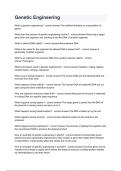
LCSW Exam Questionable section Review, Full coverage, rated A+

Rating
-
Sold
-
Pages
39
Grade
A+
Uploaded on
08-02-2023
Written in
2022/2023

LCSW Exam Questionable section Review, Full coverage, rated A+ Asceticism - -Characterized by rigor and self-denial Denial - -refusing to believe or even perceive painful realities Displacement - -psychoanalytic defense mechanism that shifts sexual or aggressive impulses toward a more acceptable or less threatening object or person, as when redirecting anger toward a safer outlet identification - -the process by which, according to Freud, children incorporate their parents' values into their developing superegos Intellectualization - -a coping mechanism in which the person analyzes a situation from an emotionally detached viewpoint Introjection/Internalization - -is the internalization of outside events or characteristics of other people. Refers to the process of taking it all in or swallowing it whole. Ex: a victim uses identification with the aggressor's behaviors to help protect himself Putting on a seat belt before driving. Projection - -psychoanalytic defense mechanism by which people disguise their own threatening impulses by attributing them to others Rationalization - -defense mechanism that offers self-justifying explanations in place of the real, more threatening, unconscious reasons for one's actions reaction formation - -psychoanalytic defense mechanism by which the ego unconsciously switches unacceptable impulses into their opposites. Thus, people may express feelings that are the opposite of their anxiety-arousing unconscious feelings. Repression - -in psychoanalytic theory, the basic defense mechanism that banishes from consciousness anxiety-arousing thoughts, feelings, and memories sublimation (defense mechanism) - -- Rechanneling of drives or impulses that are personally or socially unacceptable into activities that are constructive. EX: Mom of son killed by drunk driver, president of MADD. Undoing: Defense Mechanism - -atoning for or trying to magically dispel unacceptable desires or acts Id - -a reservoir of unconscious psychic energy that, according to Freud, strives to satisfy basic sexual and aggressive drives. The id operates on the pleasure principle, demanding immediate gratification. ego - -the largely conscious, "executive" part of personality that, according to Freud, mediates among the demands of the id, superego, and reality. The ego operates on the reality principle, satisfying the id's desires in ways that will realistically bring pleasure rather than pain. Superego (Freud) - -Represents the conscience, holds rules, values for socially acceptable behavior Oral Stage (0-18 months) - -pleasure centers on the mouth- sucking, biting, chewing Anal Stage (18-36 months) - -pleasure focuses on bowel and bladder elimination; coping with demands for control phalic stage - -According to Freud, the third psychosexual stage (from 3 to 6 years) in which gratification is focused on the genitals latent stage - -Freud's stage of psychosexual development occuring from about age 6 to puberty during which little happens in psychosexual terms genital stage - -Freud's last stage of personality development, from the onset of puberty through adulthood, during which the sexual conflicts of childhood resurface (at puberty) and are often resolved during adolescence). Piaget's Theory - -Theory stating that children actively construct their understanding of the world and go through four stages of cognitive development. Assimilation (Piaget) - -According to Piaget this is the process of fitting new ideas or concepts into existing ideas or concepts. It suggests that a child may change or alter what he perceives in the outside world in order to fit his internal world. Equilibrium (Piaget) - -balance between assimilation and accommodation Accommodation (Piaget) - -adapting our current understandings (schemas) to incorporate new information Adaptation (Piaget) - -The process of adjusting schemes in response to the environment by means of assimilation and accommodation. Object Permanence (Piaget) - -concept, gained in infancy, that objects continue to exist even when they are hidden from view Causality (piaget) - -when a child recognizes certain events, cause other events Pre operational Stage (Piaget) - -2-7yrs; thinking is concrete, egocentric; language develops. A key characteristic of this stage is the symbolic function, which allows the child to learn through the use of mental images, language and other symbols that represent objects that aren't present. Children during this stage engage in symbolic play and can solve problems mentally Concrete Operational Stage (Piaget) - -7-12. The child develops the ability to understand constant factors in the environment, rules, and higher-order symbolic systems. Conservation is developed here. Formal Operational Stage (Piaget) - -12-adulthood. Children develop the ability to think logically in the abstract. They develop deductive reasoning skills and are capable of achieving post-conventional moral reasoning. Erickson's Developmental Theory - -Based on Freud's emphasis on unconscious motivation Greater emphasis on the ego Assumes that people are basically rational and that behavior is largely due to ego functioning. Each of the 8 stages involves a psychosocial task that is to be mastered. If not mastered, the person still continues to develop, but the ego is damaged and subsequent stages will be affected. Trust vs. Mistrust (Erikson) - -0-1 years. Erikson's first stage during the first year of life, infants learn to trust when they are cared for in a consistent warm manner sundowning (sundown syndrome) - -a condition frequently reported (especially by family and professional caregivers), in which the affected individual is observed to become increasingly agitated, may become profoundly confused, emotionally volatile, and uncooperative (with a wide variety of behaviors across individuals). The signs of sundowning syndrome reliably occur with onset at or after daylight hours, and may become progressively more severe in cases of progressive forms of dementia. It also is observed in individuals who are survivors of traumatic brain injuries, although it is not as well documented as with dementias. Universalization - -technique of therapeutic communication in which the thought or behavior expressed is normalized to help the client feel less disoriented and to remove barriers to effective problem-solving. experimental research design - -random assignment of participants and the measure of intervention versus non-intervention. Quasiexperimental designs - -Experimental designs that do not involve random allocation of subjects to treatment combinations. Only has the intervention and comparison groups. Pre-experimental designs - -designs that offer little or no control over extraneous factors and only measures the effect of an intervention. secondary gain - -reward value of having a psychological or physical symptom, such as release from ordinary responsibilities Malingering - -Deliberate faking of a physical or psychological disorder motivated by gain. tertiary gain - -What the caretaker gets from the patient's symptoms (like an MD on an interesting case). Advantage or a benefit that a person with mental or physical illness brings to others as a result of the illness. factitious disorder - -Condition in which a person acts as if he or she has a physical or mental illness when he or she is not really sick. premenstrual dysphoric disorder - -a disorder marked by repeated episodes of significant depression and related symptoms during the week before menstruation. To be diagnosed in this way, symptoms must occur in the final week before onset of menses, symptoms must improve within a few days after onset of menses, and symptoms must be minimal or absent in the week after menses. psychodynamic theory - -Freudian theory that unconscious forces determine behavior, and that relationships with family/caregivers in early life is the primary determinant of most areas of psychosocial functioning throughout the life cycle. Cluster A personality disorders - -(odd and eccentric disorders) paranoid, schizoid, schizotypal Cluster B personality disorders - -(dramatic, emotional and erratic disorders) antisocial, borderline, histrionic, narcissistic Cluster C personality disorders - -( anxious and fearful disorders) avoidant, dependent, obsessive-compulsive Vicarious Liability - -Legal doctrine under which a party can be held liable for the wrongful actions of another party. In-kind assistance - -when tangible items, such as food and/or shelter, are given instead of money. It is an example of a micro level of intervention. Counselor Role - -Social workers in this role follow the planned-change process and help clients develop solutions to problems (empower clients). Change Agent Role - -more concerned with the needs of groups or organizations. Broker Role - -Social workers in this role link clients to needed resources and services Advocate Role - -step in to speak for clients and advocate for their rights. Dissociation - -Used as a defense mechanism in which clients have thoughts that are inappropriate to the current situation, such as thinking about a party when they are at a funeral. delirium - -state of confusion that is accompanied by hallucinations, delusions, emotional liabilities, and anxiety. dysphoria - -sense of great unhappiness or dissatisfaction Antisocial Personality Disorder - -most characterized by a pattern of impulsive, irresponsible, and sometimes violent and exploitative behavior, as well as a lack of remorse or empathy for others. quantitative research validity types - -construct validity, content validity, face validity, criterion validity construct validity - -assesses whether a test is representative of all aspects of the construct. To produce valid results, the content of a test, survey or measurement method must cover all relevant parts of the subject it aims to measure. If some aspects are missing from the measurement (or if irrelevant aspects are included), the validity is threatened. face validity - -considers how suitable the content of a test seems to be on the surface. It's similar to content validity, but face validity is a more informal and subjective assessment. As face validity is a subjective measure, it's often considered the weakest form of validity. However, it can be useful in the initial stages of developing a method. criterion validity - -evaluates how closely the results of your test correspond to the results of a different test. To evaluate criterion validity, you calculate the correlation between the results of your measurement and the results of the criterion measurement. If there is a high correlation, this gives a good indication that your test is measuring what it intends to measure. choreographing group therapy - -technique used in group therapy in which a member dramatically reenacts the life of another group member in order to clarify conflicts. sculpting group therapy - -technique used in group therapy in which a member depicts his/her understanding of the relationship with others by moving people into certain positions and asking them to stay frozen in that position. doubling group therapy - -a technique used in group therapy in which a member acts as an alter-ego of the protagonist. mirroring group therapy - -technique used in group therapy in which a member reenacts the protagonist's behavior by mimicking his/her gestures, expressions, and vocalization for objective scrutiny. roles - -the behaviors, obligations, and privileges attached to a status Values - -customs, beliefs, and principles that people consider to be good, positive, and important in their lives Ethics - -the principles of right and wrong that guide an individual in making decisions Laws - -a system of rules created and recognized by a state, nation, or community. autonomy versus shame and doubt - -(18 months to 3 years) The toddler's psychosocial task during this stage is to achieve a sense of independence over her own body in the context of relationships with primary caregivers. If a child experiences autonomy (in walking, exploring, etc.), she will gain confidence and pride, which then become ego strengths. If the child is over controlled or prohibited from exploring or becoming autonomous, she is likely to feel doubtful of her own abilities and excessive shame. Initiative vs. Guilt - -(3-6 years) The child's psychosocial task during this stage is to set goals and carry out plans without infringing on the rights of others. Exerting too much control (or taking action that does infringe on the rights of others) results in disapproval from adults and subsequent feelings of guilt. Those feelings of guilt, then, prohibit the child (or adult) from effectively making plans or setting goals in the future. Industry vs. Inferiority - -(6-12 years) The child's psychosocial task during this stage is to develop a sense of competence by beginning school and learning to do things on his own which instills a sense of pride and confidence. A child's peer group also begins to be of greater significance in this stage as well and contributes to a child's self-esteem. If adults do not support the child in his initiative, then a sense of inferiority is likely to develop where the child doubts his own abilities, making it more difficult to reach his potential. identity vs. role confusion - -The adolescent's task is to learn the roles that s/he will occupy as an adult while developing a sense of personal identity. Peer relationships help them to explore various identities. Success in this stage leads to fidelity where the adolescent feels comfortable with others who have varying values, while remaining true to her own identity. If the adolescent fails to develop a sense of identity, than she may feel role confusion or a weakened sense of self. Intimacy vs. Isolation - -(18-40 years) The task during this stage is to begin forming intimate relationships with other people. An individual develops comfortable relationships with a sense of commitment and care. Failure to develop intimacy can lead to isolation, loneliness, and a feeling of exclusion. generativty vs stagnation - -(40-65 years) The psychosocial task during this stage is to participate in activities that give the individual a sense of purpose such as a career, raising children, and creating positive changes that benefit others. If an adult does not feel this sense of purpose, he may then feel little connection to others and a sense of uselessness or rejection. Ego Integrity vs. Despair - -The psychosocial task during this stage is for older adults to look back on life and feel a sense of fulfillment and accomplishment. This wisdom allows for them to face the end of life and accept successes and failures, aging, and loss. Those who see their lives as unproductive or with many regrets may develop a sense of despair and guilt that can lead to depression and hopelessness. object relations theory (Mahler) - -the psychodynamic theory that views the desire for relationships as the key motivating force in human behavior. Refers to the way a child's Ego becomes organized over the first 3 1/2 years of life. During this time the child struggles between the self and others. The theory focuses on the reciprocal relationship between a mother and her infant and its effect on the infant's development of sense of self that occurs in three stages. Individuals are born with the drive to develop a sense of self and others along with the motivation to build interpersonal relationships. Autistic Stage of Object Relations Theory (birth to 1 month) - -Infant is focused purely on his/herself; unresponsive to external stimuli. Symbiotic Stage (1-5 months) - -infant begins to perceive the "needs satisfying object". During this stage, the mother's ego functions for the infant. Begins to understand that the mother as a separate being. seperation individuation phase - -(5-24 months+) During separation, the infant begins to develop an understanding of the boundaries of self and they start to see their mother as a separate individual. During individuation the child begins to develop a sense of self. Within separation-individuation there are four sub-stages. Differentiation Substage - -(5-9 months): infant's attention shifts from being inwardly focused to outwardly focused. (i.e. crawling) Practicing Substage - -(9-14 months): infant continues to separate from caretaker, his/her autonomous ego functions become more apparent. (i.e. walking, playing) Rapprochement Substage - -(14-24 months): infant begins to want to act independently. Moves away from mother but regularly comes back to ensure she is still there. Object Constancy Substage - -(after 24 months): infant internalizes his/her mother and begins to understand that his/her mother still exists for him/her despite her absence Alexithymia - -identified as one of the most frequently found characteristics of individuals who identify themselves as victims of childhood emotional abuse or neglect, which refers to the difficulties individuals may have identifying and/or expressing their emotions. Cognitive Theory - -A theory of human development that focuses on changes in how people think over time. According to this theory, our thoughts shape our attitudes, beliefs, and behaviors. Existential Theory - -a focus on the acceptance of the client's fundamental autonomy, freedom of choice, and the social worker's commitment to the concept of client self-determination. object relations theory - -focus on a client's relationship with others based on his/her early parent-child interactions and internalized self-images. P psychoanalytic theory - -A theory developed by Freud that attempts to explain personality, motivation, and mental disorders by focusing on unconscious determinants of behavior Emotional coldness, avoidance of people, and a fearfulness of intimacy are all characteristic of... - -Schizoid personality disorder in-kind assistance programs - -when tangible items, such as food and/or shelter, are given instead of money. It is an example of a micro level of intervention. block grants - -a federal government grant that provides a state or local government with a chunk of money to spend how they see fit. categorical grants - -Federal grants for specific purposes, such as building an airport grants-in-aid - -specific allotments of money for specific projects. Most characterized by a pattern of impulsive, irresponsible, and sometimes violent and exploitative behavior, as well as a lack of remorse or empathy for others. Avoidant traits are not usually considered part of a diagnosis of... - -antisocial personality disorder Substitution - -defense mechanism in which a client would replace an unattainable goal with an attainable goal. Usage include visual hallucinations, confusion, restlessness, chills, nausea, and dilated pupils. - -cocaine Prozac (fluoxetine) - -SSRI, antidepressant Major depression OCD Bulimia nervosa Premenstrual Dipneitc Syndrome Celexa (citalopram) - -SSRI antidepressant Zoloft (sertraline) - -SSRI antidepressant/anxiolytic Lexapro (escitalopram) - -SSRI antidepressant Paxil (paroxetine) - -SSRI antidepressant Luvox (fluvoxamine) - -SSRI antidepressant Valium (diazepam) - -Antianxiety (Benzodiazepine) Xanax (alprazolam) - -anti-anxiety benzodiazepines Ativan (lorazepam) - -Antianxiety (Benzodiazepine) Klonopin (clonazepam) - -Antianxiety (Benzodiazepine) Lithium - -used to treat bipolar disorder Depakote - -(Divalproex Sodium); Anticonvulsant Lamictal (lamotrigine) - -anticonvulsant/mood stabilizer Abilify (aripiprazole) - -atypical antipsychotic; an add-on treatment to be used in conjunction with another medication for depression, Bipolar Disorder, or Schizophrenia, when the other drug alone is not enough. Haldol (haloperidol) - -Antipsychotic (treats schizophrenia) Thorazine (chlorpromazine) - -Antipsychotic (treats schizophrenia)

Show more Read less
Institution
LCSW
Course
LCSW


Whoops! We can’t load your doc right now. Try again or contact support.

Document information

Uploaded on
February 8, 2023
Number of pages
39
Written in
2022/2023
Type
Exam (elaborations)
Contains
Questions & answers

Subjects

  • full coverage

Content preview

LCSW Exam Questionable section
Review, Full coverage, rated A+

Asceticism - ✔✔-Characterized by rigor and self-denial


Denial - ✔✔-refusing to believe or even perceive painful realities


Displacement - ✔✔-psychoanalytic defense mechanism that shifts sexual or aggressive impulses toward
a more acceptable or less threatening object or person, as when redirecting anger toward a safer outlet


identification - ✔✔-the process by which, according to Freud, children incorporate their parents' values
into their developing superegos


Intellectualization - ✔✔-a coping mechanism in which the person analyzes a situation from an
emotionally detached viewpoint


Introjection/Internalization - ✔✔-is the internalization of outside events or characteristics

of other people. Refers to the process of taking it all in or swallowing it whole.

Ex: a victim uses identification with the aggressor's

behaviors to help protect himself

Putting on a seat belt before driving.


Projection - ✔✔-psychoanalytic defense mechanism by which people disguise their own threatening
impulses by attributing them to others


Rationalization - ✔✔-defense mechanism that offers self-justifying explanations in place of the real,
more threatening, unconscious reasons for one's actions

,reaction formation - ✔✔-psychoanalytic defense mechanism by which the ego unconsciously switches
unacceptable impulses into their opposites. Thus, people may express feelings that are the opposite of
their anxiety-arousing unconscious feelings.


Repression - ✔✔-in psychoanalytic theory, the basic defense mechanism that banishes from
consciousness anxiety-arousing thoughts, feelings, and memories


sublimation (defense mechanism) - ✔✔-- Rechanneling of drives or impulses that are personally or
socially unacceptable into activities that are constructive.


EX: Mom of son killed by drunk driver, president of MADD.


Undoing: Defense Mechanism - ✔✔-atoning for or trying to magically dispel unacceptable desires or
acts


Id - ✔✔-a reservoir of unconscious psychic energy that, according to Freud, strives to satisfy basic sexual
and aggressive drives. The id operates on the pleasure principle, demanding immediate gratification.


ego - ✔✔-the largely conscious, "executive" part of personality that, according to Freud, mediates
among the demands of the id, superego, and reality. The ego operates on the reality principle, satisfying
the id's desires in ways that will realistically bring pleasure rather than pain.


Superego (Freud) - ✔✔-Represents the conscience, holds rules, values for socially acceptable behavior


Oral Stage (0-18 months) - ✔✔-pleasure centers on the mouth- sucking, biting, chewing


Anal Stage (18-36 months) - ✔✔-pleasure focuses on bowel and bladder elimination; coping with
demands for control


phalic stage - ✔✔-According to Freud, the third psychosexual stage (from 3 to 6 years) in which
gratification is focused on the genitals

,latent stage - ✔✔-Freud's stage of psychosexual development occuring from about age 6 to puberty
during which little happens in psychosexual terms


genital stage - ✔✔-Freud's last stage of personality development, from the onset of puberty through
adulthood, during which the sexual conflicts of childhood resurface (at puberty) and are often resolved
during adolescence).


Piaget's Theory - ✔✔-Theory stating that children actively construct their understanding of the world
and go through four stages of cognitive development.


Assimilation (Piaget) - ✔✔-According to Piaget this is the process of fitting new ideas or concepts into
existing ideas or concepts. It suggests that a child may change or alter what he perceives in the outside
world in order to fit his internal world.


Equilibrium (Piaget) - ✔✔-balance between assimilation and accommodation


Accommodation (Piaget) - ✔✔-adapting our current understandings (schemas) to incorporate new
information


Adaptation (Piaget) - ✔✔-The process of adjusting schemes in response to the environment by means of
assimilation and accommodation.


Object Permanence (Piaget) - ✔✔-concept, gained in infancy, that objects continue to exist even when
they are hidden from view


Causality (piaget) - ✔✔-when a child recognizes certain events, cause other events


Pre operational Stage (Piaget) - ✔✔-2-7yrs; thinking is concrete, egocentric; language develops. A key
characteristic of this stage is the symbolic function, which allows the child to learn through the use of
mental images, language and other symbols that represent objects that aren't present. Children during
this stage engage in symbolic play and can solve problems mentally

, Concrete Operational Stage (Piaget) - ✔✔-7-12. The child develops the ability to understand constant
factors in the environment, rules, and higher-order symbolic systems. Conservation is developed here.


Formal Operational Stage (Piaget) - ✔✔-12-adulthood. Children develop the ability to think logically in
the abstract. They develop deductive reasoning skills and are capable of achieving post-conventional
moral reasoning.


Erickson's Developmental Theory - ✔✔-Based on Freud's emphasis on unconscious motivation

Greater emphasis on the ego

Assumes that people are basically rational and that behavior is largely due to ego functioning.

Each of the 8 stages involves a psychosocial task that is to be mastered. If not mastered, the person still
continues to develop, but the ego is damaged and subsequent stages will be affected.


Trust vs. Mistrust (Erikson) - ✔✔-0-1 years. Erikson's first stage during the first year of life, infants learn
to trust when they are cared for in a consistent warm manner


sundowning (sundown syndrome) - ✔✔-a condition frequently reported (especially by family and
professional caregivers), in which the affected individual is observed to become increasingly agitated,
may become profoundly confused, emotionally volatile, and uncooperative (with a wide variety of
behaviors across individuals). The signs of sundowning syndrome reliably occur with onset at or after
daylight hours, and may become progressively more severe in cases of progressive forms of dementia. It
also is observed in individuals who are survivors of traumatic brain injuries, although it is not as well
documented as with dementias.


Universalization - ✔✔-technique of therapeutic communication in which the thought or behavior
expressed is normalized to help the client feel less disoriented and to remove barriers to effective
problem-solving.


experimental research design - ✔✔-random assignment of participants and the measure of intervention
versus non-intervention.


Quasiexperimental designs - ✔✔-Experimental designs that do not involve random allocation of subjects
to treatment combinations. Only has the intervention and comparison groups.

Get to know the seller

Seller avatar
Reputation scores are based on the amount of documents a seller has sold for a fee and the reviews they have received for those documents. There are three levels: Bronze, Silver and Gold. The better the reputation, the more your can rely on the quality of the sellers work.
QuickPass Chamberlain College Of Nursing
View profile
Follow You need to be logged in order to follow users or courses
Sold
410
Member since
3 year
Number of followers
304
Documents
6372
Last sold
3 weeks ago
Get all Documents you need at discount.

All nursing docs available: question banks, summaries, study guide and test banks

3.8

97 reviews

5
52
4
11
3
10
2
10
1
14

Recently viewed by you

Why students choose Stuvia

Created by fellow students, verified by reviews

Quality you can trust: written by students who passed their tests and reviewed by others who've used these notes.

Didn't get what you expected? Choose another document

No worries! You can instantly pick a different document that better fits what you're looking for.

Pay as you like, start learning right away

No subscription, no commitments. Pay the way you're used to via credit card and download your PDF document instantly.

Student with book image

“Bought, downloaded, and aced it. It really can be that simple.”

Alisha Student

Frequently asked questions