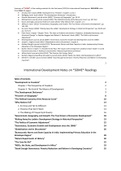
Summary of *SOME* of the reading materials for the final exam (2023) for International Development. INCLUDES notes
from (Total: 35 pages):
● Amartya Sen’s book (1999) “Development as Freedom”, chapters 1 and 2.
● Wolfgang Sachs’ book (2010) “The Development Dictionary”, Introduction.
● Ricardo Hausmann’s journal article (2001) “Prisoners of Geography”, pp. 44-53.
● Michael Ross’ journal article review (1999) “The Political Economy of the Resource Curse”, pp. 297-322.
● Daron Acemoglu and James Robinson’s book (2012) “Why Nations Fail”, chapters 1-3.
● Jeffrey D. Sachs’ (2012) “Government, Geography, and Growth: The True Drivers of Economic Development”, pp.
142-150.
● Ha-Joon Chang’s (2002) “Kicking Away the Ladder: Development Strategy in Historical Perspective”, pp. 69-85 and
pp. 110-123.
● Peter Evans’ chapter “Chapter Three: The State as Problem and Solution: Predation, Embedded Autonomy, and
Structural Change” in Stephen Haggard and Robert R. Kaufmann’s book (1992) “The Politics of Economic
Adjustment”.
● Mushtaq Khan’s journal article (2007) “Governance, Economic Growth and Development since the 1960s”.
● Joseph E. Stiglitz’s book (2002) “Globalization and its Discontents”, chapter 3.
● Akshay Mangla’s journal article (2015) “Bureaucratic Norms and State Capacity in India: Implementing Primary
Education in the Himalayan Region”.
● Nathan Nunn’s chapter “5. Shackled to the Past: The Causes and Consequences of Africa’s Slave Trades” in Jared
Diamond and James A. Robinson’s book (2010) “Natural Experiments of History”.
● Jeffrey Sachs’s journal article (2014) “The Case for Aid, Foreign Policy”.
● Berhanu Nega and Geoffrey Schneider’s journal article (2014) “NGOs, the State, and Development in Africa”.
● Merilee S. Grindle’s journal article (2004) “Good Enough Governance: Poverty Reduction and Reform in Developing
Countries”.
1
International Development Notes on *SOME* Readings
Table of Contents
“Development as Freedom” 2
Chapter I: The Perspective of Freedom 2
Chapter II: The Ends & The Means of Development 3
“The Development Dictionary” 7
“Prisoners of Geography” 8
“The Political Economy of the Resource Curse” 10
“Why Nations Fail” 14
1. So Close and Yet So Different 14
2. Theories That Don’t Work 14
3. The Making of Prosperity & Poverty 16
“Government, Geography, and Growth: The True Drivers of Economic Development” 18
“Kicking Away the Ladder: Development Strategy in Historical Perspective” 19
“The Politics of Economic Adjustment” 22
“Governance, Economic Growth and Development since the 1960s” 24
“Globalization and its Discontents” 26
“Bureaucratic Norms and State Capacity in India: Implementing Primary Education in the
Himalayan Region” 28
“Natural Experiments of History” 30
“The Case for Aid” 32
“NGOs, the State, and Development in Africa” 33
“Good Enough Governance: Poverty Reduction and Reform in Developing Countries” 35
, 2
“Development as Freedom”
Chapter I: The Perspective of Freedom
Development conceptualisation = capability to live long + have a good life.
➔ Usefulness of wealth = allows us to do the substantive freedoms it helps us to achieve.
◆ NOT exclusive or uniform.
➔ Development: Enhancing the lives we lead + freedoms we enjoy.
FORMS OF UNFREEDOM
Varieties:
● Famines.
● Denial of political liberty + basic civil rights.
➔ Lee Thesis: Denial of basic civil + political rights leads to alleged economic
development advantages.
● Economic insecurity.
PROCESSES & OPPORTUNITIES
Freedom = process that allows freedom of actions/decisions + actual opportunities that people have
given personal/social circumstances.
➔ Freedom’s process + opportunity aspects can be pursued at different levels.
➔ Reasons for the importance of individual freedom relating to development:
1. Evaluation = substantive freedoms that members of a society enjoy (assessments
based on individual advantages vs. social progress).
● Greater freedom is:
○ Significant for the person’s overall freedom.
○ Important in fostering the person’s opportunity.
● Evaluative systems use a factual base:
○ “Economic” concentration → income & wealth.
○ “Utilitarian” → mental satisfaction.
○ “Libertarian” → procedures for liberty.
● Implications in analysing for poverty & inequality + mortality & income.
2. Effectiveness = freedom is the basic evaluation of success + principal determinant of
individual initiative/social effectiveness.
Elementary Freedom: Ability to survive premature mortality, BUT a range of relevant freedoms exists.
Freedom-Centred Perspective: Way human life goes + resources that a person commands.
➔ Role of the market mechanisms vs. freedom.
➔ Distinct perspectives on economic development:
1. Denial of opportunities of transaction through arbitrary controls.
2. Markets typically work to expand income/wealth + economic opportunities that
people have.
➔ Freedom-based vs. evaluative system (focuses only on culmination outcomes).
, 3
◆ E.g., slaves’ commodity baskets & life expectancy compared favourably to that of
free agricultural labourers.
➔ Has far-reaching implications for the ultimate objective of development + processes &
procedures that have to be respected.
Importance of freedom of employment:
● Formal freedom of the worker under capitalism to change employers.
● Real unfreedom of workers in pre-capitalist systems.
TRADITION, CULTURE & DEMOCRACY
Inescapable valuational problem in deciding what to choose if tradition CANNOT be maintained with
economic/social changes.
Conflict between:
1. Value that the people must be allowed to decide freely what traditions to follow.
2. Insistence that established traditions & religious/secular authorities be followed (NO matter
what).
Chapter II: The Ends & The Means of Development
2 general attitudes to the process of development:
1. “Fierce” Process: Temptations to be resisted (e.g., social safety nets), pointing to distinct
areas of softness that are to be avoided.
2. “Friendly” Process: Development with mutually beneficial exchanges.
ROLES OF FREEDOM
Constitutive Role (Primary End): Relates to the importance of substantive freedom in enriching
human life (e.g., avoiding starvation, access to literacy).
➔ Development = process of expanding human freedoms.
➔ E.g., a very rich person that is prevented from speaking freely = deprived.
Instrumental Role (Principal Means): These freedoms/rights may also be very effective in
contributing to economic progress.
➔ Instrumental freedoms types (contribute to a person’s capability to live more freely +
complement each other):
1. Political freedoms = opportunities in determining who/how to govern, criticise
authorities, freedom of political expression.
2. Economic facilities = individuals’ opportunities to utilise economic resources (access
to finance) for the purpose of consumption, production, exchange (important =
distributional + aggregative considerations).
3. Social opportunities = arrangements that society makes (e.g., education, health care)
that influence the individual's substantive freedom to live better.
4. Transparency guarantees = the need for openness that people can expect, freedom
to deal with one another under guarantees of disclosure + lucidity.
from (Total: 35 pages):
● Amartya Sen’s book (1999) “Development as Freedom”, chapters 1 and 2.
● Wolfgang Sachs’ book (2010) “The Development Dictionary”, Introduction.
● Ricardo Hausmann’s journal article (2001) “Prisoners of Geography”, pp. 44-53.
● Michael Ross’ journal article review (1999) “The Political Economy of the Resource Curse”, pp. 297-322.
● Daron Acemoglu and James Robinson’s book (2012) “Why Nations Fail”, chapters 1-3.
● Jeffrey D. Sachs’ (2012) “Government, Geography, and Growth: The True Drivers of Economic Development”, pp.
142-150.
● Ha-Joon Chang’s (2002) “Kicking Away the Ladder: Development Strategy in Historical Perspective”, pp. 69-85 and
pp. 110-123.
● Peter Evans’ chapter “Chapter Three: The State as Problem and Solution: Predation, Embedded Autonomy, and
Structural Change” in Stephen Haggard and Robert R. Kaufmann’s book (1992) “The Politics of Economic
Adjustment”.
● Mushtaq Khan’s journal article (2007) “Governance, Economic Growth and Development since the 1960s”.
● Joseph E. Stiglitz’s book (2002) “Globalization and its Discontents”, chapter 3.
● Akshay Mangla’s journal article (2015) “Bureaucratic Norms and State Capacity in India: Implementing Primary
Education in the Himalayan Region”.
● Nathan Nunn’s chapter “5. Shackled to the Past: The Causes and Consequences of Africa’s Slave Trades” in Jared
Diamond and James A. Robinson’s book (2010) “Natural Experiments of History”.
● Jeffrey Sachs’s journal article (2014) “The Case for Aid, Foreign Policy”.
● Berhanu Nega and Geoffrey Schneider’s journal article (2014) “NGOs, the State, and Development in Africa”.
● Merilee S. Grindle’s journal article (2004) “Good Enough Governance: Poverty Reduction and Reform in Developing
Countries”.
1
International Development Notes on *SOME* Readings
Table of Contents
“Development as Freedom” 2
Chapter I: The Perspective of Freedom 2
Chapter II: The Ends & The Means of Development 3
“The Development Dictionary” 7
“Prisoners of Geography” 8
“The Political Economy of the Resource Curse” 10
“Why Nations Fail” 14
1. So Close and Yet So Different 14
2. Theories That Don’t Work 14
3. The Making of Prosperity & Poverty 16
“Government, Geography, and Growth: The True Drivers of Economic Development” 18
“Kicking Away the Ladder: Development Strategy in Historical Perspective” 19
“The Politics of Economic Adjustment” 22
“Governance, Economic Growth and Development since the 1960s” 24
“Globalization and its Discontents” 26
“Bureaucratic Norms and State Capacity in India: Implementing Primary Education in the
Himalayan Region” 28
“Natural Experiments of History” 30
“The Case for Aid” 32
“NGOs, the State, and Development in Africa” 33
“Good Enough Governance: Poverty Reduction and Reform in Developing Countries” 35
, 2
“Development as Freedom”
Chapter I: The Perspective of Freedom
Development conceptualisation = capability to live long + have a good life.
➔ Usefulness of wealth = allows us to do the substantive freedoms it helps us to achieve.
◆ NOT exclusive or uniform.
➔ Development: Enhancing the lives we lead + freedoms we enjoy.
FORMS OF UNFREEDOM
Varieties:
● Famines.
● Denial of political liberty + basic civil rights.
➔ Lee Thesis: Denial of basic civil + political rights leads to alleged economic
development advantages.
● Economic insecurity.
PROCESSES & OPPORTUNITIES
Freedom = process that allows freedom of actions/decisions + actual opportunities that people have
given personal/social circumstances.
➔ Freedom’s process + opportunity aspects can be pursued at different levels.
➔ Reasons for the importance of individual freedom relating to development:
1. Evaluation = substantive freedoms that members of a society enjoy (assessments
based on individual advantages vs. social progress).
● Greater freedom is:
○ Significant for the person’s overall freedom.
○ Important in fostering the person’s opportunity.
● Evaluative systems use a factual base:
○ “Economic” concentration → income & wealth.
○ “Utilitarian” → mental satisfaction.
○ “Libertarian” → procedures for liberty.
● Implications in analysing for poverty & inequality + mortality & income.
2. Effectiveness = freedom is the basic evaluation of success + principal determinant of
individual initiative/social effectiveness.
Elementary Freedom: Ability to survive premature mortality, BUT a range of relevant freedoms exists.
Freedom-Centred Perspective: Way human life goes + resources that a person commands.
➔ Role of the market mechanisms vs. freedom.
➔ Distinct perspectives on economic development:
1. Denial of opportunities of transaction through arbitrary controls.
2. Markets typically work to expand income/wealth + economic opportunities that
people have.
➔ Freedom-based vs. evaluative system (focuses only on culmination outcomes).
, 3
◆ E.g., slaves’ commodity baskets & life expectancy compared favourably to that of
free agricultural labourers.
➔ Has far-reaching implications for the ultimate objective of development + processes &
procedures that have to be respected.
Importance of freedom of employment:
● Formal freedom of the worker under capitalism to change employers.
● Real unfreedom of workers in pre-capitalist systems.
TRADITION, CULTURE & DEMOCRACY
Inescapable valuational problem in deciding what to choose if tradition CANNOT be maintained with
economic/social changes.
Conflict between:
1. Value that the people must be allowed to decide freely what traditions to follow.
2. Insistence that established traditions & religious/secular authorities be followed (NO matter
what).
Chapter II: The Ends & The Means of Development
2 general attitudes to the process of development:
1. “Fierce” Process: Temptations to be resisted (e.g., social safety nets), pointing to distinct
areas of softness that are to be avoided.
2. “Friendly” Process: Development with mutually beneficial exchanges.
ROLES OF FREEDOM
Constitutive Role (Primary End): Relates to the importance of substantive freedom in enriching
human life (e.g., avoiding starvation, access to literacy).
➔ Development = process of expanding human freedoms.
➔ E.g., a very rich person that is prevented from speaking freely = deprived.
Instrumental Role (Principal Means): These freedoms/rights may also be very effective in
contributing to economic progress.
➔ Instrumental freedoms types (contribute to a person’s capability to live more freely +
complement each other):
1. Political freedoms = opportunities in determining who/how to govern, criticise
authorities, freedom of political expression.
2. Economic facilities = individuals’ opportunities to utilise economic resources (access
to finance) for the purpose of consumption, production, exchange (important =
distributional + aggregative considerations).
3. Social opportunities = arrangements that society makes (e.g., education, health care)
that influence the individual's substantive freedom to live better.
4. Transparency guarantees = the need for openness that people can expect, freedom
to deal with one another under guarantees of disclosure + lucidity.