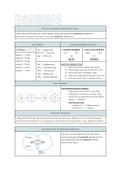
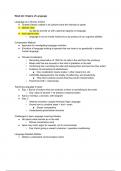
how ions are formed by electron loss or gain
Metal atoms lose the electron/s in their highest energy level and become positively charged ions.
Non-metal atoms gain an electron/s, to become negatively charged ions.
ionic fórmula compounds formed between ions
2+
ion charges Cu = copper ion COPPER NITRIDE CALCIUM NITRATE
2+ 3+ +2 -3 -1 2+
Fe Fe = iron ions Cu N NO3 Ca
group 1= +1 ions +1
Ag = silver ion 3:2 2:1
group 2= +2 ions
Cu3 N2 Ca (NO3)2
group 3= +3 ions
group 5= -3 ions -2
SO4 = sulphate ion HOW TO WORK IT OUT
group 6= -2 ions -2
CO = carbonate ion
3
1) Write down ionic symbols with charge
group 7= -1 ions NO
-1
= nitrate ion 2) Swap charge nums and write down in ratio
3
- 3) Write + ions first in formula, - after
OH = hydrate ion
+ 4) After each symbol put the number from ratio
NH4 = ammonium ion
5) If there are more than 1 complex ion put ( )
ionic compounds
Ion formation (electron transfer):
- sodium has 1 electron in its outer shell
- chlorine has 7 electrons in its outer shell.
- an electron is transferred from outer shell of
sodium —> chlorine
- Now there are ions:
- sodium ion —> +1 charge (group 1)
- chloride ion —> -1 charge
electrostatic attractions
Linkage formed from the electrostatic attraction between oppositely charged ions in a chemical compound.
Atom that loses the electrons = pos. charged ion (cation), the one that gains them = a neg. charged ion (anion).
attraction between the shared pair of electrons
The atoms are held together by the electrostatic
attraction between the positively charged nuclei of
the bonded atoms and the negatively charged
electrons they share.
Metal atoms lose the electron/s in their highest energy level and become positively charged ions.
Non-metal atoms gain an electron/s, to become negatively charged ions.
ionic fórmula compounds formed between ions
2+
ion charges Cu = copper ion COPPER NITRIDE CALCIUM NITRATE
2+ 3+ +2 -3 -1 2+
Fe Fe = iron ions Cu N NO3 Ca
group 1= +1 ions +1
Ag = silver ion 3:2 2:1
group 2= +2 ions
Cu3 N2 Ca (NO3)2
group 3= +3 ions
group 5= -3 ions -2
SO4 = sulphate ion HOW TO WORK IT OUT
group 6= -2 ions -2
CO = carbonate ion
3
1) Write down ionic symbols with charge
group 7= -1 ions NO
-1
= nitrate ion 2) Swap charge nums and write down in ratio
3
- 3) Write + ions first in formula, - after
OH = hydrate ion
+ 4) After each symbol put the number from ratio
NH4 = ammonium ion
5) If there are more than 1 complex ion put ( )
ionic compounds
Ion formation (electron transfer):
- sodium has 1 electron in its outer shell
- chlorine has 7 electrons in its outer shell.
- an electron is transferred from outer shell of
sodium —> chlorine
- Now there are ions:
- sodium ion —> +1 charge (group 1)
- chloride ion —> -1 charge
electrostatic attractions
Linkage formed from the electrostatic attraction between oppositely charged ions in a chemical compound.
Atom that loses the electrons = pos. charged ion (cation), the one that gains them = a neg. charged ion (anion).
attraction between the shared pair of electrons
The atoms are held together by the electrostatic
attraction between the positively charged nuclei of
the bonded atoms and the negatively charged
electrons they share.