

Functional Groups
Quick Resources:
https://quizlet.com/_bz4wwe?x=1jqt&i=2matcs
Overview of Functional Groups
Functional groups are reactive clusters of atoms in molecules
Have predictable chemical properties
(ie. Carboxyl groups have acid properties)
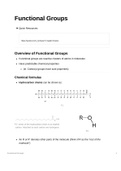
Chemical formulas
Hydrocarbon chains can be shown as:
F1
F2- vertex of the hydrocarbon chain is an implied
carbon. Attached to each carbon are hydrogens
F3
An R or R’ denotes other parts of the molecule (think of R as the “rest of the
molecule”)
Functional Groups 1
, carbon can assemble into a variety of chain and ring structures
capable of forming up to four covalent bonds with other atoms
mostly with hydrogen, nitrogen, oxygen, and sulfur
the smallest hydrocarbon chain is methane (CH4 )
carbon atoms can form chains that branch
Functional Groups
carbohydrates, lipids, proteins, and nucleic acids undergo synthesis and
degradation in living organisms through interactions between small reactive groups
of atoms called functional groups
they are usually ionic or strongly polar
attract other polar or ionic molecules, such as water
the non-polar parts of the molecule do not attract other molecules, so they do
not help to initiate chemical reactions
functional groups on large molecules interact with other molecules and introduce
different types of bonding
⚛ functional group: a group of atoms that affects the function of a molecule by
participating in chemical reactions
Functional Groups 2
Quick Resources:
https://quizlet.com/_bz4wwe?x=1jqt&i=2matcs
Overview of Functional Groups
Functional groups are reactive clusters of atoms in molecules
Have predictable chemical properties
(ie. Carboxyl groups have acid properties)
Chemical formulas
Hydrocarbon chains can be shown as:
F1
F2- vertex of the hydrocarbon chain is an implied
carbon. Attached to each carbon are hydrogens
F3
An R or R’ denotes other parts of the molecule (think of R as the “rest of the
molecule”)
Functional Groups 1
, carbon can assemble into a variety of chain and ring structures
capable of forming up to four covalent bonds with other atoms
mostly with hydrogen, nitrogen, oxygen, and sulfur
the smallest hydrocarbon chain is methane (CH4 )
carbon atoms can form chains that branch
Functional Groups
carbohydrates, lipids, proteins, and nucleic acids undergo synthesis and
degradation in living organisms through interactions between small reactive groups
of atoms called functional groups
they are usually ionic or strongly polar
attract other polar or ionic molecules, such as water
the non-polar parts of the molecule do not attract other molecules, so they do
not help to initiate chemical reactions
functional groups on large molecules interact with other molecules and introduce
different types of bonding
⚛ functional group: a group of atoms that affects the function of a molecule by
participating in chemical reactions
Functional Groups 2


