Viruses
September 13, 2022 12:03 PM
Viruses
• Not made of cells, acellular
• Surrounded by a protein shell with a nucleic acid genome inside
○ Does not have a cytoplasm or organelles
○ Can be DNA or RNA
• Some viruses can be surrounded by a lipid envelope
• Must infect other cells in order to make proteins and replicate
○ Are "obligate parasites", meaning they must be a parasitic agent as they cannot
reproduce due to their lack of ribosomes
§ This does NOT mean they do not have genes that encode proteins, simply
themselves
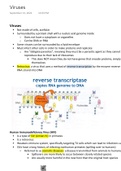
• Retrovirus: a virus that uses a method of reverse transcription by the enzyme reverse t
RNA strand into DNA
Human Immunodeficiency Virus (HIV)
• Is a type of SIV (simian IV) in primates
• Is a retrovirus
• Weakens immune system, specifically targeting T4 cells which can lead to infections su
• SIVs have a long history of infecting nonhuman primates (spilling over to humans)
○ Referred to as zoonotic diseases: a disease transmitted from animals to humans
§ Spillovers are more likely to occur between closely related species
§ Are usually more harmful in the new host than the original host species
,Evolution vs intelligent design
September 15, 2022 12:30 PM
Belief System Theory o
• Complex features of the universe and life are explained by an intelligent cause, rather than science • Na
○ Believes in a superior being or creator of the universe ○
• A belief is an acceptance that certain things are true with faith
○ Not intended to need evidence or be tested
• Scientific theory is a set of testable hypotheses that attempt to explain facts about the natural world
○ Meant to find evidence and father facts
○ Are falsifiable
§ Open to the possibility of being wrong
§ Can be tested
§ Is progressive; uses evidence to modify theory if needed
• Theory of evolution: populations or organisms change over time, and all organisms are related
Macro evidence for evolution
Biogeography
• Similar but not identical species are found in far, distant places
• A species in the past (common ancestor) changed over time into different forms
• Ex. The rhea, ostrich, and emu • Th
• Comparative morphology ○
• Ind
off
• Ov
○
• Va
• Be
○
, Population genetics and microevolution
October 19, 2022 5:52 PM
• Mendelian genetics: inheritance of traits governed by a single locus (gene)
○ From P to F1 or F2 generations
• Microevolution: change in allele frequencies that occurs from 1 generation to the nex
within a population
○ Genotype and phenotypic frequencies changings
• Macroevolution:
○ Speciation, evolution of new species
○ Large scale evolutionary patterns in history of life
Mating conditions to produce generation:
• Individuals mate randomly (anyone can mate with anyone)
• Equal number of offspring (same fitness, no selection)
• No new variation/no mutation
• No immigration of individuals from other populations
• Infinitely large population (no genetic drift)
Hardy-Weinberg Principle
September 13, 2022 12:03 PM
Viruses
• Not made of cells, acellular
• Surrounded by a protein shell with a nucleic acid genome inside
○ Does not have a cytoplasm or organelles
○ Can be DNA or RNA
• Some viruses can be surrounded by a lipid envelope
• Must infect other cells in order to make proteins and replicate
○ Are "obligate parasites", meaning they must be a parasitic agent as they cannot
reproduce due to their lack of ribosomes
§ This does NOT mean they do not have genes that encode proteins, simply
themselves
• Retrovirus: a virus that uses a method of reverse transcription by the enzyme reverse t
RNA strand into DNA
Human Immunodeficiency Virus (HIV)
• Is a type of SIV (simian IV) in primates
• Is a retrovirus
• Weakens immune system, specifically targeting T4 cells which can lead to infections su
• SIVs have a long history of infecting nonhuman primates (spilling over to humans)
○ Referred to as zoonotic diseases: a disease transmitted from animals to humans
§ Spillovers are more likely to occur between closely related species
§ Are usually more harmful in the new host than the original host species
,Evolution vs intelligent design
September 15, 2022 12:30 PM
Belief System Theory o
• Complex features of the universe and life are explained by an intelligent cause, rather than science • Na
○ Believes in a superior being or creator of the universe ○
• A belief is an acceptance that certain things are true with faith
○ Not intended to need evidence or be tested
• Scientific theory is a set of testable hypotheses that attempt to explain facts about the natural world
○ Meant to find evidence and father facts
○ Are falsifiable
§ Open to the possibility of being wrong
§ Can be tested
§ Is progressive; uses evidence to modify theory if needed
• Theory of evolution: populations or organisms change over time, and all organisms are related
Macro evidence for evolution
Biogeography
• Similar but not identical species are found in far, distant places
• A species in the past (common ancestor) changed over time into different forms
• Ex. The rhea, ostrich, and emu • Th
• Comparative morphology ○
• Ind
off
• Ov
○
• Va
• Be
○
, Population genetics and microevolution
October 19, 2022 5:52 PM
• Mendelian genetics: inheritance of traits governed by a single locus (gene)
○ From P to F1 or F2 generations
• Microevolution: change in allele frequencies that occurs from 1 generation to the nex
within a population
○ Genotype and phenotypic frequencies changings
• Macroevolution:
○ Speciation, evolution of new species
○ Large scale evolutionary patterns in history of life
Mating conditions to produce generation:
• Individuals mate randomly (anyone can mate with anyone)
• Equal number of offspring (same fitness, no selection)
• No new variation/no mutation
• No immigration of individuals from other populations
• Infinitely large population (no genetic drift)
Hardy-Weinberg Principle