

Session 7
Postpartum
Physiological Health
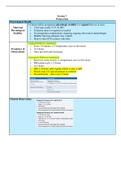
5 Criteria define postpartum physiologic stability for vaginal delivery at term
Maternal • Vital signs stable (T, P, R, BP)
Physiological • Perineum intact or repaired as needed
Stability • No postpartum complications requiring ongoing observation (hemorrhage)
• Bladder function adequate (has voided)
• Skin-to-skin (STS) contact with baby
Vaginal Delivery (minimal)
• Every 15 minutes x 4 (temperature once in first hour)
Frequency of • At 2 hours
Observations • Once per shift until discharge
Caesarean Delivery (minimal)
• Recovery room record x 4 (temperature once in first hour)
• RR/sedation q1h x 12 hours
• At 2 hours
• Q4h x 24 hours after regular which is once a shift
• Hourly resp x12 and orientation or sedation
• Second hourly – after every 2 hours
Clinical Observation
, Vital Signs
BP. HR, RR, Temperature, O2 Sats on scale
Sedation Scale
1 – Fully awake and oriented
2 – Drowsy
Normal sleep 3 – Eyes closed but rousable to command: sleepy but wake up when you call them
documented as 4 – Eyes closed but rousable to mild physical stimulation (earlobe tug): eyes are closed,
3 not responding, but wake up to touch
5 – Eyes closed but unrousable to mild
physical stimulation
For scores of 5 or more – Call attending
physician / anesthesiologist: not waking
by touch
Pain (numerical scale)
Perineal pain
Muscle pain – fatigue/tired
Breast – engorgement
Nipple
Caesarean – incision pain (severe pain is
not okay)
Pain Management
• Pain control is essential to reduce the woman’s distress and facilitate movement
that can prevent several complications.
Boggy fundus, massage until firm to prevent hemmorhage
Uterine Fundus: upper portion of the body uterus. After 24 hours, it descends 1 cm (1
finger width/day for 10 days.
Fundal Tone
Firm
Firm with massage: scooping
Boggy: Not good = Uterus is not empty
Full bladder interferes with uterine contraction, causes fundus
to deviate to right side
massaging fundus
Skill 9.1 Steps to help expel blood clots/ fundus massage
1. Place nondominant hand above symphysis pubis, press
downwards to lower uterus
2. Massage fundus using flat portion of fingers of dominant hand in firm, circular
motion. Keep other hand in place to avoid inverting uterus
Fundal Height
• 0 (at umbilicus)
, • below the umbilicus (measured in 1 cm increments)
• above the umbilicus (measured in 1 cm increments)
Color
Lochia •
Rubra: mosly blood, 3 days after birth
Serosa: pinkish (bld &mucus) 3 – 10 days
•
Vaginal • Alba: mostly mucus, 10th -21st day post birth
discharge: → excessive discharge, q15 mins
endometrial
tissue, blood, & Amount
lymph • SC – scant
• S - small
1 gram = 1 mL • M – moderate
volume • H – heavy
• CL - clots 1 pad/ Hr → PP Hem
Absence is not
normal
Notes o Heavier flow with ambulation, lochia pools, discharged in upright position
(small clots = normal) NOT large clots
o Quanity during breastfeed → suckling causes uterine contractions b/c
release of oxytocin
Report:
o Foul-smell, with or without fever
o Lochia rubra lasts longer than 3 days
o Unusually/ heavy flow
o Lochia that returns to a bright red color after it has progressed to serosa or alba
Abdominal DI: Dressing dry and intact
Incision Oz: Dressing oozing
H: Dealing
DR: Dressing removed
S/R: Sutures/staples removed
N/A
Maternal Assessment
Changes in the breasts
Breasts o 2 – 3 days: breasts full/ soft
o 3rd day firm/ lumpy d/t blood flow milk production
o Engorged breast: hard, erect, & uncomfortable (feeding/non-feeding)
o Nipple: hard (newborn c/n grasp)
o Non-nursing: return to normal size in 1 to 2 weeks
Differences in non-breast-feeding woman
o Avoid nipple stimulation (during shower too), which stimulates lactation. Wear
bra (clothing doesn’t touch breasts), shower facing water from water
Postpartum
Physiological Health
5 Criteria define postpartum physiologic stability for vaginal delivery at term
Maternal • Vital signs stable (T, P, R, BP)
Physiological • Perineum intact or repaired as needed
Stability • No postpartum complications requiring ongoing observation (hemorrhage)
• Bladder function adequate (has voided)
• Skin-to-skin (STS) contact with baby
Vaginal Delivery (minimal)
• Every 15 minutes x 4 (temperature once in first hour)
Frequency of • At 2 hours
Observations • Once per shift until discharge
Caesarean Delivery (minimal)
• Recovery room record x 4 (temperature once in first hour)
• RR/sedation q1h x 12 hours
• At 2 hours
• Q4h x 24 hours after regular which is once a shift
• Hourly resp x12 and orientation or sedation
• Second hourly – after every 2 hours
Clinical Observation
, Vital Signs
BP. HR, RR, Temperature, O2 Sats on scale
Sedation Scale
1 – Fully awake and oriented
2 – Drowsy
Normal sleep 3 – Eyes closed but rousable to command: sleepy but wake up when you call them
documented as 4 – Eyes closed but rousable to mild physical stimulation (earlobe tug): eyes are closed,
3 not responding, but wake up to touch
5 – Eyes closed but unrousable to mild
physical stimulation
For scores of 5 or more – Call attending
physician / anesthesiologist: not waking
by touch
Pain (numerical scale)
Perineal pain
Muscle pain – fatigue/tired
Breast – engorgement
Nipple
Caesarean – incision pain (severe pain is
not okay)
Pain Management
• Pain control is essential to reduce the woman’s distress and facilitate movement
that can prevent several complications.
Boggy fundus, massage until firm to prevent hemmorhage
Uterine Fundus: upper portion of the body uterus. After 24 hours, it descends 1 cm (1
finger width/day for 10 days.
Fundal Tone
Firm
Firm with massage: scooping
Boggy: Not good = Uterus is not empty
Full bladder interferes with uterine contraction, causes fundus
to deviate to right side
massaging fundus
Skill 9.1 Steps to help expel blood clots/ fundus massage
1. Place nondominant hand above symphysis pubis, press
downwards to lower uterus
2. Massage fundus using flat portion of fingers of dominant hand in firm, circular
motion. Keep other hand in place to avoid inverting uterus
Fundal Height
• 0 (at umbilicus)
, • below the umbilicus (measured in 1 cm increments)
• above the umbilicus (measured in 1 cm increments)
Color
Lochia •
Rubra: mosly blood, 3 days after birth
Serosa: pinkish (bld &mucus) 3 – 10 days
•
Vaginal • Alba: mostly mucus, 10th -21st day post birth
discharge: → excessive discharge, q15 mins
endometrial
tissue, blood, & Amount
lymph • SC – scant
• S - small
1 gram = 1 mL • M – moderate
volume • H – heavy
• CL - clots 1 pad/ Hr → PP Hem
Absence is not
normal
Notes o Heavier flow with ambulation, lochia pools, discharged in upright position
(small clots = normal) NOT large clots
o Quanity during breastfeed → suckling causes uterine contractions b/c
release of oxytocin
Report:
o Foul-smell, with or without fever
o Lochia rubra lasts longer than 3 days
o Unusually/ heavy flow
o Lochia that returns to a bright red color after it has progressed to serosa or alba
Abdominal DI: Dressing dry and intact
Incision Oz: Dressing oozing
H: Dealing
DR: Dressing removed
S/R: Sutures/staples removed
N/A
Maternal Assessment
Changes in the breasts
Breasts o 2 – 3 days: breasts full/ soft
o 3rd day firm/ lumpy d/t blood flow milk production
o Engorged breast: hard, erect, & uncomfortable (feeding/non-feeding)
o Nipple: hard (newborn c/n grasp)
o Non-nursing: return to normal size in 1 to 2 weeks
Differences in non-breast-feeding woman
o Avoid nipple stimulation (during shower too), which stimulates lactation. Wear
bra (clothing doesn’t touch breasts), shower facing water from water


