Benjamin Odei F2021STAT213
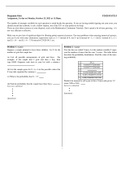
Assignment 1 is due on Monday, October 04, 2021 at 11:59pm.
The number of attempts available for each question is noted beside the question. If you are having trouble figuring out your error, you
should consult the textbook, or ask a fellow student, one of the TA’s or your professor for help.
There are also other resources at your disposal, such as the Mathematics Continuous Tutorials. Don’t spend a lot of time guessing – it’s
not very efficient or effective.
Make sure to give lots of significant digits for (floating point) numerical answers. For most problems when entering numerical answers,
you can if you wish enter elementary expressions such as 2 ∧ 3 instead of 8, sin(3 ∗ pi/2)instead of -1, e ∧ (ln(2)) instead of 2, (2 +
tan(3)) ∗ (4 − sin(5)) ∧ 6 − 7/8 instead of 27620.3413, etc.
• (1)/(2)
Problem 1. (1 point) • (1)/(36)
Two fair die are tossed, and the uppermost face of each die is • C
observed. The following events are defined from this random ex- (score 0.325)
periment:
A represent the event the uppermost faces sum to five
B represent the event that the product of the uppermost faces
is four. For example, die1*die2 = 4
C represent the event that the absolute difference between the
uppermost faces is 1. For example, |die1 − die2| = 1
Part (a) Find the probability that the uppermost faces do not
sum to five. (Use four decimals in your answer)
Part (b) Find P(A ∪C) (Use four decimals)
Part (c) What is the probability that the uppermost faces do not
sum to five or are not a product of 4? (use four decimals)
Part (d) Find P(A ∩ (B ∪C)) (use four decimals)
Part (e) Are the events a sum of 5 and a product of 4 mutu-
ally exclusive events? Select the most appropriate reason below.
• A. A sum of 5 and a product of 4 are not mutually exclu-
sive events because P(A ∩ B) = P(A)P(B).
• B. A sum of 5 and a product of 4 are mutually exclusive
events because P(A ∩ B) = 0.
• C. A sum of 5 and a product of 4 are not mutually exclu-
sive events because P(A ∩ B) 6= 0.
• D. A sum of 5 and a product of 4 are mutually exclusive
events because they are not independent events.
• E. A sum of 5 and a product of 4 are not mutually exclu-
sive events because P(A ∩ B) 6= P(A)P(B).
Answer(s) submitted:
• 0.8888
• (7)/(9)
1
, Problem 2. (1 point) Problem 3. (1 point)
A triangular die is a four-sided die, each side possessing either a
number 1, 2, 3, or 4. Two such die are tossed simultaneously and Two fair dice are tossed, and the up face on each die is recorded.
the bottom faces - the face that each die lands on - is observed. Find the probability of observing each of the following events:
Consider the following events:
A : { The difference of the numbers is 2 }
A the bottom-most faces sum to six
B : { A 3 appears on at least one of the dice }
B each bottom-most face shows an even number
C : { The sum of the numbers is equal to 2 }
C both bottom-most faces show the same number, referred to
as doubles P(A) = P(B) = P(C) =
Answer(s) submitted:
•
Part (a) What is the probability that the bottom-most faces do •
not sum to six? (Use four decimals in your answer) •
(incorrect)
Part (b) Compute P(A ∪ B) (Use four decimals)
Part (c) Compute P(AC ∩Cc ) (use four decimals)
Part (d) Compute P(A ∩ B ∩C) (use four decimals)
Part (e) Are the events A and C mutually exclusive events?
Select the most appropriate reason below.
• A. A and C are not mutually exclusive events because
P(A ∩C) 6= 0.
• B. A and C are not mutually exclusive events because
P(A ∩C) 6= P(A)P(C).
• C. A and C are not mutually exclusive events because
P(A ∩C) = P(A)P(C).
• D. A and C are mutually exclusive events because they are
not independent events.
• E. A and C are mutually exclusive events because P(A ∩
C) = 0.
Answer(s) submitted:
•
•
•
•
•
(incorrect)
2
Assignment 1 is due on Monday, October 04, 2021 at 11:59pm.
The number of attempts available for each question is noted beside the question. If you are having trouble figuring out your error, you
should consult the textbook, or ask a fellow student, one of the TA’s or your professor for help.
There are also other resources at your disposal, such as the Mathematics Continuous Tutorials. Don’t spend a lot of time guessing – it’s
not very efficient or effective.
Make sure to give lots of significant digits for (floating point) numerical answers. For most problems when entering numerical answers,
you can if you wish enter elementary expressions such as 2 ∧ 3 instead of 8, sin(3 ∗ pi/2)instead of -1, e ∧ (ln(2)) instead of 2, (2 +
tan(3)) ∗ (4 − sin(5)) ∧ 6 − 7/8 instead of 27620.3413, etc.
• (1)/(2)
Problem 1. (1 point) • (1)/(36)
Two fair die are tossed, and the uppermost face of each die is • C
observed. The following events are defined from this random ex- (score 0.325)
periment:
A represent the event the uppermost faces sum to five
B represent the event that the product of the uppermost faces
is four. For example, die1*die2 = 4
C represent the event that the absolute difference between the
uppermost faces is 1. For example, |die1 − die2| = 1
Part (a) Find the probability that the uppermost faces do not
sum to five. (Use four decimals in your answer)
Part (b) Find P(A ∪C) (Use four decimals)
Part (c) What is the probability that the uppermost faces do not
sum to five or are not a product of 4? (use four decimals)
Part (d) Find P(A ∩ (B ∪C)) (use four decimals)
Part (e) Are the events a sum of 5 and a product of 4 mutu-
ally exclusive events? Select the most appropriate reason below.
• A. A sum of 5 and a product of 4 are not mutually exclu-
sive events because P(A ∩ B) = P(A)P(B).
• B. A sum of 5 and a product of 4 are mutually exclusive
events because P(A ∩ B) = 0.
• C. A sum of 5 and a product of 4 are not mutually exclu-
sive events because P(A ∩ B) 6= 0.
• D. A sum of 5 and a product of 4 are mutually exclusive
events because they are not independent events.
• E. A sum of 5 and a product of 4 are not mutually exclu-
sive events because P(A ∩ B) 6= P(A)P(B).
Answer(s) submitted:
• 0.8888
• (7)/(9)
1
, Problem 2. (1 point) Problem 3. (1 point)
A triangular die is a four-sided die, each side possessing either a
number 1, 2, 3, or 4. Two such die are tossed simultaneously and Two fair dice are tossed, and the up face on each die is recorded.
the bottom faces - the face that each die lands on - is observed. Find the probability of observing each of the following events:
Consider the following events:
A : { The difference of the numbers is 2 }
A the bottom-most faces sum to six
B : { A 3 appears on at least one of the dice }
B each bottom-most face shows an even number
C : { The sum of the numbers is equal to 2 }
C both bottom-most faces show the same number, referred to
as doubles P(A) = P(B) = P(C) =
Answer(s) submitted:
•
Part (a) What is the probability that the bottom-most faces do •
not sum to six? (Use four decimals in your answer) •
(incorrect)
Part (b) Compute P(A ∪ B) (Use four decimals)
Part (c) Compute P(AC ∩Cc ) (use four decimals)
Part (d) Compute P(A ∩ B ∩C) (use four decimals)
Part (e) Are the events A and C mutually exclusive events?
Select the most appropriate reason below.
• A. A and C are not mutually exclusive events because
P(A ∩C) 6= 0.
• B. A and C are not mutually exclusive events because
P(A ∩C) 6= P(A)P(C).
• C. A and C are not mutually exclusive events because
P(A ∩C) = P(A)P(C).
• D. A and C are mutually exclusive events because they are
not independent events.
• E. A and C are mutually exclusive events because P(A ∩
C) = 0.
Answer(s) submitted:
•
•
•
•
•
(incorrect)
2