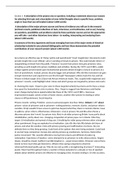
1. To what extent does global history have to be comparative?
This essay will assess the extent to which global history must be comparative by examining a working
definition of ‘global history’, by assessing globalisation’s impact upon the perceived nature of time
and space, and global history’s relationship with national histories. Most historians concur that
global history is a new ‘perspective’ with which to examine the past, and this method gained
popularity from the 1980’s.1 It seems that comparison is a fundamental tool of examination for
global history. However, it is imperative that global historians balance their comparisons with
analyses of similarities, interactions and connections, to gain a holistic understanding of global
history.
It is requisite to provide a working definition of what the term ‘global history’ entails, to establish the
value of comparison in global history. ‘Global history’ is an attempt by historians, living in a new
global epoch, to trace back the factors that created this epoch. This is often achieved by examining
case studies on a local, national or international scale, and assessing their comparisons, similarities
and tracing interactions and connections. Global history aims to nurture a better understanding of
the factors that brought about globalisation.
There is debate regarding the extent to which we are living in a new global epoch. However, the key
global historical work argues that we are living in a new global epoch and noted this is suggested by
relatively recent changes in human history. Changes include a greater idea of living on one planet
due to the world viewed from space, environmental changes that affect the whole globe and
multinational corporations.2 These factors, and others such as the development of cables and the
telephone, coalesced to form the process of globalisation. The histories of each factor’s
development differ vastly, regarding location across the globe and context. In this way, it is useful to
compare facets within factors, such as speed differences between regions in constructing satellites,
to identify the motors of historical change. However, this is only useful when drawing similarities
within and between factors and identifying interactions that also drove the processes. When
amalgamated in this way, one may draw a more balanced viewpoint regarding the importance of
factors pushing and pulling in the dance of globalisation.
It is reasonable to argue that the culmination of globalising processes has considerably densified
time and space. The Industrial Revolution’s development of steam engines reduced travel time. The
19th century’s laying of the first transatlantic cable, building of the Suez Canal and the telephone’s
invention, and other later developments such as satellites, make communication across vast
distances almost instantaneous. These developments have individual rich histories, and comparison
between these different case studies across time is useful for tracking the mobilisation and
development of civilisations. Hopkins favoured this view. He argued that a comparison of trans-
societal movements of products, people and ideas is requisite for understanding the global impact of
mobilisation.3 Comparison can enlighten the historian in this manner; comparison here it useful for
tracking the movements of products and ideas from one area to another, and for explaining the
modifications of revived ideas. However, more recent historians such as Geoff Eley convincingly
1
J. Laurence Hare and Jack Wells, ‘Promising the World: Surveys, Curricula, and the Challenge of Global
History’, History Teacher, 48, no. 1 (2015), pp. 371-88.
2
Bruce Mazlish, ‘An Introduction to Global History,’ in Ralph Buultjens (ed.), Conceptualizing Global History,
(Boulder: Westview Press, 1993), pp. 1- 47.
3
A. G. Hopkins, ‘The Historiography of Globalisation and the Globalisation of Regionalism’, Journal of the
Economic and Social History of the Orient, 53, no. ½ (2010), pp. 19- 36.
, maintained the argument for also exploring societal similarities during globalisation. 4 He argued this
in conjuncture with utilising comparison and assessing interactions as historical tools, is greatly
valuable in gaining a more accurate understanding of the globe. Comparison as one tool balanced
against others de-centralises Europe as the main actor on the historical stage for globalisation
because historians may trace important developments that occurred across the globe as necessary.
Thus, global history as utilising comparison checked against the tools of similarity and assessing
interactions, cultivates a more balanced judgement as comparison alone could overstate the
importance of certain factors and understate or overlook the role of other factors.
Comparisons of national histories can be informative. However, understanding the history of
globalisation well calls for marrying comparisons with similarities, and assessing general global
trends and contexts. Drawing a similarity between each nations’ political tensions, and the global
context of the Cold War denotes the context of the Soviet and American national histories when
studying their satellite development. This creates a systematic method for analysis and generates a
more complete view of these nations’ histories which imposed the communication revolution upon
the globe.
In conclusion, global history is fundamentally comparative because this allows historians to note and
trace changes or developments. However, global history balances comparison equally against other
important historical tools. Assessing similarities in global history allows historians to trace long term
developments over time. Assessing interactions allows historians to connect developments between
societies around the globe and enables historians to find the sources for developments in regions
around the globe. Global history discusses global processes that have fundamentally altered our
behaviour and attitudes, such as through personal communication and international communication.
Global historians currently debate views regarding a developing global identity, where people feel
connected on a global scale, due to communication advance. Due to time and space constraints, this
essay has not examined differences between the importance of comparison on a local, national and
international scale. The debate would be greatly aided by this, as it is possible the importance of
comparison as a tool in global history may alter between the scales of enquiry.
4
Geoff Eley, ‘Historicizing the Global, Politicizing Capital: Giving the Present a Name’, History Workshop
Journal, 63, no. 1, pp. 154- 188.
This essay will assess the extent to which global history must be comparative by examining a working
definition of ‘global history’, by assessing globalisation’s impact upon the perceived nature of time
and space, and global history’s relationship with national histories. Most historians concur that
global history is a new ‘perspective’ with which to examine the past, and this method gained
popularity from the 1980’s.1 It seems that comparison is a fundamental tool of examination for
global history. However, it is imperative that global historians balance their comparisons with
analyses of similarities, interactions and connections, to gain a holistic understanding of global
history.
It is requisite to provide a working definition of what the term ‘global history’ entails, to establish the
value of comparison in global history. ‘Global history’ is an attempt by historians, living in a new
global epoch, to trace back the factors that created this epoch. This is often achieved by examining
case studies on a local, national or international scale, and assessing their comparisons, similarities
and tracing interactions and connections. Global history aims to nurture a better understanding of
the factors that brought about globalisation.
There is debate regarding the extent to which we are living in a new global epoch. However, the key
global historical work argues that we are living in a new global epoch and noted this is suggested by
relatively recent changes in human history. Changes include a greater idea of living on one planet
due to the world viewed from space, environmental changes that affect the whole globe and
multinational corporations.2 These factors, and others such as the development of cables and the
telephone, coalesced to form the process of globalisation. The histories of each factor’s
development differ vastly, regarding location across the globe and context. In this way, it is useful to
compare facets within factors, such as speed differences between regions in constructing satellites,
to identify the motors of historical change. However, this is only useful when drawing similarities
within and between factors and identifying interactions that also drove the processes. When
amalgamated in this way, one may draw a more balanced viewpoint regarding the importance of
factors pushing and pulling in the dance of globalisation.
It is reasonable to argue that the culmination of globalising processes has considerably densified
time and space. The Industrial Revolution’s development of steam engines reduced travel time. The
19th century’s laying of the first transatlantic cable, building of the Suez Canal and the telephone’s
invention, and other later developments such as satellites, make communication across vast
distances almost instantaneous. These developments have individual rich histories, and comparison
between these different case studies across time is useful for tracking the mobilisation and
development of civilisations. Hopkins favoured this view. He argued that a comparison of trans-
societal movements of products, people and ideas is requisite for understanding the global impact of
mobilisation.3 Comparison can enlighten the historian in this manner; comparison here it useful for
tracking the movements of products and ideas from one area to another, and for explaining the
modifications of revived ideas. However, more recent historians such as Geoff Eley convincingly
1
J. Laurence Hare and Jack Wells, ‘Promising the World: Surveys, Curricula, and the Challenge of Global
History’, History Teacher, 48, no. 1 (2015), pp. 371-88.
2
Bruce Mazlish, ‘An Introduction to Global History,’ in Ralph Buultjens (ed.), Conceptualizing Global History,
(Boulder: Westview Press, 1993), pp. 1- 47.
3
A. G. Hopkins, ‘The Historiography of Globalisation and the Globalisation of Regionalism’, Journal of the
Economic and Social History of the Orient, 53, no. ½ (2010), pp. 19- 36.
, maintained the argument for also exploring societal similarities during globalisation. 4 He argued this
in conjuncture with utilising comparison and assessing interactions as historical tools, is greatly
valuable in gaining a more accurate understanding of the globe. Comparison as one tool balanced
against others de-centralises Europe as the main actor on the historical stage for globalisation
because historians may trace important developments that occurred across the globe as necessary.
Thus, global history as utilising comparison checked against the tools of similarity and assessing
interactions, cultivates a more balanced judgement as comparison alone could overstate the
importance of certain factors and understate or overlook the role of other factors.
Comparisons of national histories can be informative. However, understanding the history of
globalisation well calls for marrying comparisons with similarities, and assessing general global
trends and contexts. Drawing a similarity between each nations’ political tensions, and the global
context of the Cold War denotes the context of the Soviet and American national histories when
studying their satellite development. This creates a systematic method for analysis and generates a
more complete view of these nations’ histories which imposed the communication revolution upon
the globe.
In conclusion, global history is fundamentally comparative because this allows historians to note and
trace changes or developments. However, global history balances comparison equally against other
important historical tools. Assessing similarities in global history allows historians to trace long term
developments over time. Assessing interactions allows historians to connect developments between
societies around the globe and enables historians to find the sources for developments in regions
around the globe. Global history discusses global processes that have fundamentally altered our
behaviour and attitudes, such as through personal communication and international communication.
Global historians currently debate views regarding a developing global identity, where people feel
connected on a global scale, due to communication advance. Due to time and space constraints, this
essay has not examined differences between the importance of comparison on a local, national and
international scale. The debate would be greatly aided by this, as it is possible the importance of
comparison as a tool in global history may alter between the scales of enquiry.
4
Geoff Eley, ‘Historicizing the Global, Politicizing Capital: Giving the Present a Name’, History Workshop
Journal, 63, no. 1, pp. 154- 188.