International HRM
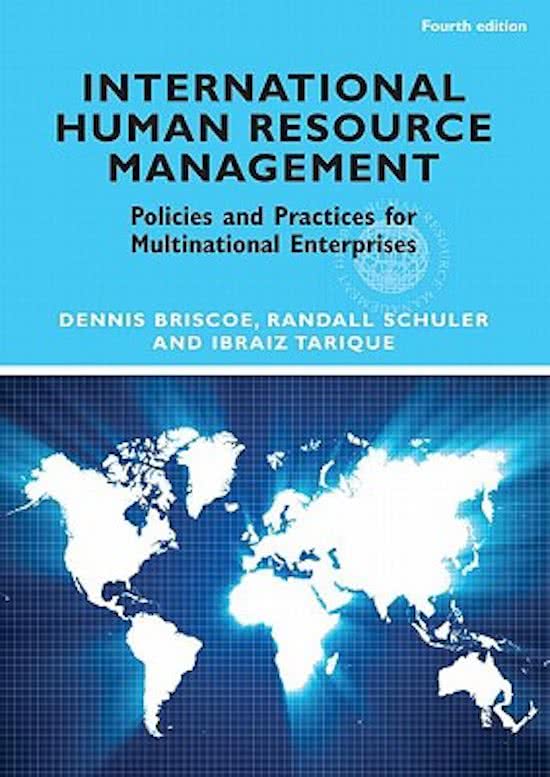
Policies and practices for multinational enterprises
Chapter 1 – The internationalization of HRM
International Human Resource Management (IHRM) is the study and application of all
human resource management (HRM) activities as they impact the process of managing
human resources in enterprises in the global environment. Markets for most goods and
services are global. The most important drivers of the internationalization of business are:
Trade agreements: Decrease trade barriers and increase of open markets (EU) leads to
more cross-border trade.
Search of new markets and reduced costs: Firms have to search for new markets and
revenues, and lower their production costs, due to global competition.
Rapid and extensive global communication: The technological revolution and its digital
reformation (Internet, World Wide Web, mobile phones) have made communication
much easier, quicker and cheaper. This also enabled information sharing all over the
world, creating global expectation for an ever-increasing quality of life.
Rapid development and transfer of new technology: New technologies make it possible
to manufacture products and deliver services with good quality and prices everywhere.
Education and information technology enables every country to play a part in this.
Improving global education and a global talent pool: Education is not only enabling
firms to improve the quality of products, they can also produce products everywhere.
Furthermore, the quality of global education results in a global talent pool.
Increased travel and migration: international travelling has become easier, quicker and
cheaper. People experience other products and practices in the countries they visit and
take those experiences back home. Or people relocate in another country and bringing
their own products and practices with them.
Knowledge sharing: Firms operating internationally “export” their knowledge and
culture.
E-commerce: Business over the Internet is always on a global basis.
Homogenization of culture and consumer demands: Integration of cultures and values
has led to common consumer demands for some products. However, differences in
culture across countries remain.
THE GROWTH AND SPREAD OF INTERNATIONALIZATION
International business continues to grow nowadays, from all over the world. Enterprises from
small, developing, and/or emerging markets are contributing increasingly to global trade.
DIFFERENT SETTINGS OF IHRM
Headquarters of multinationals
The focus is from the center out to the subsidiaries and subcontractors, developing and
overseeing IHRM practices in all foreign operations, and directing the movement of
employees between headquarters and foreign locations. In some MNE’s IHRM becomes a
, major strategic partner in the organization’s planning and in talent management of the global
workforce. HRM tries to apply its policies directly to its foreign subsidiaries, or it tries to
merge its policies with those that are common in the host countries.
Home-country subsidiaries of foreign-owned firms
The HR manager will likely be on the receiving end of policy and practice, coming from the
foreign headquarters. S/he will typically have to integrate a local culture and organizational
culture into local operations. The different communication styles, worker motivation
philosophies, and the lack of understanding the host country cultures, markets, laws, and
language by the parent company can cause major problems for the local HR manager.
Domestic firms
Purely domestic firms also confront many of the complexities of international business:
The hiring of employees who come from another country, culture, and language
Dealing with competition from foreign firms for customers and suppliers.
These domestic firms can be very large in their country, and facing the same questions as
MNE’s: How to merge cultures, languages, attitudes, and expectations?
Government agencies and non-governmental organizations
Embassies and NGO’s send hundreds of people from their parent countries to their overseas
operations. Many IHRM responsibilities for these are organizations are similar to those faced
by their commercial counterparts. IHR managers must be internationally savvy in order to
effectively carry out their responsibilities.
THE DEVELOPMENT OF IHRM
HR managers will confront aspects of IHRM. The extent of this involvement will vary
according to, among others, the global strategy. Within an MNE need to answer some
questions as it establishes its international strategy, such as:
Does the firm have the necessary globally experienced executives and employees?
To which country should we relocate our international operations? And how many
employees will need to be relocated to international location to start up and run the
new operations?
What is required to recruit necessary talent to make this move successful?
Do we want uniform IHRM policies and practices or tailored to each location?
HR managers must learn to integrate and coordinate policies and practices, which are taking
place in diverse environments and with people of divers backgrounds. Organizational success
depends on how well they handle their IHRM issues. These issues differ from purely
domestic HRM in for instance:
More HR functions and activities (e.g. work visas, foreign taxes)
More expertise (e.g. knowledge about foreign countries, laws, cultural differences)
More involvement in people’s lives by relocating them.
More external factors and influences (e.g. dealing with issues from multiple laws)
Greater level of risk, greater exposure to problems and difficulties (e.g. legal
compliance issues, early return of employees from foreign assignments)
Policies and practices for multinational enterprises
Chapter 1 – The internationalization of HRM
International Human Resource Management (IHRM) is the study and application of all
human resource management (HRM) activities as they impact the process of managing
human resources in enterprises in the global environment. Markets for most goods and
services are global. The most important drivers of the internationalization of business are:
Trade agreements: Decrease trade barriers and increase of open markets (EU) leads to
more cross-border trade.
Search of new markets and reduced costs: Firms have to search for new markets and
revenues, and lower their production costs, due to global competition.
Rapid and extensive global communication: The technological revolution and its digital
reformation (Internet, World Wide Web, mobile phones) have made communication
much easier, quicker and cheaper. This also enabled information sharing all over the
world, creating global expectation for an ever-increasing quality of life.
Rapid development and transfer of new technology: New technologies make it possible
to manufacture products and deliver services with good quality and prices everywhere.
Education and information technology enables every country to play a part in this.
Improving global education and a global talent pool: Education is not only enabling
firms to improve the quality of products, they can also produce products everywhere.
Furthermore, the quality of global education results in a global talent pool.
Increased travel and migration: international travelling has become easier, quicker and
cheaper. People experience other products and practices in the countries they visit and
take those experiences back home. Or people relocate in another country and bringing
their own products and practices with them.
Knowledge sharing: Firms operating internationally “export” their knowledge and
culture.
E-commerce: Business over the Internet is always on a global basis.
Homogenization of culture and consumer demands: Integration of cultures and values
has led to common consumer demands for some products. However, differences in
culture across countries remain.
THE GROWTH AND SPREAD OF INTERNATIONALIZATION
International business continues to grow nowadays, from all over the world. Enterprises from
small, developing, and/or emerging markets are contributing increasingly to global trade.
DIFFERENT SETTINGS OF IHRM
Headquarters of multinationals
The focus is from the center out to the subsidiaries and subcontractors, developing and
overseeing IHRM practices in all foreign operations, and directing the movement of
employees between headquarters and foreign locations. In some MNE’s IHRM becomes a
, major strategic partner in the organization’s planning and in talent management of the global
workforce. HRM tries to apply its policies directly to its foreign subsidiaries, or it tries to
merge its policies with those that are common in the host countries.
Home-country subsidiaries of foreign-owned firms
The HR manager will likely be on the receiving end of policy and practice, coming from the
foreign headquarters. S/he will typically have to integrate a local culture and organizational
culture into local operations. The different communication styles, worker motivation
philosophies, and the lack of understanding the host country cultures, markets, laws, and
language by the parent company can cause major problems for the local HR manager.
Domestic firms
Purely domestic firms also confront many of the complexities of international business:
The hiring of employees who come from another country, culture, and language
Dealing with competition from foreign firms for customers and suppliers.
These domestic firms can be very large in their country, and facing the same questions as
MNE’s: How to merge cultures, languages, attitudes, and expectations?
Government agencies and non-governmental organizations
Embassies and NGO’s send hundreds of people from their parent countries to their overseas
operations. Many IHRM responsibilities for these are organizations are similar to those faced
by their commercial counterparts. IHR managers must be internationally savvy in order to
effectively carry out their responsibilities.
THE DEVELOPMENT OF IHRM
HR managers will confront aspects of IHRM. The extent of this involvement will vary
according to, among others, the global strategy. Within an MNE need to answer some
questions as it establishes its international strategy, such as:
Does the firm have the necessary globally experienced executives and employees?
To which country should we relocate our international operations? And how many
employees will need to be relocated to international location to start up and run the
new operations?
What is required to recruit necessary talent to make this move successful?
Do we want uniform IHRM policies and practices or tailored to each location?
HR managers must learn to integrate and coordinate policies and practices, which are taking
place in diverse environments and with people of divers backgrounds. Organizational success
depends on how well they handle their IHRM issues. These issues differ from purely
domestic HRM in for instance:
More HR functions and activities (e.g. work visas, foreign taxes)
More expertise (e.g. knowledge about foreign countries, laws, cultural differences)
More involvement in people’s lives by relocating them.
More external factors and influences (e.g. dealing with issues from multiple laws)
Greater level of risk, greater exposure to problems and difficulties (e.g. legal
compliance issues, early return of employees from foreign assignments)