100% satisfaction guarantee Immediately available after payment Both online and in PDF No strings attached 4.2 TrustPilot
logo-home
Exam (elaborations)

Understanding Pathophysiology 6th Edition .

Rating
-
Sold
-
Pages
368
Grade
A+
Uploaded on
01-06-2022
Written in
2020/2021

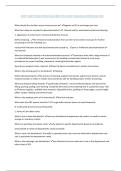
Understanding Pathophysiology 6th Edition. MULTIPLE CHOICE 1. A student is observing a cell under the microscope. It is observed to have supercoiled DNA with histones. Which of the following would also be observed by the student? a. A single circular chromosome b. A nucleus c. Free-floating nuclear material d. No organelles ANS: B The cell described is a eukaryotic cell, so it has histones and a supercoiled DNA within its nucleus; thus, the nucleus should be observed. A single circular chromosome called a prokaryote contains free-floating nuclear material but has no organelles. REF: p. 2 2. A nurse is instructing the staff about cellular functions. Which cellular function is the nurse describing when an isolated cell absorbs oxygen and uses it to transform nutrients to energy? a. Metabolic absorption b. Communication c. Secretion d. Respiration ANS: D The cell’s ability to absorb oxygen is referred to as respiration while its communication ability involves maintenance of a steady dynamic state, metabolic absorption provides nutrition, and secretion allows for the synthesizing of new substances. REF: p. 2 3. A eukaryotic cell is undergoing DNA replication. In which region of the cell would most of the genetic information be contained? a. Mitochondria b. Ribosome c. Nucleolus d. Nucleus Cytoplasm ANS: C The region of the cell that contains genetic material, including a large amount of ribonucleic acid, most of the DNA, and DNA-binding proteins, is the nucleolus, which is located within the cell’s nucleus. Mitochondria is associated with cellular respiration, while ribosomes are involved with protein manufacturing. Cytoplasm is a fluid filling that is a component of the cell. REF: p. 2 NURSINGTB.COM Understanding Pathophysiology 6th Edition Huether Test Bank 4. Which of the following can remove proteins attached to the cell’s bilayer by dissolving the layer itself? a. Peripheral membrane proteins b. Integral membrane proteins c. Glycoproteins d. Cell adhesion molecules ANS: B Proteins directly attached to the membrane bilayer can be removed by the action of integral membrane proteins that dissolve the bilayer. Peripheral membrane proteins reside at the surface while cell adhesion molecules are on the outside of the membrane. Glycoprotein marks cells and does not float. REF: p. 7 5. Which of the following can bind to plasma membrane receptors? a. Oxygen b. Ribosomes c. Amphipathic lipids d. Ligands ANS: D Ligands are the only specific molecules that can bind with receptors on the cell membrane. REF: p. 9 6. A nurse is reviewing a report from a patient with metastatic cancer. What alternation in the a. Decreased fibronectin b. Increased collagen c. Decreased elastin d. Increased glycoproteins ANS: A Only a reduced amount of fibronectin is found in some types of cancerous cells, allowing them to travel or metastasize. REF: p. 10 7. Which form of cell communication is used to relate to other cells in direct physical contact? a. Cell junction b. Gap junction c. Desmosome d. Tight junction ANS: A Cell junctions hold cells together and permit molecules to pass from cell to cell. Gap junctions allow for cellular communication between cells. Neither desmosomes nor tight junctions are associated with cellular communication. REF: p. 11 NURSINGTB.COM Understanding Pathophysiology 6th Edition Huether Test Bank NU RS IN GT B.CO M 8. Pancreatic beta cells secrete insulin, which inhibits secretion of glucagon from neighboring alpha cells. This action is an example of which of the following signaling types? a. Paracrine b. Autocrine c. Neurohormonal d. Hormonal ANS: A Paracrine signaling involves the release of local chemical mediators that are quickly taken up, destroyed, or immobilized, as in the case of insulin and the inhibition of the secretion of glucagon. None of the other options involve signaling that is associated with a local chemical mediator like insulin. REF: p. 12 9. In cellular metabolism, each enzyme has a high affinity for a: a. solute. b. substrate. c. receptor. d. ribosome. ANS: B Each enzyme has a high affinity for a substrate, a specific substance converted to a product of the reaction. Cellular metabolism is not dependent on an attraction between an enzyme and any of the remaining options. REF: p. 16 10. An athlete runs a marathon, after which his muscles feel fatigued and unable to contract. The athlete asks the nurse why this happened. The nurse’s response is based on the knowledge that the problem is result of a deficiency of: a. GTP b. AMP c. ATP d. GMP ANS: C When ATP is deficient, impaired muscle contraction results. None of the other options are involved in muscle contraction. REF: p. 16 11. Which phase of catabolism produces the most ATP? a. Digestion b. Glycolysis c. Oxidation d. Citric acid cycle ANS: D While some ATP is produced during the oxidation and glycolysis phases, most of the ATP is generated during the citric acid cycle. Digestion does not produce any ATP. NURSINGTB.COM Understanding Pathophysiology 6th Edition Huether Test Bank NU RS IN GT B.CO M REF: p. 16 12. A nurse is teaching the staff about the phases of cellular catabolism. Which phases should the nurse include? a. Digestion, glycolysis, oxidation, and the citric acid cycle b. Diffusion, osmosis, and mediated transport c. S phase, G phase, and M phase d. Metabolic absorption, respiration, and excretion ANS: A Only digestion, glycolysis, oxidation, and the citric acid cycle are the phases of cellular catabolism. REF: p. 16 13. A runner has depleted all the oxygen available for muscle energy. Which of the following will facilitate his continued muscle performance? a. Electron-transport chain b. Aerobic glycolysis c. Anaerobic glycolysis d. Oxidative phosphorylation ANS: C When no oxygen is available, anaerobic glycolysis occurs. The electron-transport chain is part of the citric acid cycle. Aerobic glycolysis involves the presence of oxygen. Oxidative phosphorylation is the mechanism by which the energy produced from carbohydrates, fats, and proteins is transferred to ATP. It is not part of muscle performance. REF: p. 16 14. A faculty member asks a student to identify the appropriate term for the movement of a solute from an area of greater to lesser concentration. Which answer indicates the nursing student understood the teaching? a. Osmosis b. Diffusion c. Hydrostatic pressure d. Active transport ANS: B Diffusion is the movement of a solute molecule from an area of greater solute concentration to an area of lesser solute concentration through a permeable membrane. Osmosis is the movement of water across a semipermeable membrane from a region of higher water concentration to one of lower concentration. Hydrostatic pressure is the force of fluid against a cell membrane. In active transport, molecules move up a concentration gradient. REF: p. 19 15. Which description accurately describes electrolytes? a. Small lipid-soluble molecules b. Large protein molecules c. Micronutrients used to produce ATP NURSINGTB.COM Understanding Pathophysiology 6th Edition Huether Test Bank NU RS IN GT B.CO M d. Electrically charged molecules ANS: D Electrolytes are electrically charged molecules. They are not lipid soluble, they are not made up of protein, and they do not play a role in ATP production. REF: p. 18 16. A nurse is reading a chart and sees the term oncotic pressure. The nurse recalls that oncotic pressure (colloid osmotic pressure) is determined by: a. the concentration of sodium. b. plasma proteins. c. hydrostatic pressure. d. the availability of membrane transporter proteins. ANS: B Oncotic pressure is determined by the effect of colloids or plasma proteins. The concentration of sodium plays a role in tonicity. Hydrostatic pressure is the force within a vessel. Membrane transporter proteins are involved in active transport within a concentration gradient. REF: p. 20 17. A patient has a body fluid of 300 mOsm/kg. This lab result is measuring: a. osmolality. b. osmolarity. c. osmotic pressure. d. oncotic pressure. ANS: A Osmolality measures the number of milliosmoles per kilogram of water, or the concentration of molecules per weight of water, while osmolarity measures the number of milliosmoles per liter of solution, or the concentration of molecules per volume of solution. Osmotic pressure is the amount of hydrostatic pressure required to oppose the osmotic movement of water. Oncotic pressure is from plasma proteins, not body fluids. REF: p. 19 18. A nurse is discussing the movement of fluid across the arterial end of capillary membranes into the interstitial fluid surrounding the capillary. Which process of fluid movement is the nurse describing? a. Hydrostatic pressure b. Osmosis c. Diffusion d. Active transport ANS: A Blood reaching the capillary bed has a hydrostatic pressure of 25–30 mm Hg, which is sufficient force to push water across the thin capillary membranes into the interstitial space. Osmosis involves the movement of fluid from an area of higher concentration to an area of lower concentration. It does not involve pressure or force. Diffusion is the passive movement of a solute from an area of higher solute concentration to an area of lower solute concentration. Active transport involves movement up a concentration gradient. NURSINGTB.COM Understanding Pathophysiology 6th Edition Huether Test Bank NU RS IN GT B.CO M REF: p. 19 19. How are potassium and sodium transported across plasma membranes? a. By passive electrolyte channels b. By coupled channels c. By adenosine triphosphate enzyme (ATPase) d. By diffusion ANS: C The transporter protein ATPase is directly related to sodium and potassium transport via active transport. Electrolyte movements require energy and do not move passively, nor are they transported by diffusion. Enzymes, not electrolytes, are passed via coupled channels. REF: p. 21 20. The ion transporter that moves Na+ and Ca2+ simultaneously in the same direction is an example of which of the following types of transport? a. Biport b. Uniport c. Antiport d. Symport ANS: D When ions are transported in one direction, it is termed symport. There is no such term as biport. Uniport refers to the movement of a single molecule. Antiport refers to the movement of molecules in the opposite direction. REF: p. 19, Figure 1-22 21. During which process are bacteria engulfed for ingestion? a. Endocytosis b. Pinocytosis c. Phagocytosis d. Exocytosis ANS: C Phagocytosis (cell eating) involves the ingestion of large particles, such as bacteria, through the formation of large vesicles. Endocytosis involves the formation of vesicles to facilitate movement into the cell. Pinocytosis is a type of endocytosis in which fluids and solute molecules are ingested through the formation of small vesicles. Exocytosis occurs when coated pits invaginate and internalize ligand-receptor complexes in coated vesicles. REF: p. 22 22. Some cancer drugs work during the cell cycle phase where nuclear and cytoplasmic divisions occur. What is this cell cycle phase called? a. G1 b. S c. M d. G2 NURSINGTB.COM Understanding Pathophysiology 6th Edition Huether Test Bank NU RS IN GT B.CO M ANS: C The M phase includes both nuclear and cytoplasmic divisions. The G1 phase includes the period between the M phase and the start of DNA synthesis. The S phase includes synthesis of DNA in the cell nucleus. The G2 phase includes RNA and protein synthesis. REF: pp. 25-26 23. Which causes the rapid change in the resting membrane potential that initiates an action potential? a. Potassium gates open, and potassium rushes into the cell, changing the membrane potential from negative to positive. b. Sodium gates open, and sodium rushes into the cell, changing the membrane potential from negative to positive. c. Sodium gates close, allowing potassium into the cell to change the membrane potential from positive to negative. d. Potassium gates close, allowing sodium into the cell to change the membrane potential from positive to negative. ANS: B When the threshold is reached, the cell will continue to depolarize with no further stimulation. The sodium gates open, and sodium rushes into the cell, causing the membrane potential to reduce to zero and then become positive (depolarization). Sodium is involved in creating the action potential, not potassium. The sodium gate and channel must be open, not closed. The action potential is not affected by a change in the potassium gate. REF: pp. 24-25 24. A cell is isolated, and electrophysiology studies reveal that the resting membrane potential is −70 mV. The predominant intracellular ion is Na+ , and the predominant extracellular ion is K + . With voltage change, which of the following would result in an action potential? a. K + rushing into the cell b. Na+ rushing into the cell c. Na+ rushing out of the cell d. K + rushing out of the cell ANS: A With voltage change, potassium rushes into, not out of, the cell. Sodium movement is not related to this process. REF: pp. 24-25 25. A nurse teaching the staff about platelet-derived growth factor includes information that platelet-derived growth factor (PDGF) stimulates the production of: a. platelets. b. epidermal cells. c. connective tissue cells. d. fibroblast cells. ANS: C Different types of cells require different growth factors; for example, PDGF stimulates the production of connective tissue cells, but not platelets, epidermal cells, or fibroblast cells. NURSINGTB.COM Understanding Pathophysiology 6th Edition Huether Test Bank NU RS IN GT B.CO M REF: p. 27 26. The phase of the cell cycle during which the centromeres split and the sister chromatids are pulled apart is referred to as: a. anaphase. b. telophase. c. prophase. d. metaphase. ANS: A Anaphase begins when the centromeres split and the sister chromatids are pulled apart. During telophase, a new nuclear membrane is formed around each group of 46 chromosomes, the spindle fibers disappear, and the chromosomes begin to uncoil. During prophase, the first appearance of chromosomes occurs. Metaphase occurs when two centrioles located at opposite poles of the cell pull the chromosomes to opposite sides of the cell. REF: p. 26 27. What is the role of cytokines in cell reproduction? a. Provide growth factor for tissue growth and development. b. Block progress of cell reproduction through the cell cycle. c. Restrain cell growth and development. d. Provide nutrients for cell growth and development. ANS: A Cytokines play a major role in the regulation of tissue growth and development but do not restrain it. Cytokines help overcome intracellular braking mechanisms that restrain cell growth and promote cell growth, but they do not provide nutrients. REF: p. 26 28. A biopsy of the lung bronchi revealed ciliated epithelial cells that are capable of secretion and absorption. These cells are called _____ columnar epithelium. a. simple b. ciliated simple c. stratified d. pseudostratified ciliated ANS: B Ciliated simple columnar epithelium is found in the lungs. Simple columnar epithelium is found from the stomach to the anus. Stratified columnar epithelium is found in the lining of the epiglottis, part of the pharynx, the anus, and the male urethra. Pseudostratified ciliate columnar epithelium is found in the lining of the large ducts of some glands (parotid, salivary), male urethra, respiratory passages, and Eustachian tubes of the ears. REF: p. 30, Table 1-6 29. A student is reviewing functions of the cell. The student would be correct in identifying a chief function of the nerve cell as: a. sensory interpretation. b. conductivity. NURSINGTB.COM Understanding Pathophysiology 6th Edition Huether Test Bank NU RS IN GT B.CO M c. maintenance of homeostasis. d. communication. ANS: B Conductivity, not sensory interpretation, homeostasis, or communication, is one of the eight chief functions of nerve cells.

Show more Read less


Whoops! We can’t load your doc right now. Try again or contact support.

Document information

Uploaded on
June 1, 2022
Number of pages
368
Written in
2020/2021
Type
Exam (elaborations)
Contains
Questions & answers

Subjects

  • pathophysiology

Content preview

Understanding
Pathophysiology,
6th Edition Huether &
McCance Test Bank.

, Understanding Pathophysiology 6th Edition Huether Test Bank


Chapter 01: Cellular Biology
Huether & McCance: Understanding Pathophysiology, 6th Edition


MULTIPLE CHOICE

1. A student is observing a cell under the microscope. It is observed to have supercoiled DNA
with histones. Which of the following would also be observed by the student?
a. A single circular chromosome
b. A nucleus
c. Free-floating nuclear material
d. No organelles
ANS: B
The cell described is a eukaryotic cell, so it has histones and a supercoiled DNA within its
nucleus; thus, the nucleus should be observed. A single circular chromosome called a
prokaryote contains free-floating nuclear material but has no organelles.

REF: p. 2

2. A nurse is instructing the staff about cellular functions. Which cellular function is the nurse
describing when an isolated cell absorbs oxygen and uses it to transform nutrients to energy?
a. Metabolic absorption
b. Communication
c. Secretion
d. Respiration
ANS: D
The cell’s ability to absorb oxygen is referred to as respiration while its communication ability
involves maintenance of a steady dynamic state, metabolic absorption provides nutrition, and
secretion allows for the synthesizing of new substances.

REF: p. 2

3. A eukaryotic cell is undergoing DNA replication. In which region of the cell would most of
the genetic information be contained?
a. Mitochondria
b. Ribosome
c. Nucleolus
d. Nucleus Cytoplasm
ANS: C
The region of the cell that contains genetic material, including a large amount of ribonucleic
acid, most of the DNA, and DNA-binding proteins, is the nucleolus, which is located within
the cell’s nucleus. Mitochondria is associated with cellular respiration, while ribosomes are
involved with protein manufacturing. Cytoplasm is a fluid filling that is a component of the
cell.

REF: p. 2


NURSINGTB.COM

, Understanding Pathophysiology 6th Edition Huether Test Bank


4. Which of the following can remove proteins attached to the cell’s bilayer by dissolving the
layer itself?
a. Peripheral membrane proteins
b. Integral membrane proteins
c. Glycoproteins
d. Cell adhesion molecules
ANS: B
Proteins directly attached to the membrane bilayer can be removed by the action of integral
membrane proteins that dissolve the bilayer. Peripheral membrane proteins reside at the
surface while cell adhesion molecules are on the outside of the membrane. Glycoprotein
marks cells and does not float.

REF: p. 7

5. Which of the following can bind to plasma membrane receptors?
a. Oxygen
b. Ribosomes
c. Amphipathic lipids
d. Ligands
ANS: D
Ligands are the only specific molecules that can bind with receptors on the cell membrane.

REF: p. 9

6. A nurse is reviewing a report from a patient with metastatic cancer. What alternation in the

a. Decreased fibronectin
b. Increased collagen
c. Decreased elastin
d. Increased glycoproteins
ANS: A
Only a reduced amount of fibronectin is found in some types of cancerous cells, allowing
them to travel or metastasize.

REF: p. 10

7. Which form of cell communication is used to relate to other cells in direct physical contact?
a. Cell junction
b. Gap junction
c. Desmosome
d. Tight junction
ANS: A
Cell junctions hold cells together and permit molecules to pass from cell to cell.
Gap junctions allow for cellular communication between cells. Neither desmosomes nor tight
junctions are associated with cellular communication.

REF: p. 11


NURSINGTB.COM

, Understanding Pathophysiology 6th Edition Huether Test Bank


8. Pancreatic beta cells secrete insulin, which inhibits secretion of glucagon from neighboring
alpha cells. This action is an example of which of the following signaling types?
a. Paracrine
b. Autocrine
c. Neurohormonal
d. Hormonal
ANS: A
Paracrine signaling involves the release of local chemical mediators that are quickly taken up,
destroyed, or immobilized, as in the case of insulin and the inhibition of the secretion of
glucagon. None of the other options involve signaling that is associated with a local chemical
mediator like insulin.

REF: p. 12

9. In cellular metabolism, each enzyme has a high affinity for a:
a. solute.
b. substrate.
c. receptor.
d. ribosome.
ANS: B
Each enzyme has a high affinity for a substrate, a specific substance converted to a product of
the reaction. Cellular metabolism is not dependent on an attraction between an enzyme and
any of the remaining options.

REF: p. 16
NURSINGTB.COM
10. An athlete runs a marathon, after which his muscles feel fatigued and unable to contract. The
athlete asks the nurse why this happened. The nurse’s response is based on the knowledge that
the problem is result of a deficiency of:
a. GTP
b. AMP
c. ATP
d. GMP
ANS: C
When ATP is deficient, impaired muscle contraction results. None of the other options are
involved in muscle contraction.

REF: p. 16

11. Which phase of catabolism produces the most ATP?
a. Digestion
b. Glycolysis
c. Oxidation
d. Citric acid cycle
ANS: D
While some ATP is produced during the oxidation and glycolysis phases, most of the ATP is
generated during the citric acid cycle. Digestion does not produce any ATP.


NURSINGTB.COM
Get to know the seller

Seller avatar
Reputation scores are based on the amount of documents a seller has sold for a fee and the reviews they have received for those documents. There are three levels: Bronze, Silver and Gold. The better the reputation, the more your can rely on the quality of the sellers work.
DoctorReinhad Chamberlain College Of Nursing
View profile
Follow You need to be logged in order to follow users or courses
Sold
2131
Member since
4 year
Number of followers
1728
Documents
6004
Last sold
4 days ago
TOP SELLER CENTER

Welcome All to this page. Here you will find ; ALL DOCUMENTS, PACKAGE DEALS, FLASHCARDS AND 100% REVISED & CORRECT STUDY MATERIALS GUARANTEED A+. NB: ALWAYS WRITE A GOOD REVIEW WHEN YOU FIND MY DOCUMENTS OF SUCCOUR TO YOU. ALSO, REFER YOUR COLLEGUES TO MY ACCOUNT. ( Refer 3 and get 1 free document). AM AVAILABLE TO SERVE YOU ANY TIME. WISHING YOU SUCCESS IN YOUR STUDIES. THANK YOU.

3.6

300 reviews

5
130
4
48
3
55
2
17
1
50

Recently viewed by you

Why students choose Stuvia

Created by fellow students, verified by reviews

Quality you can trust: written by students who passed their tests and reviewed by others who've used these notes.

Didn't get what you expected? Choose another document

No worries! You can instantly pick a different document that better fits what you're looking for.

Pay as you like, start learning right away

No subscription, no commitments. Pay the way you're used to via credit card and download your PDF document instantly.

Student with book image

“Bought, downloaded, and aced it. It really can be that simple.”

Alisha Student

Frequently asked questions