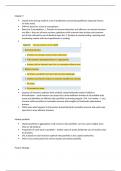
Chapter 4: Theories of Cognitive Development :
Piagets theory: Removing an objects from an infants view leads them to act like the object never existed.
Theory Main Questions Addressed
Piagetian Nature and nurture, continuity/discontinuity, the active child
Information-processing Nature and nurture, how change occurs
Core-knowledge Nature and nurture, continuity/discontinuity
Sociocultural Nature and nurture, influence of the sociocultural context, how change occurs
Dynamic-systems Nature and nurture, the active child, how change occurs
Piaget’s Theory:
Theory is detailed regarding the different stages of children's experience. A recognizable field in cognitive development
Children from birth are mentally active. Mental and physical activity both contribute to development
o Constructivist: Constructing knowledge in response to one's experience
Important processes: generating hypothesis, performing experiments, & drawing conclusions
from observations…… Child as scientist
o Children learn lessons that are important by themselves rather than by instructions
o Children intrinsically motivated to learn, do not need rewards to learn
Believe nurture not only influenced by caregivers, but by everyone around the child
Nature meaning the way the child grows to react to their nurture and the development of their senses/body
Main sources of continuity:
o Assimilation: the process where one incorporates prior knowledge in incoming information
o Accommodation: The response of improving current knowledge in response to new experiences
o Equilibration: The balance of assimilation and accommodation to create a stable understanding. 3 phases
Equilibrium: the satisfaction of the understanding of a phenomenon
Disequilibrium: The realization that ones prior knowledge was inadequate. Confused
Development of a more sophisticated understanding
Characteristics of discontinuity (Piagets stages of development):
o Qualitative change: Age causes a difference in qualitative thought process- a change in moral judgements
on entirely different criteria
o Broad Applicability: The characteristics of the types of thinking children go through regarding diverse
topics and contexts
o Brief Transitions: the fluctuation of thinking- switching between new, advanced stages of think to the
characteristics of the old one
o Invariant Sequence: progressing through the stages in the same order without skipping any of them
The 4 Stages of Development:
o Sensorimotor stage; (0-2) intelligence expressed through sensory and motor abilities. Learning concepts
like time, space & causality
Infants are adaptive- From birth sucks anything the same way, few weeks sucking becomes
adjustable to the object in their mouth
Their reflexes become part of a larger behaviour when they get older (from sticking out hands to
grasping an object)
, By late 1st year infants begin to grasp object permanence but is fragile
A-not-B error: the tendency to reach for a hidden object where it was last found rather
than in the new location where it was last hidden.
By 18-24 months infants form mental representations
Deferred imitation: repetition of other people’s behaviour a substantial time after it
originally occurred.
Moving on from out of sight, out of mind thinking
o Preoperational Stage (2-7): Can represent their experiences in language and mental imagery, but still
unable to perform mental operations (understanding simple)
They develop symbolic representations. The older they get, the more conventional the symbols
become
They become less egocentric as they grow (perceiving the world solely from their point of view)
They focus a lot on centration (the tendency to focus on a single, perceptually striking feature of
an object or event)
Conservation-of-liquid-quantity
o 4-5 yr olds answers that the change in glasses changes the quantity of the liquid
o The older they get, the more they understand these physics
o Concrete operational Stage (7 -12): A better understanding of physics is seen but unable to follow
through using scientific method
can solve tasks like conservation tasks although other tasks limited
Understands that events are often influenced by multiple factors
pendulum experiment:
experiment that focuses on factors influencing the swinging of the pendulum
will say weight is the most important factor but often the experiments conducted to verify
it will not be related and concrete evidence
o Formal Operational Stage (12+): Think deeply about concrete and hypothetical situations, & can
conduct experiments with understanding
Not universal like all the other stages, some people are more likely to follow through with
enriched thinking
understands politics, ethics, and science fiction about alternative political and ethical systems
o Weakness:
The theory is vague about mechanisms that help with growth and thinking
Infants and young children are more cognitively competent than Piaget recognized.
Piaget’s theory understates the contribution of the social world to cognitive development
The stage model depicts children’s thinking as being more consistent than it is
Information Processing Theories:
a class of theories that focus on the structure of the cognitive system and the mental activities used to deploy attention and
memory to solve problems.
Two Features of these theories:
Task analysis: technique of specifying the goals, obstacles to their realization, and potential solution strategies
involved in problem solving
o Researchers focus on children’s task analysis to calculate the level of development of the child
Thinking is a process that occurs over time
Theorists see development as a continuous timeline, contrast to Piaget’s theories
Time causes children to learn and mature their thinking
Children are also active problem solvers; they typically follow a goal-obstacle-strategy problem solving sequence
Change in mechanisms:
Piagets theory: Removing an objects from an infants view leads them to act like the object never existed.
Theory Main Questions Addressed
Piagetian Nature and nurture, continuity/discontinuity, the active child
Information-processing Nature and nurture, how change occurs
Core-knowledge Nature and nurture, continuity/discontinuity
Sociocultural Nature and nurture, influence of the sociocultural context, how change occurs
Dynamic-systems Nature and nurture, the active child, how change occurs
Piaget’s Theory:
Theory is detailed regarding the different stages of children's experience. A recognizable field in cognitive development
Children from birth are mentally active. Mental and physical activity both contribute to development
o Constructivist: Constructing knowledge in response to one's experience
Important processes: generating hypothesis, performing experiments, & drawing conclusions
from observations…… Child as scientist
o Children learn lessons that are important by themselves rather than by instructions
o Children intrinsically motivated to learn, do not need rewards to learn
Believe nurture not only influenced by caregivers, but by everyone around the child
Nature meaning the way the child grows to react to their nurture and the development of their senses/body
Main sources of continuity:
o Assimilation: the process where one incorporates prior knowledge in incoming information
o Accommodation: The response of improving current knowledge in response to new experiences
o Equilibration: The balance of assimilation and accommodation to create a stable understanding. 3 phases
Equilibrium: the satisfaction of the understanding of a phenomenon
Disequilibrium: The realization that ones prior knowledge was inadequate. Confused
Development of a more sophisticated understanding
Characteristics of discontinuity (Piagets stages of development):
o Qualitative change: Age causes a difference in qualitative thought process- a change in moral judgements
on entirely different criteria
o Broad Applicability: The characteristics of the types of thinking children go through regarding diverse
topics and contexts
o Brief Transitions: the fluctuation of thinking- switching between new, advanced stages of think to the
characteristics of the old one
o Invariant Sequence: progressing through the stages in the same order without skipping any of them
The 4 Stages of Development:
o Sensorimotor stage; (0-2) intelligence expressed through sensory and motor abilities. Learning concepts
like time, space & causality
Infants are adaptive- From birth sucks anything the same way, few weeks sucking becomes
adjustable to the object in their mouth
Their reflexes become part of a larger behaviour when they get older (from sticking out hands to
grasping an object)
, By late 1st year infants begin to grasp object permanence but is fragile
A-not-B error: the tendency to reach for a hidden object where it was last found rather
than in the new location where it was last hidden.
By 18-24 months infants form mental representations
Deferred imitation: repetition of other people’s behaviour a substantial time after it
originally occurred.
Moving on from out of sight, out of mind thinking
o Preoperational Stage (2-7): Can represent their experiences in language and mental imagery, but still
unable to perform mental operations (understanding simple)
They develop symbolic representations. The older they get, the more conventional the symbols
become
They become less egocentric as they grow (perceiving the world solely from their point of view)
They focus a lot on centration (the tendency to focus on a single, perceptually striking feature of
an object or event)
Conservation-of-liquid-quantity
o 4-5 yr olds answers that the change in glasses changes the quantity of the liquid
o The older they get, the more they understand these physics
o Concrete operational Stage (7 -12): A better understanding of physics is seen but unable to follow
through using scientific method
can solve tasks like conservation tasks although other tasks limited
Understands that events are often influenced by multiple factors
pendulum experiment:
experiment that focuses on factors influencing the swinging of the pendulum
will say weight is the most important factor but often the experiments conducted to verify
it will not be related and concrete evidence
o Formal Operational Stage (12+): Think deeply about concrete and hypothetical situations, & can
conduct experiments with understanding
Not universal like all the other stages, some people are more likely to follow through with
enriched thinking
understands politics, ethics, and science fiction about alternative political and ethical systems
o Weakness:
The theory is vague about mechanisms that help with growth and thinking
Infants and young children are more cognitively competent than Piaget recognized.
Piaget’s theory understates the contribution of the social world to cognitive development
The stage model depicts children’s thinking as being more consistent than it is
Information Processing Theories:
a class of theories that focus on the structure of the cognitive system and the mental activities used to deploy attention and
memory to solve problems.
Two Features of these theories:
Task analysis: technique of specifying the goals, obstacles to their realization, and potential solution strategies
involved in problem solving
o Researchers focus on children’s task analysis to calculate the level of development of the child
Thinking is a process that occurs over time
Theorists see development as a continuous timeline, contrast to Piaget’s theories
Time causes children to learn and mature their thinking
Children are also active problem solvers; they typically follow a goal-obstacle-strategy problem solving sequence
Change in mechanisms: