Notes on the lectures from the course (2022) Introduction to Comparative Politics. INCLUDES
lectures 1-12 and review sessions (Total: 31 pages).
1
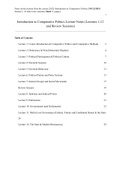
Introduction to Comparative Politics Lecture Notes (Lectures 1-12
and Review Sessions)
Table of Contents
Lecture 1: Course Introduction & Comparative Politics and Comparative Methods 2
Lecture 2: Democracy & Non-Democratic Regimes 4
Lecture 3: Political Participation & Political Culture 7
Lecture 4: Electoral Systems 10
Lecture 5: Electoral Behaviour 13
Lecture 6: Political Parties and Party Systems 15
Lecture 7: Interest Groups and Social Movements 17
Review Session 19
Lecture 8: Judiciary and Judicial Power 20
Lecture 9: Parliaments 21
Lecture 10: Governments (and Parliaments) 23
Lecture 11: Multi-Level Governance (Federal, Unitary and Confederal States) & the State
26
Lecture 12: The State & Modern Bureaucracy 29
, 2
Lecture 1: Course Introduction & Comparative Politics and Comparative
Methods
Comparative Politics
Different fields in the social sciences:
Political Theory International Relations (IR) Comparative Politics
● Normative ● Empirical questions ● Empirical questions
questions ● “What causes war?” ● “Why do certain types of
● “What is ● Mostly on state political participation prevail in
democracy?” interactions. some countries more than
others?”
● Mostly on political systems.
Comparative Politics: An important subfield of political science studying and empirically analysing
the similarities and differences across political systems and political structures, actors and processes.
➔ Has some major implications in that it is defined by its substance (that can be very broad)
and method.
Reasons for comparison:
1. Gather knowledge about other countries; learn about other countries and more closely (even
indirectly) one’s own country.
2. Description, classification and typologies; allows for a clustering/identification of differences
into groups sharing common attributes.
➔ This is important as it forms the basis of a sound comparative analysis.
3. Hypothesis testing; political science is full of different propositions that offer explanations to
particular phenomena.
➔ The problem here is that they are just hypotheses; comparative politics simply
investigates whether they are valid or not.
4. Prediction; comparative knowledge allows for predictions about certain phenomena.
Concepts: Ideas/terms with a clear defitionional structure. Most controversy in political science
comes from these concepts when explaining a particular phenomenon. They matter because:
1. They give meaning to reality and are tools for thinking, reasoning, arguing and analysing.
➔ E.g. when thinking of the state:
◆ Non-conceptually = political unit with a flag, territory and national anthem.
◆ Conceptually = a set of ideas of organising power in a territorial sense, a
unified authority holding a monopoly on the means of violence (more on the
state and inter-state relations).
2. The use of concepts sets apart from the imprecise world of practical (or beer)
politics/advocacy.
Comparative Methods
Comparative Methods: Rules and standards of comparative analysis.
➔ “How should a comparison be carried about to improve a description, classification, theory
or prediction?”
➔ Issues in comparative politics:
, 3
1. It focuses on very different units of analysis, ranging from a country, sub-national or
a supra-national level of analysis.
2. There is NO one comparative method; it depends on the number of cases employed.
Methods in comparative politics (based on Arend Lijphart’s 1971 categorisation):
1. Case Study Method: An intensive examination of one particular case and the context in
which it exists.
➔ Lijphart suggests that this method is NOT comparative. HOWEVER, the truth is that
it depends on the specification/objective of the studied case.
➔ Has an obvious advantage in that it is holistic and sensitive to context.
➔ Major disadvantage regarding the generalisation of studies.
➔ Two types of interesting/important case studies:
1. Deviant Case Study: Identities and examines an exception to what is
generally expected from an established theory. Useful in comparative politics
to refine the analysis and build up new theories.
2. Theory-Testing Case Study: Probe a theory in a new empirical context to
which it is supposed to apply.
2. Comparative Method: A systematic analysis of a small number of cases (small-N analysis)
that can lead to an import
➔ E.g. Small States in World Markets by Peter J. Katzenstein; why are small European
countries economically more successful than their larger and economically more
powerful neighbours? Focused on seven countries that followed a corporatist model
of policy-making.
➔ Problems:
◆ Too few cases, too many variables ⇒ has two solutions:
1. Increases number of cases (N)
2. Use Most Similar System Design (MSSD); control for all other
possible factors by choosing similar groups. HOWEVER, even this
faces the problem that there may be other factors that affect a
conclusion.
◆ Selection on dependent variables (DV); selecting specific cases to the study
⇒ has one solution:
1. Use Most Dissimilar System Design (MDSD); select groups that are
very different in all other aspects and isolate them based on one
common variable. This has the advantage that it reaches more
robust conclusions. HOWEVER, problems with the sensitivity to
context and uncertainty regarding the representation in the wider
phenomenon.
3. Statistical Method: A comparative method based on a large-N of cases. It uses statistical
techniques to examine relationships between variables. The difference between this method
and other comparative methods is that it:
1. Relies on numerical methods when measuring the DV and independent variables
(IV).
2. Does NOT derive a conclusion from interpretive reasoning, but from a statistical
analysis.
The experimental method is left out, as it is NOT frequently used and is limited in its scope within
comparative politics.
lectures 1-12 and review sessions (Total: 31 pages).
1
Introduction to Comparative Politics Lecture Notes (Lectures 1-12
and Review Sessions)
Table of Contents
Lecture 1: Course Introduction & Comparative Politics and Comparative Methods 2
Lecture 2: Democracy & Non-Democratic Regimes 4
Lecture 3: Political Participation & Political Culture 7
Lecture 4: Electoral Systems 10
Lecture 5: Electoral Behaviour 13
Lecture 6: Political Parties and Party Systems 15
Lecture 7: Interest Groups and Social Movements 17
Review Session 19
Lecture 8: Judiciary and Judicial Power 20
Lecture 9: Parliaments 21
Lecture 10: Governments (and Parliaments) 23
Lecture 11: Multi-Level Governance (Federal, Unitary and Confederal States) & the State
26
Lecture 12: The State & Modern Bureaucracy 29
, 2
Lecture 1: Course Introduction & Comparative Politics and Comparative
Methods
Comparative Politics
Different fields in the social sciences:
Political Theory International Relations (IR) Comparative Politics
● Normative ● Empirical questions ● Empirical questions
questions ● “What causes war?” ● “Why do certain types of
● “What is ● Mostly on state political participation prevail in
democracy?” interactions. some countries more than
others?”
● Mostly on political systems.
Comparative Politics: An important subfield of political science studying and empirically analysing
the similarities and differences across political systems and political structures, actors and processes.
➔ Has some major implications in that it is defined by its substance (that can be very broad)
and method.
Reasons for comparison:
1. Gather knowledge about other countries; learn about other countries and more closely (even
indirectly) one’s own country.
2. Description, classification and typologies; allows for a clustering/identification of differences
into groups sharing common attributes.
➔ This is important as it forms the basis of a sound comparative analysis.
3. Hypothesis testing; political science is full of different propositions that offer explanations to
particular phenomena.
➔ The problem here is that they are just hypotheses; comparative politics simply
investigates whether they are valid or not.
4. Prediction; comparative knowledge allows for predictions about certain phenomena.
Concepts: Ideas/terms with a clear defitionional structure. Most controversy in political science
comes from these concepts when explaining a particular phenomenon. They matter because:
1. They give meaning to reality and are tools for thinking, reasoning, arguing and analysing.
➔ E.g. when thinking of the state:
◆ Non-conceptually = political unit with a flag, territory and national anthem.
◆ Conceptually = a set of ideas of organising power in a territorial sense, a
unified authority holding a monopoly on the means of violence (more on the
state and inter-state relations).
2. The use of concepts sets apart from the imprecise world of practical (or beer)
politics/advocacy.
Comparative Methods
Comparative Methods: Rules and standards of comparative analysis.
➔ “How should a comparison be carried about to improve a description, classification, theory
or prediction?”
➔ Issues in comparative politics:
, 3
1. It focuses on very different units of analysis, ranging from a country, sub-national or
a supra-national level of analysis.
2. There is NO one comparative method; it depends on the number of cases employed.
Methods in comparative politics (based on Arend Lijphart’s 1971 categorisation):
1. Case Study Method: An intensive examination of one particular case and the context in
which it exists.
➔ Lijphart suggests that this method is NOT comparative. HOWEVER, the truth is that
it depends on the specification/objective of the studied case.
➔ Has an obvious advantage in that it is holistic and sensitive to context.
➔ Major disadvantage regarding the generalisation of studies.
➔ Two types of interesting/important case studies:
1. Deviant Case Study: Identities and examines an exception to what is
generally expected from an established theory. Useful in comparative politics
to refine the analysis and build up new theories.
2. Theory-Testing Case Study: Probe a theory in a new empirical context to
which it is supposed to apply.
2. Comparative Method: A systematic analysis of a small number of cases (small-N analysis)
that can lead to an import
➔ E.g. Small States in World Markets by Peter J. Katzenstein; why are small European
countries economically more successful than their larger and economically more
powerful neighbours? Focused on seven countries that followed a corporatist model
of policy-making.
➔ Problems:
◆ Too few cases, too many variables ⇒ has two solutions:
1. Increases number of cases (N)
2. Use Most Similar System Design (MSSD); control for all other
possible factors by choosing similar groups. HOWEVER, even this
faces the problem that there may be other factors that affect a
conclusion.
◆ Selection on dependent variables (DV); selecting specific cases to the study
⇒ has one solution:
1. Use Most Dissimilar System Design (MDSD); select groups that are
very different in all other aspects and isolate them based on one
common variable. This has the advantage that it reaches more
robust conclusions. HOWEVER, problems with the sensitivity to
context and uncertainty regarding the representation in the wider
phenomenon.
3. Statistical Method: A comparative method based on a large-N of cases. It uses statistical
techniques to examine relationships between variables. The difference between this method
and other comparative methods is that it:
1. Relies on numerical methods when measuring the DV and independent variables
(IV).
2. Does NOT derive a conclusion from interpretive reasoning, but from a statistical
analysis.
The experimental method is left out, as it is NOT frequently used and is limited in its scope within
comparative politics.