OB-Study Guide by chapters Ch1-to-Ch19 goodstuff.docx
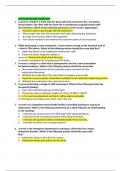
Chapter 1: Trends and Issues Multiple Choice 1. Since 1995 there has been a significant decrease in the rate of infant death related to which of the following: a. Disorders associated with short gestation and low birth weight b. Accidents c. Sudden infant death d. Newborns affected by complications of placenta, cord, and membranes ANS: c Feedback a. The rates of prematurity and low birth weight are increasing. b. The rates of accidents have increased. c. Correct. The rate of infant death related to SIDS has decreased from 87.1 to 47.2. The decrease in rate is partially attributed to placing infants on their backs when sleeping. d. The rates of newborns affected by complications of placenta, cord, and membranes have increased. 2. Tobacco use during pregnancy is associated with adverse effects on the unborn infant such as intrauterine growth restriction, preterm births, and respiratory problems. By race, which has the highest percentages of smokers? a. American Indian and Alaskan Natives b. Asian or Pacific Islanders c. Non-Hispanic blacks d. Non-Hispanic whites ANS: a Feedback a. 36% of American Indian and Native American women are cigarette smokers. b. 4.3% of Asian or Pacific Islander women are cigarette smokers. c. 17.1% of non-Hispanic black women are cigarette smokers. d. 19.6% of non-Hispanic white women are cigarette smokers. 3. Which of the following women is at the highest risk for health disparity? a. A white, middle-class, 16-year-old woman OB-Study Guide by chapters Ch1-to-Ch19 b. An African American, middle-class, 25-year-old woman c. An African American, upper-middle-class, 19-year-old woman d. An Asian, low-income, 30-year-old woman ANS: d Feedback a. Although age is a risk factor, income contributes to disparity. b. Although African American women are at increased risk, income accounts for the largest disparity. c. Although age and race contribute to increased risk, income accounts for the largest disparity. d. Although age and race contribute to increased risk, income accounts for the largest disparity. 4. A neonate born at 36 weeks gestation is classified as which of the following? a. Very premature b. Moderately premature c. Late premature d. Term ANS: c Feedback a. Very premature is less than 32 weeks’ gestation. b. Moderately premature is 32 to 33 completed weeks’ gestation. c. Correct. Late premature is 34 to 36 completed weeks’ gestation. d. Term is 37 to 42 weeks’ gestation. 5. The perinatal nurse explains to the student nurse that a goal of the Healthy People 2020 report is to: a. Increase proportion of infants who are breastfed to 93.1%. b. Increase proportion of infants who are breastfed to 90.7%. c. Increase proportion of infants who are breastfed to 85.6%. d. Increase proportion of infants who are breastfed to 83.9%. ANS: d A goal of Healthy People 2020 is to increase the proportion of infants who are breastfed from 74% to 81.9%. 6. The perinatal nurse explains to the student nurse that __________ is the leading cause of infant death in the United States. a. Sudden Infant Death Syndrome b. Respiratory distress of newborns c. Disorders related to short gestation and low birth weight d. Congenital malformations and chromosomal abnormalities ANS: d Multiple Response 7. Which of the following statements are true related to teen pregnancies? (Select all that apply.) a. Teen mothers are at higher risk for HIV. b. Teen mothers are at higher risk for hypertensive problems. c. The birth rate for teenaged women has increased in the past 15 years. d. Infants born to teen mothers are at higher risk for health problems. ANS: a, b, d Health statistics report higher risk for HIV, for hypertensive problems, and for health problems to infants born to teen mothers. Birth rates for teen mothers in all age categories have decreased since 1991. Chapter 2: Ethics and Standards of Practice Issues Multiple Choice 1. An ethical dilemma unique to perinatal nursing is the:a. Innate conflict between maternal and fetal rights b. Intensive use of technologyc. Shortage of health-care resourcesd. Risk of violation of the principle of veracity ANS: a Feedback a. A unique aspect of maternity nursing is that the nurse advocates for two individuals: the woman and the fetus. b. The use of technology is not unique to perinatal nursing. c. Currently, in the United States, decisions in perinatal nursing are not based on resources available. d. In perinatal nursing, the obligation to tell the truth is generally adhered to. 2. The American Nurses Association Code of Ethics for Nurses directs nurses to provide patient care that is:a. Curativeb. Utilitarianc. Negotiabled. Respectful ANS: d Feedback a. Adaptation rather than cure is the goal of nursing. b. Nursing does not define the value of a person by his or her utility. c. The Code of Ethics outlines the nursing profession’s nonnegotiable ethical standard. d. Respect for the inherent dignity, worth, and uniqueness of every individual is part of the Code of Ethics. 3. Evidence-based practice is the integration of the best: a. Randomized clinical trials, clinical expertise, and patients’ requestsb. Research evidence, clinical expertise, and patients’ valuesc. Quantitative research, clinical expertise, and patients’ preferencesd. Research findings, clinical experience, and patients’ preferences ANS: b Feedback a. Evidence-based practice is the use of evidence that may include research beyond randomized clinical trials. b. These elements are the accepted definition of evidence-based practice. c. Qualitative research, as well as quantitative research, contributes to evidence-based practice. d. Clinical expertise, as well as clinical experience, defines evidence-based practice. Multiple Response 4. Infants whose mothers were obese during pregnancy are at higher risk for which of the following? (Select all that apply.) a. Childhood diabetes b. Heart defects c. Hypospadias d. Respiratory distress ANS: a, b, c Fetuses and/or infants of women who were obese during pregnancy are at higher risk for spina bifida, health defects, anorectal atresia, hypospadias, intrauterine fetal death, birth injuries related to macrosomia, and childhood obesity and diabetes.
Written for
- Institution
- West Coast University
- Course
- OB NURS 306
Document information
- Uploaded on
- December 6, 2021
- Number of pages
- 201
- Written in
- 2021/2022
- Type
- Exam (elaborations)
- Contains
- Questions & answers
Subjects
-
ob nurs 306
-
ob study guide by chapters ch1 to ch19 goodstuffdocx