NURSING 465 ;question and answer rationale
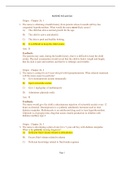
Origin: Chapter 26, 1 1. The nurse is obtaining a health history from parents whose 4-month-old boy has congenital hypothyroidism. What would the nurse most likely assess? A) The child has above-normal growth for his age. B) The child is active and playful. C) The skin is pink and healthy looking. D) It is difficult to keep the child awake. Ans: D Feedback: The parents may state, during the health history, that it is difficult to keep the child awake. Physical examination would reveal that the child is below weight and height, that his skin is pale and mottled, and that he is lethargic and irritable. Origin: Chapter 26, 2 2. The nurse is caring for an 8-year-old girl with hyperpituitarism. What ordered treatment will the nurse expect to perform? A) Give desmopressin acetate intranasally B) Inject octreotide acetate C) Give 1 mg/kg/day of methimazole D) Administer glipizide orally Ans: B Feedback: The nurse would give the child a subcutaneous injection of octreotide acetate every 12 hours as directed. Desmopressin is a synthetic antidiuretic hormone used to treat diabetes insipidus. Methimazole is an antithyroid drug used to treat hyperthyroidism. Glipizide is a hypoglycemic drug that assists insulin production in children with diabetes mellitus type 2. Origin: Chapter 26, 3 3. The nurse is developing a plan of care for a 7-year-old boy with diabetes insipidus. What is the priority nursing diagnosis? A) Deficient fluid volume related to dehydration B) Excess fluid volume related to edema C) Deficient knowledge related to fluid intake regimen D) Imbalanced nutrition, more than body requirements related to excess weight Ans: A Feedback: The priority nursing diagnosis most likely would be deficient fluid volume related to dehydration, due to a deficiency in the secretion of antidiuretic hormone (ADH). Excess fluid would result from a disorder that leads to water retention, such as syndrome of inappropriate antidiuretic hormone (SIADH). Deficient knowledge related to fluid intake regimen is a nursing diagnosis for this child, but a secondary one. Imbalanced nutrition, more than body requirements related to excess weight would be inappropriate for this child since he probably has lost weight secondary to the fluid loss. Origin: Chapter 26, 4 4. The nurse is assessing a 9-year-old girl with a history of tuberculosis at age 6 years. She has been losing weight and has no appetite. The nurse suspects Addison disease based on which assessment findings? A) Arrested height and increased weight B) Thin, fragile skin and multiple bruises C) Hyperpigmentation and hypotension D) Blurred vision and enuresis Ans: C Feedback: Hyperpigmentation and hypotension would point to Addison disease. Arrested height and increased weight are typical of acquired hypothyroidism; this girl has lost weight. Thin, fragile skin and multiple bruises are indicative of Cushing syndrome. Blurred vision, headaches, and enuresis would be complaints of a child with diabetes mellitus. Origin: Chapter 26, 5 5. The nurse is caring for a 13-year-old girl with delayed puberty. Based on the nurse's knowledge of this condition, the nurse would include which nursing diagnosis in the child's plan of care? A) Disabled family coping related to the child's disorder B) Imbalanced nutrition, less than body requirements related to the child's short stature C) Noncompliance related to the need for lifelong hormone therapy D) Deficient knowledge related to the administration of estradiol Ans: D Feedback: Deficient knowledge related to the administration of estradiol is an appropriate nursing diagnosis for this child. There are oral, transdermal, topical, injectable, and vaginal preparations available. Disabled family coping due to the child's disorder and noncompliance due to long-term therapy are not likely diagnoses because of the simplicity and brevity of the treatment for this disorder. Imbalanced nutrition evidenced by short stature would be appropriate for a child with growth hormone deficiency. Origin: Chapter 26, 6 6. The nurse is preparing a teaching plan for the family and their 6-year-old son who has just been diagnosed with diabetes mellitus. What would the nurse identify as the initial goal for the teaching plan? A) Developing management and decision-making skills B) Educating the parents about diabetes mellitus type 1 C) Developing a nutritionally sound, 30-day meal plan D) Promoting independence with self-administration of insulin Ans: A Feedback: Developing basic management and decision-making skills related to the diabetes is the initial goal of the teaching plan for this child and family. The nurse would have provided a basic description of the disorder after it was diagnosed. Development of a detailed monthly meal plan would come later, perhaps after consulting with a nutritionist. It is too soon to expect the boy to administer his own insulin. Origin: Chapter 26, 7 7. The nurse is caring for an 8-year-old girl with an endocrine disorder involving the posterior pituitary gland. What care would the nurse expect to implement? A) Instructing the parents to report adverse reactions to the growth hormone treatment B) Teaching the parents how to administer the desmopressin acetate C) Informing the parents that treatment stops when puberty begins D) Educating the parents to report signs of acute adrenal crisis Ans: B Feedback: The nurse would teach the parents how to administer desmopressin acetate, which treats diabetes insipidus, a disorder related to the posterior pituitary gland. Instructing parents to report adverse reactions to growth hormone is an intervention for growth hormone deficiency. Informing the parents that treatment stops at the normal time of puberty is a teaching intervention for precocious puberty. Educating the parents to report signs of an acute adrenal crisis is an intervention for congenital adrenal hyperplasia. All three of these other disorders are related to the anterior pituitary. Origin: Chapter 26, 8 8. The nurse is assessing a 13-year-old boy with type 2 diabetes mellitus. What would the nurse correlate with disorder? A) The parents report that their child had "a cold or flu" recently. B) Blood pressure is decreased when checking vital signs. C) The parents report that their son "can't drink enough water." D) Auscultation reveals Kussmaul breathing. Ans: C Feedback: Unquenchable thirst (polydipsia) is a common finding associated with diabetes mellitus, type 1 and 2. However, reports of flu-like illness and Kussmaul breathing are more commonly associated with type 1 diabetes. Blood pressure is normal with type 1 diabetes and elevated with type 2 diabetes. Origin: Chapter 26, 9 9. The nurse is preparing a teaching plan for a 10-year-old girl with hyperthyroidism. What information would the nurse include in the plan? A) Describing surgery to remove an anterior pituitary tumor B) Teaching her parents to give injections of growth hormone C) Explaining about the radioactive iodine procedure D) Showing her parents how to give DDAVP intranasally Ans: C Feedback: Explaining about the radioactive iodine procedure would be part of the teaching plan for a child with hyperthyroidism because this is a less invasive type of therapy for the disorder. Describing surgery to remove an anterior pituitary tumor would be included for a child with hyperpituitarism. Teaching a parent to give injections of growth hormone would be appropriate for a child with a growth hormone deficiency. Showing parents how to give DDAVP intranasally is appropriate for a child with diabetes insipidus. Origin: Chapter 26, 10 10. What finding would the nurse expect to assess in a child with hypothyroidism? A) Nervousness B) Heat intolerance C) Smooth velvety skin D) Weight gain Ans: D Feedback: Hypothyroidism is manifested by weight gain, fatigue, cold intolerance, and dry skin. Nervousness, heat intolerance, and smooth velvety skin are associated with hyperthyroidism.
Written for
- Institution
- Manchester Community College
- Course
- NURSING 465
Document information
- Uploaded on
- November 9, 2021
- Number of pages
- 95
- Written in
- 2021/2022
- Type
- Exam (elaborations)
- Contains
- Questions & answers
Subjects
-
origin chapter 26
-
1 1 the nurse is obtaining a health history from parents whose 4 month old boy has congenital hypothyroidism what would the nurse most likely assess a the child has above norm

Also available in package deal