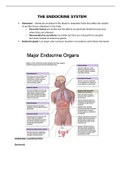
THE ENDOCRINE SYSTEM
Hormones – chemicals circulated in the blood or lymphatic fluids that affect the activity
of another tissue elsewhere in the body
o Paracrine factors are similar but the affects are generally limited to local area
where they are released
o Neuroendocrine secretions are similar but they are released from synaptic
terminals instead of endocrine glands
Endocrine gland is an organ who’s primary function is to produce and release hormones
HORMONE CLASSIFICATION
Structural:
, HORMONE CLASSIFICATION
Lipid derived – non water soluble
o Steroid hormones (derived from cholesterol)
Produced by gonads, adrenal gland
Ex: cortisol, aldosterone, estrogen, progesterone, testosterone
o Eicosanoids (mostly paracrine factors) that are derived from arachidonic acid
ex: leukotrienes, prostaglandins
o Require a carrier protein to transport them in the blood as they are not water
soluble
o Latency = around 60-90 minutes
o Have intracellular receptors
o Bind to receptors that can alter the rate of DNA transcription = alter protein
synthesis
o Take longer to affect cel function b/w they require time for production of new
proteins
Non-lipid derived (non steroid) – water soluble
o Amino acid derivative – derived from either tyrosine or tryptophan n
o Peptide and protein – short or long chains of amino acids
o Glycoprotein – protein hormones with carbohydrate groups attached
o Mostly produced by the hypothalamus, pituitary, pineal gland, thyroid, pancreas
and parathyroid gland
o Receptors found usually on cell surface (b/w they cannot get through the PM)
o Only activate existing hormones
o Latency around 1 minute
PRINCIPLES OF HORMONE ACTION
HORMONES THAT BIND SURFACE RECEPTORS
Usually referred to as “first messenger”
The intracellular events triggered by these hormones usually involve the production of
an intracellular compound to carry out the hormone’s action
o Secondary messenger – most common is cAMP and calcium ions
Hormone-receptor complex is often linked to a G-protein on the inside of
the cell membrane; some of them activate or inhibit adenylate cyclase
which converts ATP to cAMP, at which point the cAMP activates other
enzymes or opens ion channels
HORMONES THAT ENTER THE CELL
Can physically pass through the PM to interact with receptors inside the cell
Hormones – chemicals circulated in the blood or lymphatic fluids that affect the activity
of another tissue elsewhere in the body
o Paracrine factors are similar but the affects are generally limited to local area
where they are released
o Neuroendocrine secretions are similar but they are released from synaptic
terminals instead of endocrine glands
Endocrine gland is an organ who’s primary function is to produce and release hormones
HORMONE CLASSIFICATION
Structural:
, HORMONE CLASSIFICATION
Lipid derived – non water soluble
o Steroid hormones (derived from cholesterol)
Produced by gonads, adrenal gland
Ex: cortisol, aldosterone, estrogen, progesterone, testosterone
o Eicosanoids (mostly paracrine factors) that are derived from arachidonic acid
ex: leukotrienes, prostaglandins
o Require a carrier protein to transport them in the blood as they are not water
soluble
o Latency = around 60-90 minutes
o Have intracellular receptors
o Bind to receptors that can alter the rate of DNA transcription = alter protein
synthesis
o Take longer to affect cel function b/w they require time for production of new
proteins
Non-lipid derived (non steroid) – water soluble
o Amino acid derivative – derived from either tyrosine or tryptophan n
o Peptide and protein – short or long chains of amino acids
o Glycoprotein – protein hormones with carbohydrate groups attached
o Mostly produced by the hypothalamus, pituitary, pineal gland, thyroid, pancreas
and parathyroid gland
o Receptors found usually on cell surface (b/w they cannot get through the PM)
o Only activate existing hormones
o Latency around 1 minute
PRINCIPLES OF HORMONE ACTION
HORMONES THAT BIND SURFACE RECEPTORS
Usually referred to as “first messenger”
The intracellular events triggered by these hormones usually involve the production of
an intracellular compound to carry out the hormone’s action
o Secondary messenger – most common is cAMP and calcium ions
Hormone-receptor complex is often linked to a G-protein on the inside of
the cell membrane; some of them activate or inhibit adenylate cyclase
which converts ATP to cAMP, at which point the cAMP activates other
enzymes or opens ion channels
HORMONES THAT ENTER THE CELL
Can physically pass through the PM to interact with receptors inside the cell