Notes on the lectures from the course (2021) Introduction to International Relations (IIRs).
INCLUDES lectures 1 to 12 (Total: 42 pages).
1
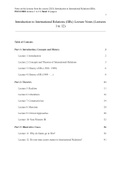
Introduction to International Relations (IIRs) Lecture Notes (Lectures
1 to 12)
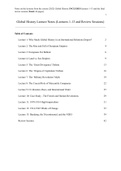
Table of Contents
Part 1: Introduction, Concepts and History 2
Lecture 1: Introduction 2
Lecture 2: Concepts and Theories of International Relations 3
Lecture 3: History of IRs (1500 - 1989) 6
Lecture 4: History of IR (1989 - …) 8
Part 2: Theories 11
Lecture 5: Realism 11
Lecture 6: Liberalism 16
Lecture 7: Constructivism 19
Lecture 8: Marxism 24
Lecture 9: Critical Approaches 28
Lecture 10: Non-Western IR 32
Part 3: Illustrative Cases 36
Lecture 11: Why do States go to War? 36
Lecture 12: Do non-state actors matter in International Relations? 41
, 2
Part 1: Introduction, Concepts and History
Lecture 1: Introduction
Further Sources:
● Additional readings on the syllabus.
● Traditional outlets:
○ Foreign Policy
○ Foreign Affairs
○ The Diplomat
○ New York Times
○ Washington Post
○ Economist
○ The Atlantic
○ Politico (US and EU editions)
● Websites and blogs:
○ Think Tanks
○ War on the rocks
○ The Monkey Cage
○ e- international relations
○ Vox
○ The Disorder of Things
○ Political Violence at a Glance
○ Relations International
● Videos and Podcasts:
○ Theory Talks
○ The Un-Diplomatic Podcast
○ Foreign Policy First Person
○ Women in Foreign Policy
○ The Truth of the Matter
○ World in 30 minutes
○ Deep Dish
○ Horns of a Dilemma
○ Power Problems
○ Sounds Strategic
○ Big World
International Relations (IRs): Has a big impact on our daily lives. We are actors in IRs, as higher
education is a transnational and global phenomenon.
Useful concepts:
● Transnationalism
● Migration
● Soft Power
● Public Diplomacy
● Sovereignty
● Hegemony
, 3
IRs in the COVID-1 Crisis:
● Realism: The COVID-19 pandemic confirmed the anarchy in world politics.
● Liberalism: Institutions and interdependence have ensured cooperation between States.
● Constructivism: COVID-19 is what States make of it (e.g. is it a foreign virus? Security issue?
Global health issue?).
CLASS OBJECTIVE: Give tools to make sense of events in our daily lives
Lecture 2: Concepts and Theories of International Relations
“Why do we need concepts?”
Concept: An academic label or a “big” category (e.g. war) that matters (it is important to ask
questions; “where are scholars coming from?” and “how do we measure them?”). However, they are
also often contested between theories. This because:
1. The definition is rarely consensual.
2. Meanings are not fixed over time (they evolve and grow outdated).
3. Of ethnocentrism. It’s criticised that concepts are defined based on the west; Eurocentric and
do not apply to other areas outside.
HOWEVER, concepts are useful, as they:
1. Make sense of complex realities (definitions help comparisons and simplify thoughts).
2. Help discuss the same things. That’s the reason why it’s very important to always define the
concepts and then build on them; make a link.
3. Helps with constructive dialogue (“not talking just past each other”).
4. Develop/evaluate theories. When causes have been agreed upon, we can develop, experiment
and test theories.
➔ Theory: A tested concept that has a causal relationship.
◆ Concept A + Concept B = Concept C
“What are theories? Why do we need them?”
Theories are necessary as real life is too complex, has too many variables, data points and moving
parts to analyze. Theories:
1. Go beyond just description.
2. Are an explanation (“what are the main factors? why?”).
3. Interpret data in-depth, more so than would be achieved by just looking at it.
4. Identify patterns and regularities across time and space.
5. Help us describe, explain, anticipate and eventually prescribe reasons for something (i.e. the
more we know, the better prediction we can make).
➔ E.g. What led to World War One (WWI)? (created In Discipline)
◆ One might argue that the reason (immediate cause) was the assassination of
Archduke Franz Ferdinand.
◆ HOWEVER, many other structural causes need to be considered
(nationalism, arms race, alliances, imperialism, power transitions, preemptive
war, etc..).
INCLUDES lectures 1 to 12 (Total: 42 pages).
1
Introduction to International Relations (IIRs) Lecture Notes (Lectures
1 to 12)
Table of Contents
Part 1: Introduction, Concepts and History 2
Lecture 1: Introduction 2
Lecture 2: Concepts and Theories of International Relations 3
Lecture 3: History of IRs (1500 - 1989) 6
Lecture 4: History of IR (1989 - …) 8
Part 2: Theories 11
Lecture 5: Realism 11
Lecture 6: Liberalism 16
Lecture 7: Constructivism 19
Lecture 8: Marxism 24
Lecture 9: Critical Approaches 28
Lecture 10: Non-Western IR 32
Part 3: Illustrative Cases 36
Lecture 11: Why do States go to War? 36
Lecture 12: Do non-state actors matter in International Relations? 41
, 2
Part 1: Introduction, Concepts and History
Lecture 1: Introduction
Further Sources:
● Additional readings on the syllabus.
● Traditional outlets:
○ Foreign Policy
○ Foreign Affairs
○ The Diplomat
○ New York Times
○ Washington Post
○ Economist
○ The Atlantic
○ Politico (US and EU editions)
● Websites and blogs:
○ Think Tanks
○ War on the rocks
○ The Monkey Cage
○ e- international relations
○ Vox
○ The Disorder of Things
○ Political Violence at a Glance
○ Relations International
● Videos and Podcasts:
○ Theory Talks
○ The Un-Diplomatic Podcast
○ Foreign Policy First Person
○ Women in Foreign Policy
○ The Truth of the Matter
○ World in 30 minutes
○ Deep Dish
○ Horns of a Dilemma
○ Power Problems
○ Sounds Strategic
○ Big World
International Relations (IRs): Has a big impact on our daily lives. We are actors in IRs, as higher
education is a transnational and global phenomenon.
Useful concepts:
● Transnationalism
● Migration
● Soft Power
● Public Diplomacy
● Sovereignty
● Hegemony
, 3
IRs in the COVID-1 Crisis:
● Realism: The COVID-19 pandemic confirmed the anarchy in world politics.
● Liberalism: Institutions and interdependence have ensured cooperation between States.
● Constructivism: COVID-19 is what States make of it (e.g. is it a foreign virus? Security issue?
Global health issue?).
CLASS OBJECTIVE: Give tools to make sense of events in our daily lives
Lecture 2: Concepts and Theories of International Relations
“Why do we need concepts?”
Concept: An academic label or a “big” category (e.g. war) that matters (it is important to ask
questions; “where are scholars coming from?” and “how do we measure them?”). However, they are
also often contested between theories. This because:
1. The definition is rarely consensual.
2. Meanings are not fixed over time (they evolve and grow outdated).
3. Of ethnocentrism. It’s criticised that concepts are defined based on the west; Eurocentric and
do not apply to other areas outside.
HOWEVER, concepts are useful, as they:
1. Make sense of complex realities (definitions help comparisons and simplify thoughts).
2. Help discuss the same things. That’s the reason why it’s very important to always define the
concepts and then build on them; make a link.
3. Helps with constructive dialogue (“not talking just past each other”).
4. Develop/evaluate theories. When causes have been agreed upon, we can develop, experiment
and test theories.
➔ Theory: A tested concept that has a causal relationship.
◆ Concept A + Concept B = Concept C
“What are theories? Why do we need them?”
Theories are necessary as real life is too complex, has too many variables, data points and moving
parts to analyze. Theories:
1. Go beyond just description.
2. Are an explanation (“what are the main factors? why?”).
3. Interpret data in-depth, more so than would be achieved by just looking at it.
4. Identify patterns and regularities across time and space.
5. Help us describe, explain, anticipate and eventually prescribe reasons for something (i.e. the
more we know, the better prediction we can make).
➔ E.g. What led to World War One (WWI)? (created In Discipline)
◆ One might argue that the reason (immediate cause) was the assassination of
Archduke Franz Ferdinand.
◆ HOWEVER, many other structural causes need to be considered
(nationalism, arms race, alliances, imperialism, power transitions, preemptive
war, etc..).