Social Psychology
CHAPTER 1: INTRODUCING SOCIAL PSYCHOLOGY
- Definition: “the scientific investigation of how the thoughts, feelings and
behaviours of individuals are influenced by the actual, imagined or implied
presence of others” (G. W. Allport, 1954)
- Aims to explain human behaviour, because it can be measured and
observed
- Definition behaviour: what humans actually do that can be objectively
measured (from running to how we dress) = publicly verifiable
- Interest also in feelings, thoughts, attitudes, intentions & goals (inferred from
behaviour) sometimes they determine behaviour à this unobservable process
subject to research (it is the psychological dimension of behaviour)
- Relating unobservable processes to cognitive processes (neuro-chemical)
- Social aspect: how are people affected by the physical presence / the implied
presence of other people à mostly concerned with face to face interaction of
individuals (differs from Individual Psychology, that investigates human
reaction to non-social stimuli)
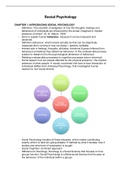
Cognitive
Psychology
Sociallingui
stics Economics
Language
Social
Psychology
Sociology Individual
Psychology
Social
Anthropolo
gy
- Social Psychology borders all these disciples, which makes constituting
exactly what it is hard (on-going debate) à defined by what it studies, how it
studies and what level of explanation is sought
- Social Cognition: dominant approach
- Difference to Sociology: Sociology is a Social Science that focuses on how
groups function, Social Psychology is a Behavioural Science that focuses on
the behaviour of the individual (within a group)
,- Social Psychology uses hypothesis, that can be falsified or supported
through empirical (experimental and non-experimental) tests à it can never
be proven, only be falsified & is always duplicable
- Experiments use dependent (measured) and independent (manipulated)
variables
- Confounding variables: when 2 or more independent variables correlate in
such a way that it is impossible to tell which has caused the effect (e.g.
showing a violent & non-violent TV content to children from abusive families)
à completely identical conditions apart from the independent variable are
crucial
- Two-factor and one-factor test designs (referring to the independent variable)
- Laboratory experiment aim to isolate a single aspect of a variable and intend
to create an artificial / controlled atmosphere à allow to establish cause-
effect relationships between variables, address theories about human social
behaviour
- Avoid demand characteristics: features that seem to ‘demand’ a specific
response à give out information about the hypothesis and manipulates
reactions (because people present themselves in their best ways)
- Experimenter effects: Because the experimenter is aware of the hypothesis,
he may give away cues to the participants à manipulates behaviour
- Double blind: to avoid experimenter effects, the experimenter doesn’t know
about the experimental conditions
- Field experience: the participants are unaware, that they are part of the
experiment, high external validity, but less control of extraneous variables
,- Non-experimental methods where experiments are impossible / inappropriate
(almost impossible to draw reliable causal conclusions)
o Archival research: for large-scale occurring phenomena, often
occurred over a long time-span. Researcher collects the data of others
(often for unconnected reasons) and makes comparisons, develops
theory. Non-reactive method, no control over the collected data
o Case studies: focuses on in-depth analysis of a single case. Involves
an array of data collection (and analysis techniques) about said case.
Well suited for rare / unusual phenomena, but cant be generalized
o Qualitative research and discourse analysis: related to case studies,
analyses largely naturally occurring behaviour in great detail. Discourse
(who said what to whom in what context) is very important to
understand the underlying narrative of the behaviour à language and
communication-based, proven to be helpful in area of prejudice
o Survey research: Data collection by (all different types of) surveys.
Helpful to obtain a large number of data from large sample group, but
can be biased by the way the survey is structured or evaluated
o Field studies: Like field experiment, but without any interventions /
manipulations. Observation, recording and coding of the behaviour as
it occurs. Experimenter is either invisible or well-integrated. Excellent
for spontaneous behaviour in its natural context, but prone to the
experimenters bias and lack generalisability
- New digital data and analysis tools, like MTurk. They provide the research
data, analysis and draw conclusions whether to support the hypothesis or
not. Analysis depends on:
o Type of data obtained (binary responses, continuous variables, ranks,
written responses etc.)
o Method to obtain data (observation, interviews, controlled experiments
etc.)
o Purpose of research (describe depth of a specific case, establish
differences between sample groups, investigate correlations etc.)
- T Test: Tests the statistical significance of a an effect in which the mean is
bigger for one conditions is bigger than for the other group (women vs. men,
friendly vs. unfriendly) / Tests whether 2 groups or more differ significantly
- Statistical significance: Defines whether the findings about differences
between groups is psychologically significant. If t < 1 in 20 it is considered to
have happened by chance
- Correlation: assesses whether to co-occurrence of 2+ variables is significant
o Positively correlated: significant difference between groups
o Negatively correlated: group findings border into each other, no
significant difference
o Un-correlated: no systematic relationship between test results
,
CHAPTER 1: INTRODUCING SOCIAL PSYCHOLOGY
- Definition: “the scientific investigation of how the thoughts, feelings and
behaviours of individuals are influenced by the actual, imagined or implied
presence of others” (G. W. Allport, 1954)
- Aims to explain human behaviour, because it can be measured and
observed
- Definition behaviour: what humans actually do that can be objectively
measured (from running to how we dress) = publicly verifiable
- Interest also in feelings, thoughts, attitudes, intentions & goals (inferred from
behaviour) sometimes they determine behaviour à this unobservable process
subject to research (it is the psychological dimension of behaviour)
- Relating unobservable processes to cognitive processes (neuro-chemical)
- Social aspect: how are people affected by the physical presence / the implied
presence of other people à mostly concerned with face to face interaction of
individuals (differs from Individual Psychology, that investigates human
reaction to non-social stimuli)
Cognitive
Psychology
Sociallingui
stics Economics
Language
Social
Psychology
Sociology Individual
Psychology
Social
Anthropolo
gy
- Social Psychology borders all these disciples, which makes constituting
exactly what it is hard (on-going debate) à defined by what it studies, how it
studies and what level of explanation is sought
- Social Cognition: dominant approach
- Difference to Sociology: Sociology is a Social Science that focuses on how
groups function, Social Psychology is a Behavioural Science that focuses on
the behaviour of the individual (within a group)
,- Social Psychology uses hypothesis, that can be falsified or supported
through empirical (experimental and non-experimental) tests à it can never
be proven, only be falsified & is always duplicable
- Experiments use dependent (measured) and independent (manipulated)
variables
- Confounding variables: when 2 or more independent variables correlate in
such a way that it is impossible to tell which has caused the effect (e.g.
showing a violent & non-violent TV content to children from abusive families)
à completely identical conditions apart from the independent variable are
crucial
- Two-factor and one-factor test designs (referring to the independent variable)
- Laboratory experiment aim to isolate a single aspect of a variable and intend
to create an artificial / controlled atmosphere à allow to establish cause-
effect relationships between variables, address theories about human social
behaviour
- Avoid demand characteristics: features that seem to ‘demand’ a specific
response à give out information about the hypothesis and manipulates
reactions (because people present themselves in their best ways)
- Experimenter effects: Because the experimenter is aware of the hypothesis,
he may give away cues to the participants à manipulates behaviour
- Double blind: to avoid experimenter effects, the experimenter doesn’t know
about the experimental conditions
- Field experience: the participants are unaware, that they are part of the
experiment, high external validity, but less control of extraneous variables
,- Non-experimental methods where experiments are impossible / inappropriate
(almost impossible to draw reliable causal conclusions)
o Archival research: for large-scale occurring phenomena, often
occurred over a long time-span. Researcher collects the data of others
(often for unconnected reasons) and makes comparisons, develops
theory. Non-reactive method, no control over the collected data
o Case studies: focuses on in-depth analysis of a single case. Involves
an array of data collection (and analysis techniques) about said case.
Well suited for rare / unusual phenomena, but cant be generalized
o Qualitative research and discourse analysis: related to case studies,
analyses largely naturally occurring behaviour in great detail. Discourse
(who said what to whom in what context) is very important to
understand the underlying narrative of the behaviour à language and
communication-based, proven to be helpful in area of prejudice
o Survey research: Data collection by (all different types of) surveys.
Helpful to obtain a large number of data from large sample group, but
can be biased by the way the survey is structured or evaluated
o Field studies: Like field experiment, but without any interventions /
manipulations. Observation, recording and coding of the behaviour as
it occurs. Experimenter is either invisible or well-integrated. Excellent
for spontaneous behaviour in its natural context, but prone to the
experimenters bias and lack generalisability
- New digital data and analysis tools, like MTurk. They provide the research
data, analysis and draw conclusions whether to support the hypothesis or
not. Analysis depends on:
o Type of data obtained (binary responses, continuous variables, ranks,
written responses etc.)
o Method to obtain data (observation, interviews, controlled experiments
etc.)
o Purpose of research (describe depth of a specific case, establish
differences between sample groups, investigate correlations etc.)
- T Test: Tests the statistical significance of a an effect in which the mean is
bigger for one conditions is bigger than for the other group (women vs. men,
friendly vs. unfriendly) / Tests whether 2 groups or more differ significantly
- Statistical significance: Defines whether the findings about differences
between groups is psychologically significant. If t < 1 in 20 it is considered to
have happened by chance
- Correlation: assesses whether to co-occurrence of 2+ variables is significant
o Positively correlated: significant difference between groups
o Negatively correlated: group findings border into each other, no
significant difference
o Un-correlated: no systematic relationship between test results
,