Chapter 3
Calculation/Short Answer Problems:
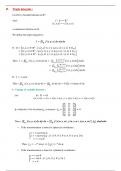
3.1 Consider a pure oxygen tank storage system for a fuel cell used in a space application.
What mass of oxygen can be stored in a 2m3 tank at 34 MPa, 20◦C. Compare the
results you get with the ideal gas law, the van der Waals EOS, and the generalized
compressibility chart. Using the generalized compressibility chart, determine at what
storage pressure the correction on the ideal gas law is 5%?
Soln:
Assuming temperature is constant:
With Ideal Gas Law (IGL):
mRuT PV
PV nRuT m MW
MW RuT
kg N
32 34 106 2 2m3
m kmol m 893.3 kg
J
8,314 293K
kmol K
Using van der Waals EOS:
RuT a RuT a
P 2 from Table 3.1, a O 2 136.95, bO 2 0.03169
vb v V V
2
b
n n
Plugging in and solving for n with iteration or equation solver, we can show:
m 888.67 kg
Using the generalized compressibility chart, Figure 3.3 (note, numbers may vary slightly
since we are reading off of the chart:
1
, PV
m MW
ZRuT
where Z is from the chart, and we need to know the reduced pressure and
temperature from Appendix A.1 to get this:
P 34
Pr 6.74
Pc 5.043
T 293
Tr 1.895
Tc 154.6
From Fig. 3.3, we find Z ~1.02, so
kg N
32 34 106 2 2m3
m kmol m 875.8 kg
J
1.02 8,314 293K
kmol K
There are two solutions to this, because the correction can be 5% when Z becomes 1.05,
or 0.95. Z = 1.05 when the reduced pressure this occurs at (for a Tr of 1.9) is ~ 8.7. The
pressure is then Pr Pc P 5.043 8.7 43.8 MPa
Z = 0.95 when the reduced pressure this occurs at (for a Tr of 1.9) is ~ 7.5. The pressure
is then Pr Pc P 5.043 7.5 37.8 MPa
Between 37.8 and 43.8 MPa, the correction is less than 5%
Instructors note: Question 3.2 is best asked with the corrections below in red, or the
answers can be too numerous to really grade.
3.2 Using the generalized compressibility chart for hydrogen (with H2 correction) and
oxygen, in what temperature and pressure range would you consider the ideal gas law
to be <95% accurate at 20oC?
Soln:
As in Question 3.1, there are two answers to this because the correction can be 5%
when Z becomes 1.05, or 0.95.
For Hydrogen, values of corrected reduced pressure: Pr 12.83 atm 8 atm Patm
T 20 273
Tr 7.11 at T = 20oC.
Tc 33.2 K 8K
Z becomes 1.05 for Tr = 7.11 at Pr ~ 4.0 so P = 83.32 atm. For hydrogen at his
temperature, Z never falls to 0.95.
2
, For Oxygen, the answer is the same as Question 3.1. Values of reduced pressure:
Pr 5.043MPa P
T 20 273
Tr 1.9 at T = 20oC.
Tc 154.6
Z = 1.05 when the reduced pressure this occurs at (for a Tr of 1.9) is ~ 8.7. The
pressure is then Pr Pc P 5.043 8.7 43.8 MPa
Z = 0.95 when the reduced pressure this occurs at (for a Tr of 1.9) is ~ 7.5. The
pressure is then Pr Pc P 5.043 7.5 37.8 MPa
Between 37.8 and 43.8 MPa, the correction is less than 5%
3.3 Complete a first-law analysis of a fuel cell system in symbols only. Include flux of
gas in and out as well as heat and electricity generated. Consider the control volume
to be the fuel cell itself.
Soln:
Q
H2 in H2 out
Air in Air out
.
W
dEcv Vi 2 Ve2
Qcv Wcv mi hi
gzi me he
gze
dt i 2 e 2
The transient term represents stored energy in the Fuel cell. The Q term represents the
rate of heat transfer via many modes (normally dominated by a coolant flow for larger
systems), which is equal to the waste heat generated by the fuel cell in steady state, the
work term represents electrical power (IVcell) done. The potential and kinetic energy
terms can normally be neglected.
3
, 3.4 Plot the relationships for molar specific heat of hydrogen, air, and water vapor given
in Eqs. (3.24), (3.27), and (3.28), respectively. Over what temperature would you
estimate that you can consider the specific heats constant?
Soln:
45
40
35
Cp (kJ/kmolK)
30
25 CP H2
CP air
20 Cp H2O
15
0 200 400 600 800 1000 1200
Temperature (K)
It would be reasonable to estimate the specific heats are constant over a 100oC or so
temperature range, using the average operational temperature. The only instance
where this may become significant in fuel cell operation is really for high temperature
fuel cells when comparing low start-up temperature operation to high temperature
operation. Even then, use of an average temperature would result in pretty reasonable
errors for a first level type of analysis. The point is unlike combustion reactions, the
fuel cell operation is over a fairly tight temperature range, and constant Cp
assumptions are mostly justified.
3.5 Do you expect gas-phase dimethyl ether (CH3OCH3) to have a greater or lower
constant-pressure specific heat than hydrogen? Why?
Soln:
Greater: There are more bonds to store energy in vibration and rotational modes with
the more complex molecule.
4
Calculation/Short Answer Problems:
3.1 Consider a pure oxygen tank storage system for a fuel cell used in a space application.
What mass of oxygen can be stored in a 2m3 tank at 34 MPa, 20◦C. Compare the
results you get with the ideal gas law, the van der Waals EOS, and the generalized
compressibility chart. Using the generalized compressibility chart, determine at what
storage pressure the correction on the ideal gas law is 5%?
Soln:
Assuming temperature is constant:
With Ideal Gas Law (IGL):
mRuT PV
PV nRuT m MW
MW RuT
kg N
32 34 106 2 2m3
m kmol m 893.3 kg
J
8,314 293K
kmol K
Using van der Waals EOS:
RuT a RuT a
P 2 from Table 3.1, a O 2 136.95, bO 2 0.03169
vb v V V
2
b
n n
Plugging in and solving for n with iteration or equation solver, we can show:
m 888.67 kg
Using the generalized compressibility chart, Figure 3.3 (note, numbers may vary slightly
since we are reading off of the chart:
1
, PV
m MW
ZRuT
where Z is from the chart, and we need to know the reduced pressure and
temperature from Appendix A.1 to get this:
P 34
Pr 6.74
Pc 5.043
T 293
Tr 1.895
Tc 154.6
From Fig. 3.3, we find Z ~1.02, so
kg N
32 34 106 2 2m3
m kmol m 875.8 kg
J
1.02 8,314 293K
kmol K
There are two solutions to this, because the correction can be 5% when Z becomes 1.05,
or 0.95. Z = 1.05 when the reduced pressure this occurs at (for a Tr of 1.9) is ~ 8.7. The
pressure is then Pr Pc P 5.043 8.7 43.8 MPa
Z = 0.95 when the reduced pressure this occurs at (for a Tr of 1.9) is ~ 7.5. The pressure
is then Pr Pc P 5.043 7.5 37.8 MPa
Between 37.8 and 43.8 MPa, the correction is less than 5%
Instructors note: Question 3.2 is best asked with the corrections below in red, or the
answers can be too numerous to really grade.
3.2 Using the generalized compressibility chart for hydrogen (with H2 correction) and
oxygen, in what temperature and pressure range would you consider the ideal gas law
to be <95% accurate at 20oC?
Soln:
As in Question 3.1, there are two answers to this because the correction can be 5%
when Z becomes 1.05, or 0.95.
For Hydrogen, values of corrected reduced pressure: Pr 12.83 atm 8 atm Patm
T 20 273
Tr 7.11 at T = 20oC.
Tc 33.2 K 8K
Z becomes 1.05 for Tr = 7.11 at Pr ~ 4.0 so P = 83.32 atm. For hydrogen at his
temperature, Z never falls to 0.95.
2
, For Oxygen, the answer is the same as Question 3.1. Values of reduced pressure:
Pr 5.043MPa P
T 20 273
Tr 1.9 at T = 20oC.
Tc 154.6
Z = 1.05 when the reduced pressure this occurs at (for a Tr of 1.9) is ~ 8.7. The
pressure is then Pr Pc P 5.043 8.7 43.8 MPa
Z = 0.95 when the reduced pressure this occurs at (for a Tr of 1.9) is ~ 7.5. The
pressure is then Pr Pc P 5.043 7.5 37.8 MPa
Between 37.8 and 43.8 MPa, the correction is less than 5%
3.3 Complete a first-law analysis of a fuel cell system in symbols only. Include flux of
gas in and out as well as heat and electricity generated. Consider the control volume
to be the fuel cell itself.
Soln:
Q
H2 in H2 out
Air in Air out
.
W
dEcv Vi 2 Ve2
Qcv Wcv mi hi
gzi me he
gze
dt i 2 e 2
The transient term represents stored energy in the Fuel cell. The Q term represents the
rate of heat transfer via many modes (normally dominated by a coolant flow for larger
systems), which is equal to the waste heat generated by the fuel cell in steady state, the
work term represents electrical power (IVcell) done. The potential and kinetic energy
terms can normally be neglected.
3
, 3.4 Plot the relationships for molar specific heat of hydrogen, air, and water vapor given
in Eqs. (3.24), (3.27), and (3.28), respectively. Over what temperature would you
estimate that you can consider the specific heats constant?
Soln:
45
40
35
Cp (kJ/kmolK)
30
25 CP H2
CP air
20 Cp H2O
15
0 200 400 600 800 1000 1200
Temperature (K)
It would be reasonable to estimate the specific heats are constant over a 100oC or so
temperature range, using the average operational temperature. The only instance
where this may become significant in fuel cell operation is really for high temperature
fuel cells when comparing low start-up temperature operation to high temperature
operation. Even then, use of an average temperature would result in pretty reasonable
errors for a first level type of analysis. The point is unlike combustion reactions, the
fuel cell operation is over a fairly tight temperature range, and constant Cp
assumptions are mostly justified.
3.5 Do you expect gas-phase dimethyl ether (CH3OCH3) to have a greater or lower
constant-pressure specific heat than hydrogen? Why?
Soln:
Greater: There are more bonds to store energy in vibration and rotational modes with
the more complex molecule.
4