

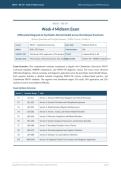
NR547 / NR-547 - Week 4 Midterm Exam Differential Diagnosis in PMHNP Practicum
NR547 / NR-547
Week 4 Midterm Exam
Differential Diagnosis in Psychiatric-Mental Health across the Lifespan Practicum
Review Questions and Verified Answers | 100% Correct | Grade A
Course: NR547 - Chamberlain University Exam Type: Midterm (Week 4)
Edition: Latest Total Questions: 100
Cognitive Mix: 25% Recall | 50% Application | 25% Analysis Format: 4-Option MCQ (A-D)
Question Style: Aligned With:
70% Scenario | 20% Direct Recall | 10% Analysis DSM-5-TR + PMHNP Competencies
Exam Overview: This comprehensive midterm examination is aligned with Chamberlain University's NR547
curriculum standards, PMHNP competencies, and DSM-5-TR diagnostic criteria. The exam covers advanced
differential diagnosis, clinical reasoning, and diagnostic application across the psychiatric-mental health lifespan.
Each question includes a detailed rationale integrating DSM-5-TR criteria, evidence-based practice, and
Chamberlain NR547 standards. The cognitive level distribution targets 25% recall, 50% application, and 25%
analysis to mirror actual midterm difficulty.
Exam Sections Overview:
Section Question Range Topic
S1 Q1-Q12 Section 1: Advanced Differential Diagnosis and Clinical Reasoning
S2 Q13-Q22 Section 2: Psychotic Disorders and Schizophrenia Spectrum
S3 Q23-Q32 Section 3: Mood Disorders (Bipolar and Depressive)
S4 Q33-Q42 Section 4: Anxiety, Trauma, and Stressor-Related Disorders
S5 Q43-Q50 Section 5: Obsessive-Compulsive and Related Disorders
S6 Q51-Q58 Section 6: Somatic Symptom, Dissociative, and Factitious Disorders
S7 Q59-Q68 Section 7: Personality Disorders Across Clusters
S8 Q69-Q78 Section 8: Neurodevelopmental and Cognitive Disorders
S9 Q79-Q88 Section 9: Substance Use and Addictive Disorders
S10 Q89-Q100 Section 10: Integrated Clinical Case Scenarios and Diagnostic Application
Chamberlain University | PMHNP Curriculum | 2026/2027 Edition Page 1
,NR547 / NR-547 - Week 4 Midterm Exam Differential Diagnosis in PMHNP Practicum
Section 1: Advanced Differential Diagnosis and Clinical Reasoning
Q1: A 34-year-old female presents with fatigue, low mood, and 12 lb weight loss over 6 weeks. She
recently emigrated from Haiti and describes her symptoms as 'semov' (a cultural concept of distress
involving spiritual disturbance). The PMHNP's BEST approach to diagnostic formulation is to:
A. Diagnose major depressive disorder and begin SSRI therapy, noting the cultural context as a secondary
factor
B. Apply DSM-5-TR criteria while integrating the cultural formulation through the Cultural
Formulation Interview, and avoid prematurely pathologizing culturally bound experiences
[CORRECT]
C. Diagnose an anxiety disorder given her spiritual interpretation of symptoms
D. Refer her to a faith healer instead of pursuing psychiatric diagnosis, since her distress is cultural rather
than biological
Correct Answer: B
Rationale: DSM-5-TR emphasizes culturally informed assessment through the Cultural Formulation Interview
(CFI). The PMHNP must integrate biological, psychological, and sociocultural data while avoiding premature
pathologization of culturally bound idioms of distress such as 'semov.' Diagnosing MDD without first exploring
the cultural meaning of symptoms would violate cultural formulation principles, while referring only to a faith
healer or diagnosing anxiety without evidence would be premature and reductionistic. The correct approach
applies DSM-5-TR criteria within the patient's cultural framework.
Q2: A 28-year-old male is brought in by police after threatening coworkers. He is agitated, verbally
aggressive, and reports auditory hallucinations telling him to 'hurt people who are watching him.' To
establish a hierarchical diagnosis, the PMHNP should FIRST:
A. Diagnose schizophrenia spectrum disorder based on the auditory hallucinations
B. Rule out substance intoxication, medical conditions, and medication-induced causes before
assigning a primary psychiatric diagnosis [CORRECT]
C. Diagnose antisocial personality disorder based on the threatening behavior
D. Begin antipsychotic medication immediately and diagnose after stabilization
Correct Answer: B
Rationale: The hierarchical diagnostic approach in DSM-5-TR requires ruling out substance-induced, medical,
and medication-induced etiologies before assigning a primary psychiatric disorder. Substance intoxication
(particularly stimulants, synthetic cannabinoids, or PCP) can present identically to a primary psychotic disorder,
and untreated medical conditions such as encephalitis or temporal lobe epilepsy can mimic psychiatric
presentations. Initiating antipsychotics without ruling out causes could obscure the diagnostic picture, and
personality disorders cannot be diagnosed during acute psychosis.
Chamberlain University | PMHNP Curriculum | 2026/2027 Edition Page 2
,NR547 / NR-547 - Week 4 Midterm Exam Differential Diagnosis in PMHNP Practicum
Q3: During a collaborative interprofessional case conference, a patient with treatment-resistant
depression, chronic pain, and polysubstance use is discussed. The team disagrees on the primary
diagnosis. The PMHNP's role in collaborative diagnostic decision-making should prioritize:
A. Asserting the psychiatric diagnosis as primary since mental health is the PMHNP's specialty
B. Deferring to the primary care provider's diagnosis since chronic pain is the presenting complaint
C. Integrating diagnostic perspectives across disciplines, clarifying how each condition contributes to
clinical presentation, and identifying which condition requires prioritized treatment [CORRECT]
D. Allowing the addiction medicine specialist to determine the primary diagnosis since substance use is
most acute
Correct Answer: C
Rationale: PMHNP competency in interprofessional practice requires integrating perspectives rather than
asserting disciplinary primacy. In complex cases with comorbid psychiatric, medical, and substance use
conditions, diagnostic prioritization should reflect clinical acuity, functional impact, and treatment readiness rather
than specialty hierarchy. The PMHNP synthesizes data to clarify how each condition contributes to presentation,
identifies the most impairing or life-threatening condition requiring priority intervention, and ensures care
coordination across disciplines. Deferring to any single specialty would compromise comprehensive diagnostic
formulation.
Q4: A 45-year-old male presents with new-onset visual hallucinations, confusion, and fluctuating level
of consciousness following a 5-day course of azithromycin for bronchitis. He has no psychiatric
history. The PMHNP's FIRST diagnostic consideration should be:
A. Brief psychotic disorder triggered by physical illness
B. Delirium secondary to medical etiology, requiring urgent medical evaluation [CORRECT]
C. Substance-induced psychotic disorder
D. Major neurocognitive disorder with Lewy bodies
Correct Answer: B
Rationale: Acute onset of fluctuating consciousness and hallucinations in a medically ill patient with no
psychiatric history is the hallmark of delirium, a medical emergency requiring urgent evaluation. DSM-5-TR
criteria for delirium include disturbance in attention and awareness that develops over a short period and fluctuates
in severity, with evidence of an underlying medical cause. Brief psychotic disorder and major neurocognitive
disorder require intact consciousness and longer duration, while substance-induced psychosis lacks the hallmark
attentional disturbance. Misdiagnosing delirium as a primary psychiatric disorder can delay life-saving medical
intervention.
Chamberlain University | PMHNP Curriculum | 2026/2027 Edition Page 3
, NR547 / NR-547 - Week 4 Midterm Exam Differential Diagnosis in PMHNP Practicum
Q5: A 52-year-old male is being evaluated for disability determination and exaggerates psychiatric
symptoms to secure benefits. Assessment reveals inconsistencies between reported symptoms and
observed behavior. Which diagnostic formulation BEST captures malingering?
A. Factitious disorder, since the patient is intentionally producing symptoms
B. Somatic symptom disorder, since the patient is preoccupied with illness
C. Malingering, characterized by intentional production of false or exaggerated symptoms motivated
by external incentives [CORRECT]
D. Conversion disorder, since the symptoms are not consciously produced
Correct Answer: C
Rationale: Malingering is defined by the intentional production of false or grossly exaggerated symptoms
motivated by external incentives such as financial compensation, avoidance of work, or obtaining medications.
Unlike factitious disorder, where motivation is the sick role itself, malingering has a clear external secondary gain.
Somatic symptom disorder involves genuine distress without intentional falsification, and conversion disorder
features unconscious symptom production. The key differentiator is conscious intentionality combined with
external motivation, which the disability-seeking context confirms.
Q6: A 19-year-old female college student presents with depressed mood, anhedonia, and passive
suicidal ideation following a romantic breakup 3 weeks ago. She reports insomnia, decreased appetite,
and difficulty concentrating, but is able to attend classes. She has no prior psychiatric history. The
MOST appropriate DSM-5-TR diagnosis is:
A. Major depressive disorder, single episode, mild
B. Adjustment disorder with depressed mood [CORRECT]
C. Persistent depressive disorder (dysthymia)
D. Unspecified depressive disorder
Correct Answer: B
Rationale: DSM-5-TR criteria for adjustment disorder require the development of emotional or behavioral
symptoms within 3 months of an identifiable stressor, with clinically significant distress exceeding expected
reaction or functional impairment. The patient's symptoms began 3 weeks ago following a clearly identifiable
stressor (breakup) and cause distress but do not fully meet MDD criteria, which requires at least 5 symptoms
persisting for at least 2 weeks. Persistent depressive disorder requires at least 2 years of symptoms, and unspecified
depressive disorder is reserved for cases not meeting criteria for any specific depressive disorder.
Chamberlain University | PMHNP Curriculum | 2026/2027 Edition Page 4
NR547 / NR-547
Week 4 Midterm Exam
Differential Diagnosis in Psychiatric-Mental Health across the Lifespan Practicum
Review Questions and Verified Answers | 100% Correct | Grade A
Course: NR547 - Chamberlain University Exam Type: Midterm (Week 4)
Edition: Latest Total Questions: 100
Cognitive Mix: 25% Recall | 50% Application | 25% Analysis Format: 4-Option MCQ (A-D)
Question Style: Aligned With:
70% Scenario | 20% Direct Recall | 10% Analysis DSM-5-TR + PMHNP Competencies
Exam Overview: This comprehensive midterm examination is aligned with Chamberlain University's NR547
curriculum standards, PMHNP competencies, and DSM-5-TR diagnostic criteria. The exam covers advanced
differential diagnosis, clinical reasoning, and diagnostic application across the psychiatric-mental health lifespan.
Each question includes a detailed rationale integrating DSM-5-TR criteria, evidence-based practice, and
Chamberlain NR547 standards. The cognitive level distribution targets 25% recall, 50% application, and 25%
analysis to mirror actual midterm difficulty.
Exam Sections Overview:
Section Question Range Topic
S1 Q1-Q12 Section 1: Advanced Differential Diagnosis and Clinical Reasoning
S2 Q13-Q22 Section 2: Psychotic Disorders and Schizophrenia Spectrum
S3 Q23-Q32 Section 3: Mood Disorders (Bipolar and Depressive)
S4 Q33-Q42 Section 4: Anxiety, Trauma, and Stressor-Related Disorders
S5 Q43-Q50 Section 5: Obsessive-Compulsive and Related Disorders
S6 Q51-Q58 Section 6: Somatic Symptom, Dissociative, and Factitious Disorders
S7 Q59-Q68 Section 7: Personality Disorders Across Clusters
S8 Q69-Q78 Section 8: Neurodevelopmental and Cognitive Disorders
S9 Q79-Q88 Section 9: Substance Use and Addictive Disorders
S10 Q89-Q100 Section 10: Integrated Clinical Case Scenarios and Diagnostic Application
Chamberlain University | PMHNP Curriculum | 2026/2027 Edition Page 1
,NR547 / NR-547 - Week 4 Midterm Exam Differential Diagnosis in PMHNP Practicum
Section 1: Advanced Differential Diagnosis and Clinical Reasoning
Q1: A 34-year-old female presents with fatigue, low mood, and 12 lb weight loss over 6 weeks. She
recently emigrated from Haiti and describes her symptoms as 'semov' (a cultural concept of distress
involving spiritual disturbance). The PMHNP's BEST approach to diagnostic formulation is to:
A. Diagnose major depressive disorder and begin SSRI therapy, noting the cultural context as a secondary
factor
B. Apply DSM-5-TR criteria while integrating the cultural formulation through the Cultural
Formulation Interview, and avoid prematurely pathologizing culturally bound experiences
[CORRECT]
C. Diagnose an anxiety disorder given her spiritual interpretation of symptoms
D. Refer her to a faith healer instead of pursuing psychiatric diagnosis, since her distress is cultural rather
than biological
Correct Answer: B
Rationale: DSM-5-TR emphasizes culturally informed assessment through the Cultural Formulation Interview
(CFI). The PMHNP must integrate biological, psychological, and sociocultural data while avoiding premature
pathologization of culturally bound idioms of distress such as 'semov.' Diagnosing MDD without first exploring
the cultural meaning of symptoms would violate cultural formulation principles, while referring only to a faith
healer or diagnosing anxiety without evidence would be premature and reductionistic. The correct approach
applies DSM-5-TR criteria within the patient's cultural framework.
Q2: A 28-year-old male is brought in by police after threatening coworkers. He is agitated, verbally
aggressive, and reports auditory hallucinations telling him to 'hurt people who are watching him.' To
establish a hierarchical diagnosis, the PMHNP should FIRST:
A. Diagnose schizophrenia spectrum disorder based on the auditory hallucinations
B. Rule out substance intoxication, medical conditions, and medication-induced causes before
assigning a primary psychiatric diagnosis [CORRECT]
C. Diagnose antisocial personality disorder based on the threatening behavior
D. Begin antipsychotic medication immediately and diagnose after stabilization
Correct Answer: B
Rationale: The hierarchical diagnostic approach in DSM-5-TR requires ruling out substance-induced, medical,
and medication-induced etiologies before assigning a primary psychiatric disorder. Substance intoxication
(particularly stimulants, synthetic cannabinoids, or PCP) can present identically to a primary psychotic disorder,
and untreated medical conditions such as encephalitis or temporal lobe epilepsy can mimic psychiatric
presentations. Initiating antipsychotics without ruling out causes could obscure the diagnostic picture, and
personality disorders cannot be diagnosed during acute psychosis.
Chamberlain University | PMHNP Curriculum | 2026/2027 Edition Page 2
,NR547 / NR-547 - Week 4 Midterm Exam Differential Diagnosis in PMHNP Practicum
Q3: During a collaborative interprofessional case conference, a patient with treatment-resistant
depression, chronic pain, and polysubstance use is discussed. The team disagrees on the primary
diagnosis. The PMHNP's role in collaborative diagnostic decision-making should prioritize:
A. Asserting the psychiatric diagnosis as primary since mental health is the PMHNP's specialty
B. Deferring to the primary care provider's diagnosis since chronic pain is the presenting complaint
C. Integrating diagnostic perspectives across disciplines, clarifying how each condition contributes to
clinical presentation, and identifying which condition requires prioritized treatment [CORRECT]
D. Allowing the addiction medicine specialist to determine the primary diagnosis since substance use is
most acute
Correct Answer: C
Rationale: PMHNP competency in interprofessional practice requires integrating perspectives rather than
asserting disciplinary primacy. In complex cases with comorbid psychiatric, medical, and substance use
conditions, diagnostic prioritization should reflect clinical acuity, functional impact, and treatment readiness rather
than specialty hierarchy. The PMHNP synthesizes data to clarify how each condition contributes to presentation,
identifies the most impairing or life-threatening condition requiring priority intervention, and ensures care
coordination across disciplines. Deferring to any single specialty would compromise comprehensive diagnostic
formulation.
Q4: A 45-year-old male presents with new-onset visual hallucinations, confusion, and fluctuating level
of consciousness following a 5-day course of azithromycin for bronchitis. He has no psychiatric
history. The PMHNP's FIRST diagnostic consideration should be:
A. Brief psychotic disorder triggered by physical illness
B. Delirium secondary to medical etiology, requiring urgent medical evaluation [CORRECT]
C. Substance-induced psychotic disorder
D. Major neurocognitive disorder with Lewy bodies
Correct Answer: B
Rationale: Acute onset of fluctuating consciousness and hallucinations in a medically ill patient with no
psychiatric history is the hallmark of delirium, a medical emergency requiring urgent evaluation. DSM-5-TR
criteria for delirium include disturbance in attention and awareness that develops over a short period and fluctuates
in severity, with evidence of an underlying medical cause. Brief psychotic disorder and major neurocognitive
disorder require intact consciousness and longer duration, while substance-induced psychosis lacks the hallmark
attentional disturbance. Misdiagnosing delirium as a primary psychiatric disorder can delay life-saving medical
intervention.
Chamberlain University | PMHNP Curriculum | 2026/2027 Edition Page 3
, NR547 / NR-547 - Week 4 Midterm Exam Differential Diagnosis in PMHNP Practicum
Q5: A 52-year-old male is being evaluated for disability determination and exaggerates psychiatric
symptoms to secure benefits. Assessment reveals inconsistencies between reported symptoms and
observed behavior. Which diagnostic formulation BEST captures malingering?
A. Factitious disorder, since the patient is intentionally producing symptoms
B. Somatic symptom disorder, since the patient is preoccupied with illness
C. Malingering, characterized by intentional production of false or exaggerated symptoms motivated
by external incentives [CORRECT]
D. Conversion disorder, since the symptoms are not consciously produced
Correct Answer: C
Rationale: Malingering is defined by the intentional production of false or grossly exaggerated symptoms
motivated by external incentives such as financial compensation, avoidance of work, or obtaining medications.
Unlike factitious disorder, where motivation is the sick role itself, malingering has a clear external secondary gain.
Somatic symptom disorder involves genuine distress without intentional falsification, and conversion disorder
features unconscious symptom production. The key differentiator is conscious intentionality combined with
external motivation, which the disability-seeking context confirms.
Q6: A 19-year-old female college student presents with depressed mood, anhedonia, and passive
suicidal ideation following a romantic breakup 3 weeks ago. She reports insomnia, decreased appetite,
and difficulty concentrating, but is able to attend classes. She has no prior psychiatric history. The
MOST appropriate DSM-5-TR diagnosis is:
A. Major depressive disorder, single episode, mild
B. Adjustment disorder with depressed mood [CORRECT]
C. Persistent depressive disorder (dysthymia)
D. Unspecified depressive disorder
Correct Answer: B
Rationale: DSM-5-TR criteria for adjustment disorder require the development of emotional or behavioral
symptoms within 3 months of an identifiable stressor, with clinically significant distress exceeding expected
reaction or functional impairment. The patient's symptoms began 3 weeks ago following a clearly identifiable
stressor (breakup) and cause distress but do not fully meet MDD criteria, which requires at least 5 symptoms
persisting for at least 2 weeks. Persistent depressive disorder requires at least 2 years of symptoms, and unspecified
depressive disorder is reserved for cases not meeting criteria for any specific depressive disorder.
Chamberlain University | PMHNP Curriculum | 2026/2027 Edition Page 4


