

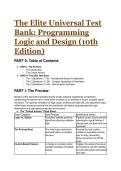
The Elite Universal Test
Bank: Programming
Logic and Design (10th
Edition)
PART 0: Table of Contents
● PART I: The Preview
○ The Introduction
○ The Critical Axioms
● PART II: The Elite Test Bank
○ Tier 1 (Questions 1–10) - Foundational Syntax & Application
○ Tier 2 (Questions 11–20) - Complex Application & Simulation
○ Tier 3 (Questions 21–30) - Grandmaster Synthesis
PART I: The Preview
Mastery of this test bank translates directly to elite software engineering competence,
transitioning the learner from a mere writer of syntax to an architect of robust, scalable logical
structures. The rigorous simulation of edge cases, architectural trade-offs, and algorithmic traps
within these scenarios ensures that the practitioner can deploy language-agnostic logic
flawlessly in any high-stakes production environment.
● The "Critical Axioms" Cheat Sheet:
Axiom Category Core Principle Architectural Impact
Logic vs. Syntax Compilers validate grammar; Flawless syntax cannot prevent
algorithmic planning validates catastrophic logical failures if
logic. pseudocode and flowcharts are
bypassed.
The Priming Read The initial input mechanism Ensures the loop control
executed before an iteration variable is evaluated correctly
structure. prior to entry, preventing
off-by-one errors and infinite
loops.
Control Break Protocol A change in a sorted control Triggers the output of previous
variable mandates immediate accumulators and the resetting
closure. of local totals before processing
new data.
,Axiom Category Core Principle Architectural Impact
Modular Purity Elite systems demand high Isolates dependencies,
cohesion and loose coupling. ensuring that a failure in one
module does not cascade into a
systemic collapse.
Object-Oriented Design Systems must enforce Protects state data, establishes
Encapsulation, Inheritance, and hierarchical "is-a" relationships,
Polymorphism. and enables dynamic execution
of overridden behaviors.
PART II: The Elite Test Bank
Tier 1 - Foundational Syntax & Application
Q1: A software engineering team is tasked with developing a financial reporting application. A
junior developer immediately begins writing language-specific code without utilizing pseudocode
or flowcharts. The resulting program compiles perfectly on the first execution but applies
incorrect tax deductions to user accounts. Based on the principles of the Program Development
Cycle, which conclusion is the MOST ACCURATE regarding this failure? A) The program
suffers from an unhandled syntax error that the compiler ignored during the build process. B)
The application contains an operating system incompatibility preventing correct mathematical
execution. C) The application contains fundamental logic errors resulting from bypassed
algorithmic planning. D) The translation from English statements to machine language was
corrupted by the interpreter.
● Answer: C (The application contains fundamental logic errors resulting from bypassed
algorithmic planning.)
● Distractor Analysis:
○ A is incorrect: Syntax errors prevent compilation entirely; since the program
compiled and executed, the syntax was technically flawless, representing a
common novice misconception that compilation equals correctness.
○ B is incorrect: Operating system incompatibilities result in execution failures,
missing dependencies, or memory crashes, not mathematically incorrect output
during a successful execution lifecycle.
○ D is incorrect: Compilers and interpreters do not arbitrarily corrupt logic during
translation; they execute the exact logical instructions provided by the developer,
however flawed those instructions may be.
The Mentor's Analysis: A compiler is completely agnostic to business rules; it only enforces
the structural grammar of the programming language. When algorithmic planning is bypassed,
developers inevitably introduce logic errors that execute perfectly at the machine level but
produce disastrous results in the business domain. The lack of structured problem-solving limits
the surface knowledge of the program, leading to domain-level failures.
Professional/Academic Intuition: Never conflate a successful compilation with a
successful program; algorithmic planning dictates logic, while compilers merely enforce
syntax.
Q2: An analyst is reviewing a payroll algorithm containing the expression netPay = grossPay -
50.00. The value 50.00 represents a fixed health insurance deduction. Based on the elements
of high-quality program design, which action should the analyst take IMMEDIATELY to improve
this architecture? A) Convert the literal constant 50.00 into an integer type to prevent
, unnecessary memory overhead during processing. B) Replace the unnamed literal constant
with a clearly identified named constant such as HEALTH_PREMIUM. C) Encapsulate the entire
mathematical expression within a nested decision structure to ensure validation. D) Change the
subtraction operation to a modular arithmetic operation to improve processing speed and
efficiency.
● Answer: B (Replace the unnamed literal constant with a clearly identified named constant
such as HEALTH_PREMIUM.)
● Distractor Analysis:
○ A is incorrect: Converting a financial deduction to an integer causes a loss of
precision (truncation), which is a catastrophic architectural error in financial
calculations.
○ C is incorrect: While validation is important in input gathering, nesting a basic
arithmetic assignment expression in a decision structure does not address the
underlying design flaw of using a magic number.
○ D is incorrect: Modular arithmetic determines the remainder of division; it is
mathematically irrelevant to calculating a net deduction, representing a severe
misunderstanding of arithmetic operators.
The Mentor's Analysis: Unnamed literal constants (often referred to as magic numbers)
obscure the developer's intent and make future modifications dangerously error-prone. By
declaring a named constant, the developer provides immediate semantic meaning,
self-documenting code, and creates a single point of maintenance for future updates across the
entire application. Professional/Academic Intuition: Code must explicitly document its own
business logic; replace all obscure literal numbers with semantically explicit named
constants.
Q3: A system processes an arithmetic expression containing integer multiplication and
floating-point division. Based on the universal rules of data types and mixing, what is the MOST
LOGICAL behavior of the compiler when evaluating this mixed-type expression? A) The
compiler will permanently alter the original variables into strings to concatenate the output
safely. B) The compiler will reject the expression entirely, as mixing data types inherently
violates fundamental machine logic. C) The compiler will temporarily perform implicit casting,
promoting the integer to a floating-point number to preserve precision. D) The compiler will
truncate the floating-point number into an integer to accelerate the mathematical processing
speed.
● Answer: C (The compiler will temporarily perform implicit casting, promoting the integer
to a floating-point number to preserve precision.)
● Distractor Analysis:
○ A is incorrect: Mathematical operations do not yield strings unless explicitly
formatted for output, nor do they permanently alter the original data type of the
source variables in memory.
○ B is incorrect: Modern compilers broadly support mixed-type arithmetic through
established promotion rules, making it a valid, albeit caution-worthy, operation in
daily programming.
○ D is incorrect: Compilers automatically promote the less precise type (integer) to
the more precise type (floating-point) to prevent data loss. Truncating down
automatically is a legacy error reflecting a deep misunderstanding of memory
allocation.
The Mentor's Analysis: When confronting mixed data types in an arithmetic expression, the
system naturally guards against data loss. It utilizes implicit casting to temporarily elevate the
Bank: Programming
Logic and Design (10th
Edition)
PART 0: Table of Contents
● PART I: The Preview
○ The Introduction
○ The Critical Axioms
● PART II: The Elite Test Bank
○ Tier 1 (Questions 1–10) - Foundational Syntax & Application
○ Tier 2 (Questions 11–20) - Complex Application & Simulation
○ Tier 3 (Questions 21–30) - Grandmaster Synthesis
PART I: The Preview
Mastery of this test bank translates directly to elite software engineering competence,
transitioning the learner from a mere writer of syntax to an architect of robust, scalable logical
structures. The rigorous simulation of edge cases, architectural trade-offs, and algorithmic traps
within these scenarios ensures that the practitioner can deploy language-agnostic logic
flawlessly in any high-stakes production environment.
● The "Critical Axioms" Cheat Sheet:
Axiom Category Core Principle Architectural Impact
Logic vs. Syntax Compilers validate grammar; Flawless syntax cannot prevent
algorithmic planning validates catastrophic logical failures if
logic. pseudocode and flowcharts are
bypassed.
The Priming Read The initial input mechanism Ensures the loop control
executed before an iteration variable is evaluated correctly
structure. prior to entry, preventing
off-by-one errors and infinite
loops.
Control Break Protocol A change in a sorted control Triggers the output of previous
variable mandates immediate accumulators and the resetting
closure. of local totals before processing
new data.
,Axiom Category Core Principle Architectural Impact
Modular Purity Elite systems demand high Isolates dependencies,
cohesion and loose coupling. ensuring that a failure in one
module does not cascade into a
systemic collapse.
Object-Oriented Design Systems must enforce Protects state data, establishes
Encapsulation, Inheritance, and hierarchical "is-a" relationships,
Polymorphism. and enables dynamic execution
of overridden behaviors.
PART II: The Elite Test Bank
Tier 1 - Foundational Syntax & Application
Q1: A software engineering team is tasked with developing a financial reporting application. A
junior developer immediately begins writing language-specific code without utilizing pseudocode
or flowcharts. The resulting program compiles perfectly on the first execution but applies
incorrect tax deductions to user accounts. Based on the principles of the Program Development
Cycle, which conclusion is the MOST ACCURATE regarding this failure? A) The program
suffers from an unhandled syntax error that the compiler ignored during the build process. B)
The application contains an operating system incompatibility preventing correct mathematical
execution. C) The application contains fundamental logic errors resulting from bypassed
algorithmic planning. D) The translation from English statements to machine language was
corrupted by the interpreter.
● Answer: C (The application contains fundamental logic errors resulting from bypassed
algorithmic planning.)
● Distractor Analysis:
○ A is incorrect: Syntax errors prevent compilation entirely; since the program
compiled and executed, the syntax was technically flawless, representing a
common novice misconception that compilation equals correctness.
○ B is incorrect: Operating system incompatibilities result in execution failures,
missing dependencies, or memory crashes, not mathematically incorrect output
during a successful execution lifecycle.
○ D is incorrect: Compilers and interpreters do not arbitrarily corrupt logic during
translation; they execute the exact logical instructions provided by the developer,
however flawed those instructions may be.
The Mentor's Analysis: A compiler is completely agnostic to business rules; it only enforces
the structural grammar of the programming language. When algorithmic planning is bypassed,
developers inevitably introduce logic errors that execute perfectly at the machine level but
produce disastrous results in the business domain. The lack of structured problem-solving limits
the surface knowledge of the program, leading to domain-level failures.
Professional/Academic Intuition: Never conflate a successful compilation with a
successful program; algorithmic planning dictates logic, while compilers merely enforce
syntax.
Q2: An analyst is reviewing a payroll algorithm containing the expression netPay = grossPay -
50.00. The value 50.00 represents a fixed health insurance deduction. Based on the elements
of high-quality program design, which action should the analyst take IMMEDIATELY to improve
this architecture? A) Convert the literal constant 50.00 into an integer type to prevent
, unnecessary memory overhead during processing. B) Replace the unnamed literal constant
with a clearly identified named constant such as HEALTH_PREMIUM. C) Encapsulate the entire
mathematical expression within a nested decision structure to ensure validation. D) Change the
subtraction operation to a modular arithmetic operation to improve processing speed and
efficiency.
● Answer: B (Replace the unnamed literal constant with a clearly identified named constant
such as HEALTH_PREMIUM.)
● Distractor Analysis:
○ A is incorrect: Converting a financial deduction to an integer causes a loss of
precision (truncation), which is a catastrophic architectural error in financial
calculations.
○ C is incorrect: While validation is important in input gathering, nesting a basic
arithmetic assignment expression in a decision structure does not address the
underlying design flaw of using a magic number.
○ D is incorrect: Modular arithmetic determines the remainder of division; it is
mathematically irrelevant to calculating a net deduction, representing a severe
misunderstanding of arithmetic operators.
The Mentor's Analysis: Unnamed literal constants (often referred to as magic numbers)
obscure the developer's intent and make future modifications dangerously error-prone. By
declaring a named constant, the developer provides immediate semantic meaning,
self-documenting code, and creates a single point of maintenance for future updates across the
entire application. Professional/Academic Intuition: Code must explicitly document its own
business logic; replace all obscure literal numbers with semantically explicit named
constants.
Q3: A system processes an arithmetic expression containing integer multiplication and
floating-point division. Based on the universal rules of data types and mixing, what is the MOST
LOGICAL behavior of the compiler when evaluating this mixed-type expression? A) The
compiler will permanently alter the original variables into strings to concatenate the output
safely. B) The compiler will reject the expression entirely, as mixing data types inherently
violates fundamental machine logic. C) The compiler will temporarily perform implicit casting,
promoting the integer to a floating-point number to preserve precision. D) The compiler will
truncate the floating-point number into an integer to accelerate the mathematical processing
speed.
● Answer: C (The compiler will temporarily perform implicit casting, promoting the integer
to a floating-point number to preserve precision.)
● Distractor Analysis:
○ A is incorrect: Mathematical operations do not yield strings unless explicitly
formatted for output, nor do they permanently alter the original data type of the
source variables in memory.
○ B is incorrect: Modern compilers broadly support mixed-type arithmetic through
established promotion rules, making it a valid, albeit caution-worthy, operation in
daily programming.
○ D is incorrect: Compilers automatically promote the less precise type (integer) to
the more precise type (floating-point) to prevent data loss. Truncating down
automatically is a legacy error reflecting a deep misunderstanding of memory
allocation.
The Mentor's Analysis: When confronting mixed data types in an arithmetic expression, the
system naturally guards against data loss. It utilizes implicit casting to temporarily elevate the


