

Final Exam: NR326 / NR 326 (Latest Update 2026/2027) Mental Health | Questions and Answers | 100% Correct | Grade A - Chamb
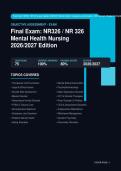
OBJECTIVE ASSESSMENT - EXAM
Final Exam: NR326 / NR 326
Mental Health Nursing
2026/2027 Edition
QUESTIONS VERIFIED ANSWERS PASSING SCORE EDITION
75 100% 80% 2026/2027
TOPICS COVERED
• Therapeutic Communication • Mental Status Examination
• Legal & Ethical Issues • Psychopharmacology
• Suicide Risk Assessment • Major Depressive Disorder
• Bipolar Disorder • ECT & Somatic Therapies
• Generalized Anxiety Disorder • Panic Disorder & Phobias
• PTSD & Trauma Care • OCD & Dissociative Disorders
• Schizophrenia Spectrum • Antipsychotic Medications
• Substance Use Disorders • Withdrawal Management
• Pediatric Mental Health • Geriatric Psychiatry
• Eating Disorders • Personality Disorders
COVER PAGE - 1
,SECTION 1: Foundations of Psychiatric-Mental Health Nursing Questions 1-15
Q1
A 34-year-old client admitted for major depressive disorder tells the nurse, "I don't think anyone
really cares what happens to me." Which therapeutic response by the nurse best demonstrates
empathy and encourages further exploration?
A. "You feel as though no one cares about you right now."
B. "Your family visited earlier today, so they obviously care."
C. "Many people with depression feel that way, but it will pass soon."
D. "Why would you say something like that when you have support?"
Correct Answer: A
Restating the client's feeling validates their experience without judgment and opens the door for deeper discussion.
Option B minimizes the client's feelings by offering contradictory evidence, while Option C offers false reassurance and
Option D places the client on the defensive.
Q2
During the initial mental status examination, a nurse observes that a client maintains poor eye
contact, has a flat affect, and responds to questions with one-word answers. These findings most
directly reflect which component of the assessment?
A. Thought process and content
B. Appearance and behavior
C. Insight and judgment
D. Sensorium and cognition
Correct Answer: B
Eye contact, affect, and verbal responsiveness are all elements of appearance and behavior in the mental status exam.
Option A refers to how thoughts are organized and what they contain, while Options C and D assess higher cognitive and
self-awareness functions.
Q3
A nurse is caring for a client who was voluntarily admitted for anxiety management. The client states
a desire to leave against medical advice. According to standard psychiatric legal principles, what is
the nurse's most appropriate initial action?
A. Notify security to prevent the client from leaving the unit
B. Inform the client of the risks of leaving and notify the provider immediately
C. Administer a PRN anxiolytic to reduce the client's distress
D. Have the client sign a liability waiver before exiting the facility
Correct Answer: B
For voluntary clients expressing intent to leave, the nurse must first inform them of medical risks and notify the provider
to assess for potential conversion to involuntary status if criteria are met. Option A is premature without provider
evaluation, and Options C and D do not address the client's right to make an informed decision.
, Q4
A newly licensed nurse expresses frustration about caring for a client with borderline personality
disorder, stating, "The client is just manipulative and doesn't really want help." Which concept
should the nurse educator emphasize to address this attitude?
A. Countertransference and the importance of self-awareness
B. The biological basis of personality disorders
C. Mandatory rotation to a different assignment
D. The client's legal right to refuse all treatment
Correct Answer: A
The nurse's negative emotional reaction represents countertransference, which requires self-awareness to prevent
compromised care. Option B, while relevant to etiology, does not directly address the nurse's attitude, and Options C and
D are inappropriate or irrelevant responses.
Q5
During a community mental health screening, a nurse interviews a 29-year-old who reports sleeping
only 3 hours nightly for three weeks, spending excessive money on electronics, and believing they
can solve world hunger. These symptoms most strongly suggest which priority nursing diagnosis?
A. Risk for self-directed violence
B. Disturbed thought processes
C. Imbalanced nutrition: less than body requirements
D. Social isolation
Correct Answer: B
The grandiose belief about solving world hunger, combined with decreased sleep and impulsive spending, indicates
disturbed thought processes consistent with mania. While Option A is always a consideration, the presented symptoms
most directly reflect cognitive disturbance rather than imminent self-harm.
Q6
A psychiatric nurse is implementing the recovery model while caring for a client with schizophrenia.
Which intervention best exemplifies this model's core philosophy?
A. Focusing primarily on symptom elimination through medication compliance
B. Collaborating with the client to identify personal goals and strengths
C. Making decisions for the client to reduce stress and prevent relapse
D. Encouraging the client to accept that full recovery is not possible
Correct Answer: B
The recovery model emphasizes client-centered care, hope, and empowerment through collaborative goal-setting.
Option A reflects the medical model, Option C promotes dependence rather than autonomy, and Option D contradicts the
recovery model's emphasis on hope and potential.
Page 3
OBJECTIVE ASSESSMENT - EXAM
Final Exam: NR326 / NR 326
Mental Health Nursing
2026/2027 Edition
QUESTIONS VERIFIED ANSWERS PASSING SCORE EDITION
75 100% 80% 2026/2027
TOPICS COVERED
• Therapeutic Communication • Mental Status Examination
• Legal & Ethical Issues • Psychopharmacology
• Suicide Risk Assessment • Major Depressive Disorder
• Bipolar Disorder • ECT & Somatic Therapies
• Generalized Anxiety Disorder • Panic Disorder & Phobias
• PTSD & Trauma Care • OCD & Dissociative Disorders
• Schizophrenia Spectrum • Antipsychotic Medications
• Substance Use Disorders • Withdrawal Management
• Pediatric Mental Health • Geriatric Psychiatry
• Eating Disorders • Personality Disorders
COVER PAGE - 1
,SECTION 1: Foundations of Psychiatric-Mental Health Nursing Questions 1-15
Q1
A 34-year-old client admitted for major depressive disorder tells the nurse, "I don't think anyone
really cares what happens to me." Which therapeutic response by the nurse best demonstrates
empathy and encourages further exploration?
A. "You feel as though no one cares about you right now."
B. "Your family visited earlier today, so they obviously care."
C. "Many people with depression feel that way, but it will pass soon."
D. "Why would you say something like that when you have support?"
Correct Answer: A
Restating the client's feeling validates their experience without judgment and opens the door for deeper discussion.
Option B minimizes the client's feelings by offering contradictory evidence, while Option C offers false reassurance and
Option D places the client on the defensive.
Q2
During the initial mental status examination, a nurse observes that a client maintains poor eye
contact, has a flat affect, and responds to questions with one-word answers. These findings most
directly reflect which component of the assessment?
A. Thought process and content
B. Appearance and behavior
C. Insight and judgment
D. Sensorium and cognition
Correct Answer: B
Eye contact, affect, and verbal responsiveness are all elements of appearance and behavior in the mental status exam.
Option A refers to how thoughts are organized and what they contain, while Options C and D assess higher cognitive and
self-awareness functions.
Q3
A nurse is caring for a client who was voluntarily admitted for anxiety management. The client states
a desire to leave against medical advice. According to standard psychiatric legal principles, what is
the nurse's most appropriate initial action?
A. Notify security to prevent the client from leaving the unit
B. Inform the client of the risks of leaving and notify the provider immediately
C. Administer a PRN anxiolytic to reduce the client's distress
D. Have the client sign a liability waiver before exiting the facility
Correct Answer: B
For voluntary clients expressing intent to leave, the nurse must first inform them of medical risks and notify the provider
to assess for potential conversion to involuntary status if criteria are met. Option A is premature without provider
evaluation, and Options C and D do not address the client's right to make an informed decision.
, Q4
A newly licensed nurse expresses frustration about caring for a client with borderline personality
disorder, stating, "The client is just manipulative and doesn't really want help." Which concept
should the nurse educator emphasize to address this attitude?
A. Countertransference and the importance of self-awareness
B. The biological basis of personality disorders
C. Mandatory rotation to a different assignment
D. The client's legal right to refuse all treatment
Correct Answer: A
The nurse's negative emotional reaction represents countertransference, which requires self-awareness to prevent
compromised care. Option B, while relevant to etiology, does not directly address the nurse's attitude, and Options C and
D are inappropriate or irrelevant responses.
Q5
During a community mental health screening, a nurse interviews a 29-year-old who reports sleeping
only 3 hours nightly for three weeks, spending excessive money on electronics, and believing they
can solve world hunger. These symptoms most strongly suggest which priority nursing diagnosis?
A. Risk for self-directed violence
B. Disturbed thought processes
C. Imbalanced nutrition: less than body requirements
D. Social isolation
Correct Answer: B
The grandiose belief about solving world hunger, combined with decreased sleep and impulsive spending, indicates
disturbed thought processes consistent with mania. While Option A is always a consideration, the presented symptoms
most directly reflect cognitive disturbance rather than imminent self-harm.
Q6
A psychiatric nurse is implementing the recovery model while caring for a client with schizophrenia.
Which intervention best exemplifies this model's core philosophy?
A. Focusing primarily on symptom elimination through medication compliance
B. Collaborating with the client to identify personal goals and strengths
C. Making decisions for the client to reduce stress and prevent relapse
D. Encouraging the client to accept that full recovery is not possible
Correct Answer: B
The recovery model emphasizes client-centered care, hope, and empowerment through collaborative goal-setting.
Option A reflects the medical model, Option C promotes dependence rather than autonomy, and Option D contradicts the
recovery model's emphasis on hope and potential.
Page 3


