

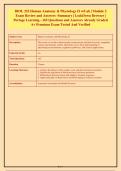
BIOL 252 Human Anatomy & Physiology II w/Lab | Module 2
Exam Review and Answers -Summary | LockDown Browser |
Portage Learning - 165 Questions and Answers Already Graded
A+ Premium Exam Tested And Verified
Subject Area Human Anatomy and Physiology II
Description This exam covers the cardiovascular system (heart and blood vessels), lymphatic
system, and immune system. Questions assess deep understanding of
physiological mechanisms, regulatory pathways, and clinical applications.
Expected Grade A+
Total Questions 165
Duration 3 hours
Learning Outcomes 1. Analyze the phases of the cardiac cycle and their electrical correlates
2. Explain the regulation of blood pressure and tissue perfusion
3. Differentiate between innate and adaptive immune responses
4. Apply principles of hemostasis and blood typing to clinical scenarios
Accreditation American Association for Health Sciences
Page 1
,1. During an echocardiogram, a patient's left ventricular pressure rises sharply
while aortic pressure remains low, and the mitral valve is closed. Which phase
of the cardiac cycle is occurring?
A. Atrial systole
B. Isovolumetric contraction
C. Rapid ejection
D. Isovolumetric relaxation
Answer: B. Isovolumetric contraction
Isovolumetric contraction occurs after mitral valve closure and before aortic
valve opening; ventricular pressure rises but volume is constant. Atrial systole
precedes this phase. Rapid ejection involves rising aortic pressure. Isovolumetric
relaxation occurs after aortic valve closure.
2. In an isolated heart experiment, end-diastolic volume is increased from 120
mL to 150 mL while afterload is held constant. What change in stroke volume
is expected immediately?
A. Decrease due to reduced contractility
B. Increase due to greater preload stretch
C. No change because of autoregulation
D. Increase due to lower afterload
Answer: B. Increase due to greater preload stretch
The Frank-Starling mechanism states that increased preload (EDV) increases
sarcomere stretch, enhancing contractile force and stroke volume. Afterload is
constant, and contractility is not reduced. Autoregulation refers to local blood
flow control.
Page 2
,3. A patient experiences sudden hypotension from hemorrhage. Which
sequence correctly describes the baroreceptor reflex response?
A. Increased sympathetic outflow to heart and vessels, decreased parasympathetic
outflow
B. Decreased sympathetic outflow, increased parasympathetic outflow
C. Increased release of atrial natriuretic peptide
D. Activation of chemoreceptors only
Answer: A. Increased sympathetic outflow to heart and vessels, decreased
parasympathetic outflow
Baroreceptors detect decreased blood pressure, leading to increased sympathetic
and decreased parasympathetic activity, raising heart rate and vasoconstriction.
ANP decreases blood pressure. Chemoreceptors respond to hypoxia, not
primarily to hypotension.
4. Capillary hydrostatic pressure is 35 mm Hg at the arteriolar end and 18 mm
Hg at the venous end; plasma colloid osmotic pressure is 25 mm Hg constant;
interstitial hydrostatic pressure is 0 mm Hg and interstitial colloid osmotic
pressure is 5 mm Hg. What is net filtration pressure at the arteriolar end?
A. 10 mm Hg outward
B. 15 mm Hg outward
C. 5 mm Hg inward
D. 20 mm Hg outward
Answer: B. 15 mm Hg outward
Net filtration pressure = (Pc + i) - (Pi + c) = (35+5) - (0+25) = 15 mm Hg outward.
The other options miscalculate or confuse inward and outward.
Page 3
, 5. Why does lymphedema often occur after lymph node dissection?
A. Increased capillary permeability
B. Obstruction of lymphatic drainage causing interstitial fluid accumulation
C. Reduced plasma protein synthesis
D. Increased venous pressure
Answer: B. Obstruction of lymphatic drainage causing interstitial fluid
accumulation
Lymph nodes are crucial for draining interstitial fluid; their removal impairs
drainage, leading to edema. Increased permeability or venous pressure can cause
edema but are not direct results of node dissection. Plasma protein synthesis is
hepatic.
6. A patient with a genetic deficiency in complement protein C3 is susceptible
to pyogenic infections but can still produce specific antibodies. Which defense
is most directly impaired?
A. Antibody opsonization
B. Membrane attack complex formation
C. T cell receptor recognition
D. Major histocompatibility complex presentation
Answer: B. Membrane attack complex formation
C3 is essential for all complement pathways; the membrane attack complex
(MAC) requires C5b-9 assembly, which depends on C3 activation. Opsonization
via C3b is also impaired, but MAC formation is directly dependent on C3. T cell
and MHC functions remain intact.
Page 4
Exam Review and Answers -Summary | LockDown Browser |
Portage Learning - 165 Questions and Answers Already Graded
A+ Premium Exam Tested And Verified
Subject Area Human Anatomy and Physiology II
Description This exam covers the cardiovascular system (heart and blood vessels), lymphatic
system, and immune system. Questions assess deep understanding of
physiological mechanisms, regulatory pathways, and clinical applications.
Expected Grade A+
Total Questions 165
Duration 3 hours
Learning Outcomes 1. Analyze the phases of the cardiac cycle and their electrical correlates
2. Explain the regulation of blood pressure and tissue perfusion
3. Differentiate between innate and adaptive immune responses
4. Apply principles of hemostasis and blood typing to clinical scenarios
Accreditation American Association for Health Sciences
Page 1
,1. During an echocardiogram, a patient's left ventricular pressure rises sharply
while aortic pressure remains low, and the mitral valve is closed. Which phase
of the cardiac cycle is occurring?
A. Atrial systole
B. Isovolumetric contraction
C. Rapid ejection
D. Isovolumetric relaxation
Answer: B. Isovolumetric contraction
Isovolumetric contraction occurs after mitral valve closure and before aortic
valve opening; ventricular pressure rises but volume is constant. Atrial systole
precedes this phase. Rapid ejection involves rising aortic pressure. Isovolumetric
relaxation occurs after aortic valve closure.
2. In an isolated heart experiment, end-diastolic volume is increased from 120
mL to 150 mL while afterload is held constant. What change in stroke volume
is expected immediately?
A. Decrease due to reduced contractility
B. Increase due to greater preload stretch
C. No change because of autoregulation
D. Increase due to lower afterload
Answer: B. Increase due to greater preload stretch
The Frank-Starling mechanism states that increased preload (EDV) increases
sarcomere stretch, enhancing contractile force and stroke volume. Afterload is
constant, and contractility is not reduced. Autoregulation refers to local blood
flow control.
Page 2
,3. A patient experiences sudden hypotension from hemorrhage. Which
sequence correctly describes the baroreceptor reflex response?
A. Increased sympathetic outflow to heart and vessels, decreased parasympathetic
outflow
B. Decreased sympathetic outflow, increased parasympathetic outflow
C. Increased release of atrial natriuretic peptide
D. Activation of chemoreceptors only
Answer: A. Increased sympathetic outflow to heart and vessels, decreased
parasympathetic outflow
Baroreceptors detect decreased blood pressure, leading to increased sympathetic
and decreased parasympathetic activity, raising heart rate and vasoconstriction.
ANP decreases blood pressure. Chemoreceptors respond to hypoxia, not
primarily to hypotension.
4. Capillary hydrostatic pressure is 35 mm Hg at the arteriolar end and 18 mm
Hg at the venous end; plasma colloid osmotic pressure is 25 mm Hg constant;
interstitial hydrostatic pressure is 0 mm Hg and interstitial colloid osmotic
pressure is 5 mm Hg. What is net filtration pressure at the arteriolar end?
A. 10 mm Hg outward
B. 15 mm Hg outward
C. 5 mm Hg inward
D. 20 mm Hg outward
Answer: B. 15 mm Hg outward
Net filtration pressure = (Pc + i) - (Pi + c) = (35+5) - (0+25) = 15 mm Hg outward.
The other options miscalculate or confuse inward and outward.
Page 3
, 5. Why does lymphedema often occur after lymph node dissection?
A. Increased capillary permeability
B. Obstruction of lymphatic drainage causing interstitial fluid accumulation
C. Reduced plasma protein synthesis
D. Increased venous pressure
Answer: B. Obstruction of lymphatic drainage causing interstitial fluid
accumulation
Lymph nodes are crucial for draining interstitial fluid; their removal impairs
drainage, leading to edema. Increased permeability or venous pressure can cause
edema but are not direct results of node dissection. Plasma protein synthesis is
hepatic.
6. A patient with a genetic deficiency in complement protein C3 is susceptible
to pyogenic infections but can still produce specific antibodies. Which defense
is most directly impaired?
A. Antibody opsonization
B. Membrane attack complex formation
C. T cell receptor recognition
D. Major histocompatibility complex presentation
Answer: B. Membrane attack complex formation
C3 is essential for all complement pathways; the membrane attack complex
(MAC) requires C5b-9 assembly, which depends on C3 activation. Opsonization
via C3b is also impaired, but MAC formation is directly dependent on C3. T cell
and MHC functions remain intact.
Page 4


