

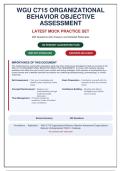
WGU C715 ORGANIZATIONAL
BEHAVIOR OBJECTIVE
ASSESSMENT
LATEST MOCK PRACTICE SET
200 Questions with Answers and Detailed Rationales
100 PERCENT GUARANTEED PASS
INSTANT DOWNLOAD ANSWERS INCLUDED
IMPORTANCE OF THIS DOCUMENT
This comprehensive examination preparation guide has been meticulously developed to help you succeed in the
WGU C715 ORGANIZATIONAL BEHAVIOR OBJECTIVE ASSESSMENT. It contains 200 carefully selected
questions that reflect the most current exam content and testing strategies. Each question is accompanied by a
correct answer and a detailed rationale that explains the underlying pathophysiology, pharmacology, or clinical
reasoning.
Self-Assessment – Test your knowledge and Exam Preparation – Familiarize yourself with the
identify areas requiring further question format and content
study areas
Concept Reinforcement – Deepen your Confidence Building – Develop test-taking
understanding through strategies and reduce
evidence-based exam anxiety
rationales
Time Management – Practice answering
questions under simulated
exam conditions
Review Summary 200 Questions
Foundations - Application - WGU C715 Organizational Behavior Objective Assessment Organizational
Behavior Undergraduate YEAR 3 / Graduate
All answers with rationales
,Table of Contents
Section A - Introduction TO Section B - Individual Behavior
Organizational Behavior Personality AND Values
Questions 1 to 50 Questions 51 to 100
Section C - Perception AND Decision Section D - Motivation Theories AND
Making Applications
Questions 101 to 150 Questions 151 to 200
,Section A - Introduction TO Organizational Behavior
Q1.
A manager notices that employees with high self-efficacy consistently outperform their
peers on complex tasks. According to social cognitive theory, which mechanism best
explains this relationship?
A. Employees with high self-efficacy are B. High self-efficacy leads to greater effort
more likely to have higher cognitive ability, and persistence, especially when facing
enabling better task performance. obstacles, thereby improving performance.
C. Self-efficacy is inversely related to goal D. Self-efficacy reduces the need for
difficulty, causing employees to set easier feedback, allowing employees to work
goals and achieve them consistently. independently without external guidance.
Correct: B - High self-efficacy leads to greater effort and persistence, especially when
facing obstacles, thereby improving performance.
Rationale:Social cognitive theory posits that self-efficacy influences motivation through effort
and persistence. High self-efficacy individuals are more likely to exert effort and persist in the
face of challenges, leading to better performance. Option A confuses self-efficacy with ability;
self-efficacy is a belief, not cognitive ability. Option C is incorrect because high self-efficacy is
associated with setting more challenging goals. Option D is false; self-efficacy does not
reduce the need for feedback; feedback can enhance self-efficacy.
Q2.
In a matrix organization, a project manager reports that team members are confused about
reporting lines and priorities. Which structural characteristic is most likely causing this
confusion?
A. High formalization of rules and B. Dual authority relationships between
procedures functional and project managers
C. Centralized decision-making authority at D. Narrow span of control in the functional
the top departments
Correct: B - Dual authority relationships between functional and project managers
Rationale:Matrix structures are characterized by dual authority, where employees report to
both a functional manager and a project manager. This can lead to confusion about priorities
and reporting lines. Option A (high formalization) might reduce ambiguity but is not the root
cause. Option C (centralized decision-making) is typical of simple structures, not matrix.
Option D (narrow span of control) does not directly cause confusion about reporting lines.
Page 3
, Section A - Introduction TO Organizational Behavior
Q3.
A multinational corporation is expanding into a country with high power distance and
collectivist culture. According to Hofstede's cultural dimensions, which leadership style
would be most effective?
A. Participative leadership that encourages B. Directive leadership with clear
subordinate input in decisions instructions and hierarchical authority
C. Laissez-faire leadership that allows D. Transformational leadership focused on
teams to self-manage inspiring individual creativity
Correct: B - Directive leadership with clear instructions and hierarchical authority
Rationale:In high power distance cultures, subordinates expect and accept hierarchical
authority and clear directives. In collectivist cultures, group harmony and respect for authority
are important. Directive leadership aligns with these values. Participative leadership (A) may
be seen as weak or inappropriate. Laissez-faire (C) may lead to ambiguity. Transformational
leadership (D) emphasizing individual creativity may conflict with collectivist norms.
Q4.
During a negotiation, one party uses hardball tactics such as making extreme initial
demands and conceding slowly. According to dual-concerns model, which
conflict-handling intention does this reflect?
A. Collaborating (high assertiveness, high B. Competing (high assertiveness, low
cooperativeness) cooperativeness)
C. Avoiding (low assertiveness, low D. Accommodating (low assertiveness, high
cooperativeness) cooperativeness)
Correct: B - Competing (high assertiveness, low cooperativeness)
Rationale:Hardball tactics like extreme demands and slow concessions demonstrate high
assertiveness (pursuing one's own interests) and low cooperativeness (disregarding the other
party's interests), which is the competing style. Collaborating (A) would involve open
information sharing and problem-solving. Avoiding (C) would entail withdrawal.
Accommodating (D) would involve yielding to the other party.
Q5.
A team has been together for six months and is experiencing intragroup conflict over task
procedures. According to Tuckman's model, which stage is the team likely in?
A. Forming B. Storming
C. Norming D. Performing
Correct: B - Storming
Page 4
BEHAVIOR OBJECTIVE
ASSESSMENT
LATEST MOCK PRACTICE SET
200 Questions with Answers and Detailed Rationales
100 PERCENT GUARANTEED PASS
INSTANT DOWNLOAD ANSWERS INCLUDED
IMPORTANCE OF THIS DOCUMENT
This comprehensive examination preparation guide has been meticulously developed to help you succeed in the
WGU C715 ORGANIZATIONAL BEHAVIOR OBJECTIVE ASSESSMENT. It contains 200 carefully selected
questions that reflect the most current exam content and testing strategies. Each question is accompanied by a
correct answer and a detailed rationale that explains the underlying pathophysiology, pharmacology, or clinical
reasoning.
Self-Assessment – Test your knowledge and Exam Preparation – Familiarize yourself with the
identify areas requiring further question format and content
study areas
Concept Reinforcement – Deepen your Confidence Building – Develop test-taking
understanding through strategies and reduce
evidence-based exam anxiety
rationales
Time Management – Practice answering
questions under simulated
exam conditions
Review Summary 200 Questions
Foundations - Application - WGU C715 Organizational Behavior Objective Assessment Organizational
Behavior Undergraduate YEAR 3 / Graduate
All answers with rationales
,Table of Contents
Section A - Introduction TO Section B - Individual Behavior
Organizational Behavior Personality AND Values
Questions 1 to 50 Questions 51 to 100
Section C - Perception AND Decision Section D - Motivation Theories AND
Making Applications
Questions 101 to 150 Questions 151 to 200
,Section A - Introduction TO Organizational Behavior
Q1.
A manager notices that employees with high self-efficacy consistently outperform their
peers on complex tasks. According to social cognitive theory, which mechanism best
explains this relationship?
A. Employees with high self-efficacy are B. High self-efficacy leads to greater effort
more likely to have higher cognitive ability, and persistence, especially when facing
enabling better task performance. obstacles, thereby improving performance.
C. Self-efficacy is inversely related to goal D. Self-efficacy reduces the need for
difficulty, causing employees to set easier feedback, allowing employees to work
goals and achieve them consistently. independently without external guidance.
Correct: B - High self-efficacy leads to greater effort and persistence, especially when
facing obstacles, thereby improving performance.
Rationale:Social cognitive theory posits that self-efficacy influences motivation through effort
and persistence. High self-efficacy individuals are more likely to exert effort and persist in the
face of challenges, leading to better performance. Option A confuses self-efficacy with ability;
self-efficacy is a belief, not cognitive ability. Option C is incorrect because high self-efficacy is
associated with setting more challenging goals. Option D is false; self-efficacy does not
reduce the need for feedback; feedback can enhance self-efficacy.
Q2.
In a matrix organization, a project manager reports that team members are confused about
reporting lines and priorities. Which structural characteristic is most likely causing this
confusion?
A. High formalization of rules and B. Dual authority relationships between
procedures functional and project managers
C. Centralized decision-making authority at D. Narrow span of control in the functional
the top departments
Correct: B - Dual authority relationships between functional and project managers
Rationale:Matrix structures are characterized by dual authority, where employees report to
both a functional manager and a project manager. This can lead to confusion about priorities
and reporting lines. Option A (high formalization) might reduce ambiguity but is not the root
cause. Option C (centralized decision-making) is typical of simple structures, not matrix.
Option D (narrow span of control) does not directly cause confusion about reporting lines.
Page 3
, Section A - Introduction TO Organizational Behavior
Q3.
A multinational corporation is expanding into a country with high power distance and
collectivist culture. According to Hofstede's cultural dimensions, which leadership style
would be most effective?
A. Participative leadership that encourages B. Directive leadership with clear
subordinate input in decisions instructions and hierarchical authority
C. Laissez-faire leadership that allows D. Transformational leadership focused on
teams to self-manage inspiring individual creativity
Correct: B - Directive leadership with clear instructions and hierarchical authority
Rationale:In high power distance cultures, subordinates expect and accept hierarchical
authority and clear directives. In collectivist cultures, group harmony and respect for authority
are important. Directive leadership aligns with these values. Participative leadership (A) may
be seen as weak or inappropriate. Laissez-faire (C) may lead to ambiguity. Transformational
leadership (D) emphasizing individual creativity may conflict with collectivist norms.
Q4.
During a negotiation, one party uses hardball tactics such as making extreme initial
demands and conceding slowly. According to dual-concerns model, which
conflict-handling intention does this reflect?
A. Collaborating (high assertiveness, high B. Competing (high assertiveness, low
cooperativeness) cooperativeness)
C. Avoiding (low assertiveness, low D. Accommodating (low assertiveness, high
cooperativeness) cooperativeness)
Correct: B - Competing (high assertiveness, low cooperativeness)
Rationale:Hardball tactics like extreme demands and slow concessions demonstrate high
assertiveness (pursuing one's own interests) and low cooperativeness (disregarding the other
party's interests), which is the competing style. Collaborating (A) would involve open
information sharing and problem-solving. Avoiding (C) would entail withdrawal.
Accommodating (D) would involve yielding to the other party.
Q5.
A team has been together for six months and is experiencing intragroup conflict over task
procedures. According to Tuckman's model, which stage is the team likely in?
A. Forming B. Storming
C. Norming D. Performing
Correct: B - Storming
Page 4


