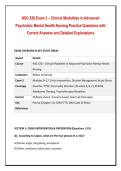
NSG 526 Exam 3 – Clinical Modalities in Advanced
Psychiatric Mental Health Nursing Practice Questions with
Correct Answers and Detailed Explanations
EXAM OVERVIEW & KEY STUDY AREAS
Aspect Details
Course NSG 526 – Clinical Modalities in Advanced Psychiatric Mental Health
Nursing
Institution Wilkes University
Exam 3 Modules 9–12: Crisis Intervention, Disaster Management, Acute Stress
Coverage Disorder, PTSD, Personality Disorders (Clusters A, B, C), Child &
Adolescent Therapy, Psychotherapy Modalities
Format Multiple-choice, Scenario-based, Select-all-that-apply
Key Perese (Chapter 11), DSM-5-TR, ANA Code of Ethics
References
SECTION 1: CRISIS INTERVENTION & PREVENTION (Questions 1-25)
Q1. According to Caplan, what are the four phases of a crisis?
A) Denial, anger, bargaining, acceptance
B) Alarm, resistance, exhaustion, recovery
,C) Problem arises with increased anxiety; usual coping fails; trial-and-error fails;
anxiety overwhelms leading to crisis
D) Shock, realization, adaptation, resolution
Correct Answer: C. Problem arises with increased anxiety; usual coping fails;
trial-and-error fails; anxiety overwhelms leading to crisis
Phase 1 involves a problem that increases anxiety and triggers usual problem-
solving methods. Phase 2 occurs when these methods fail and anxiety continues to
rise. Phase 3 involves failed trial-and-error attempts with escalating anxiety to
severe or panic levels. Phase 4 occurs when anxiety overwhelms the person,
leading to serious personality disorganization and crisis .
Q2. How long does a crisis typically last?
A) 24-48 hours
B) 1-2 weeks
C) 4-6 weeks
D) 3-6 months
Correct Answer: C. 4-6 weeks
A crisis is generally regarded as time-limited, lasting no more than 4 to 6 weeks.
There is no such thing as a chronic crisis. People who live in constant turmoil are
not in crisis but in chaos .
Q3. What is the goal for individuals experiencing a crisis?
,A) To develop new personality traits
B) To return to the pre-crisis level of functioning
C) To achieve a higher level of functioning than before
D) To eliminate all anxiety permanently
Correct Answer: B. To return to the pre-crisis level of functioning
The goal for people experiencing a crisis is to return to the pre-crisis level of
functioning. The role of the PMH-APRN is to provide a framework of support
systems that guide the client through the crisis and facilitate the development and
use of positive coping skills .
Q4. What is the primary prevention level in crisis intervention?
A) Early identification and treatment
B) Actually preventing the crisis before it occurs
C) Avoiding complications after a crisis
D) Providing rehabilitation services
Correct Answer: B. Actually preventing the crisis before it occurs
Primary prevention focuses on avoiding the development of a crisis by addressing
risk factors and enhancing protective factors before a problem emerges. This is the
most proactive level of intervention .
Q5. What is secondary prevention in crisis intervention?
, A) Actually preventing the crisis before it occurs
B) Early identification and treatment of a crisis
C) Avoiding complications after a crisis has occurred
D) Long-term rehabilitation services
Correct Answer: B. Early identification and treatment of a crisis
Secondary prevention aims to reduce the duration and impact of a crisis through
early detection and prompt intervention. This level of prevention focuses on
minimizing the effects once a crisis has begun .
Q6. What is tertiary prevention in crisis intervention?
A) Actually preventing the crisis before it occurs
B) Early identification and treatment
C) Avoiding complications and preventing relapse after a crisis
D) Providing crisis education to the community
Correct Answer: C. Avoiding complications and preventing relapse after a crisis
Tertiary prevention focuses on reducing the long-term effects of a crisis,
preventing relapse, and promoting rehabilitation after the crisis has been
managed. This is the final level of prevention in the crisis intervention framework .
Q7. According to Erikson, a maturational crisis is:
A) A crisis caused by a sudden, unexpected event
B) A crisis related to normal life transitions such as leaving home, completing
Psychiatric Mental Health Nursing Practice Questions with
Correct Answers and Detailed Explanations
EXAM OVERVIEW & KEY STUDY AREAS
Aspect Details
Course NSG 526 – Clinical Modalities in Advanced Psychiatric Mental Health
Nursing
Institution Wilkes University
Exam 3 Modules 9–12: Crisis Intervention, Disaster Management, Acute Stress
Coverage Disorder, PTSD, Personality Disorders (Clusters A, B, C), Child &
Adolescent Therapy, Psychotherapy Modalities
Format Multiple-choice, Scenario-based, Select-all-that-apply
Key Perese (Chapter 11), DSM-5-TR, ANA Code of Ethics
References
SECTION 1: CRISIS INTERVENTION & PREVENTION (Questions 1-25)
Q1. According to Caplan, what are the four phases of a crisis?
A) Denial, anger, bargaining, acceptance
B) Alarm, resistance, exhaustion, recovery
,C) Problem arises with increased anxiety; usual coping fails; trial-and-error fails;
anxiety overwhelms leading to crisis
D) Shock, realization, adaptation, resolution
Correct Answer: C. Problem arises with increased anxiety; usual coping fails;
trial-and-error fails; anxiety overwhelms leading to crisis
Phase 1 involves a problem that increases anxiety and triggers usual problem-
solving methods. Phase 2 occurs when these methods fail and anxiety continues to
rise. Phase 3 involves failed trial-and-error attempts with escalating anxiety to
severe or panic levels. Phase 4 occurs when anxiety overwhelms the person,
leading to serious personality disorganization and crisis .
Q2. How long does a crisis typically last?
A) 24-48 hours
B) 1-2 weeks
C) 4-6 weeks
D) 3-6 months
Correct Answer: C. 4-6 weeks
A crisis is generally regarded as time-limited, lasting no more than 4 to 6 weeks.
There is no such thing as a chronic crisis. People who live in constant turmoil are
not in crisis but in chaos .
Q3. What is the goal for individuals experiencing a crisis?
,A) To develop new personality traits
B) To return to the pre-crisis level of functioning
C) To achieve a higher level of functioning than before
D) To eliminate all anxiety permanently
Correct Answer: B. To return to the pre-crisis level of functioning
The goal for people experiencing a crisis is to return to the pre-crisis level of
functioning. The role of the PMH-APRN is to provide a framework of support
systems that guide the client through the crisis and facilitate the development and
use of positive coping skills .
Q4. What is the primary prevention level in crisis intervention?
A) Early identification and treatment
B) Actually preventing the crisis before it occurs
C) Avoiding complications after a crisis
D) Providing rehabilitation services
Correct Answer: B. Actually preventing the crisis before it occurs
Primary prevention focuses on avoiding the development of a crisis by addressing
risk factors and enhancing protective factors before a problem emerges. This is the
most proactive level of intervention .
Q5. What is secondary prevention in crisis intervention?
, A) Actually preventing the crisis before it occurs
B) Early identification and treatment of a crisis
C) Avoiding complications after a crisis has occurred
D) Long-term rehabilitation services
Correct Answer: B. Early identification and treatment of a crisis
Secondary prevention aims to reduce the duration and impact of a crisis through
early detection and prompt intervention. This level of prevention focuses on
minimizing the effects once a crisis has begun .
Q6. What is tertiary prevention in crisis intervention?
A) Actually preventing the crisis before it occurs
B) Early identification and treatment
C) Avoiding complications and preventing relapse after a crisis
D) Providing crisis education to the community
Correct Answer: C. Avoiding complications and preventing relapse after a crisis
Tertiary prevention focuses on reducing the long-term effects of a crisis,
preventing relapse, and promoting rehabilitation after the crisis has been
managed. This is the final level of prevention in the crisis intervention framework .
Q7. According to Erikson, a maturational crisis is:
A) A crisis caused by a sudden, unexpected event
B) A crisis related to normal life transitions such as leaving home, completing