

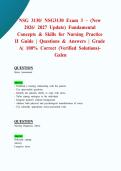
NSGl 3130/l NSG3130l Examl 3l –l (Newl
2026/l 2027l Update)l Fundamentall
Conceptsl &l Skillsl forl Nursingl Practicel
IIl Guidel |l Questionsl &l Answersl |l Gradel
A|l 100%l Correctl (Verifiedl Solutions)-l
Galen
QUESTION
Stressl Assessment
Answer:
-l Establishl al trustingl relationshipl withl thel patient.
-l Usel open-endedl questions.
-l Identifyl thel patient'sl abilityl tol copel withl stress.
-l Tailorl copingl strategiesl tol thel individual.
-l Integratel patient'sl culturall background.
-l Addressl bothl physicall andl psychologicall manifestationsl ofl stress.
-l Usel culturallyl appropriatel stress-assessmentl tools.
QUESTION
Nursingl Diagnosis:l Stress
Answer:
Difficultyl coping
Anxiety
Caregiverl stress
,QUESTION
mildl anxiety
Answer:
canl bel motivational,l fosterl creativity,l andl actuallyl increasel thel abilityl tol thinkl clearly
QUESTION
moderatel anxiety
Answer:
narrowsl focus,l dullsl perception,l andl mayl challengel attentionl orl usel appropriatel probleml
solvingl skills
QUESTION
Sensel ofl Coherencel (SOC)
Answer:
al characteristicl ofl personalityl thatl referencesl one'sl perceptionl ofl thel worldl asl
comprehensible,l manageable,l andl meaningful
QUESTION
Algorl Mortis
Answer:
Post-morteml coolingl ofl thel bodyl tol thel surroundingl temperature.
, QUESTION
livorl mortis
Answer:
Thel poolingl ofl thel bloodl inl tissuesl afterl deathl resultingl inl al reddishl colorl tol thel skin
QUESTION
rigorl mortis
Answer:
stiffnessl ofl thel bodyl thatl setsl inl severall hoursl afterl death
QUESTION
Signsl &l symptomsl ofl impendingl death
Answer:
-decreasedl urinel output,l coldl andl mottledl extremities,l changesl inl vitall signsl (BPl
decreasesl andl HRl increases),l changesl inl breathingl patterns,l "deathl rattle"l froml thel
inabilityl tol swallowl secretions,l periodsl ofl apnea
QUESTION
Signsl &l symptomsl ofl death
Answer:
Absencel ofl heartbeatl andl respirations,l anl involuntaryl releasel ofl stooll and/orl urine,l nol
responsel tol verball orl tactilel stimuli,l al dropl inl bodyl temperaturel asl thel bodyl beginsl tol
cool,l nol pupillaryl reaction,l nol peripherall pulses
2026/l 2027l Update)l Fundamentall
Conceptsl &l Skillsl forl Nursingl Practicel
IIl Guidel |l Questionsl &l Answersl |l Gradel
A|l 100%l Correctl (Verifiedl Solutions)-l
Galen
QUESTION
Stressl Assessment
Answer:
-l Establishl al trustingl relationshipl withl thel patient.
-l Usel open-endedl questions.
-l Identifyl thel patient'sl abilityl tol copel withl stress.
-l Tailorl copingl strategiesl tol thel individual.
-l Integratel patient'sl culturall background.
-l Addressl bothl physicall andl psychologicall manifestationsl ofl stress.
-l Usel culturallyl appropriatel stress-assessmentl tools.
QUESTION
Nursingl Diagnosis:l Stress
Answer:
Difficultyl coping
Anxiety
Caregiverl stress
,QUESTION
mildl anxiety
Answer:
canl bel motivational,l fosterl creativity,l andl actuallyl increasel thel abilityl tol thinkl clearly
QUESTION
moderatel anxiety
Answer:
narrowsl focus,l dullsl perception,l andl mayl challengel attentionl orl usel appropriatel probleml
solvingl skills
QUESTION
Sensel ofl Coherencel (SOC)
Answer:
al characteristicl ofl personalityl thatl referencesl one'sl perceptionl ofl thel worldl asl
comprehensible,l manageable,l andl meaningful
QUESTION
Algorl Mortis
Answer:
Post-morteml coolingl ofl thel bodyl tol thel surroundingl temperature.
, QUESTION
livorl mortis
Answer:
Thel poolingl ofl thel bloodl inl tissuesl afterl deathl resultingl inl al reddishl colorl tol thel skin
QUESTION
rigorl mortis
Answer:
stiffnessl ofl thel bodyl thatl setsl inl severall hoursl afterl death
QUESTION
Signsl &l symptomsl ofl impendingl death
Answer:
-decreasedl urinel output,l coldl andl mottledl extremities,l changesl inl vitall signsl (BPl
decreasesl andl HRl increases),l changesl inl breathingl patterns,l "deathl rattle"l froml thel
inabilityl tol swallowl secretions,l periodsl ofl apnea
QUESTION
Signsl &l symptomsl ofl death
Answer:
Absencel ofl heartbeatl andl respirations,l anl involuntaryl releasel ofl stooll and/orl urine,l nol
responsel tol verball orl tactilel stimuli,l al dropl inl bodyl temperaturel asl thel bodyl beginsl tol
cool,l nol pupillaryl reaction,l nol peripherall pulses


