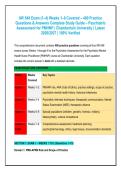
NR 548 Exam (1–4) Weeks 1–8 Covered – 400 Practice
Questions & Answers Complete Study Guide – Psychiatric
Assessment for PMHNP | Chamberlain University | Latest
2026/2027 | 100% Verified
This comprehensive document contains 400 practice questions covering all four NR 548
exams across Weeks 1 through 8 for the Psychiatric Assessment for the Psychiatric-Mental
Health Nurse Practitioner (PMHNP) course at Chamberlain University. Each question
includes the correct answer in bold with a detailed rationale.
EXAM STRUCTURE OVERVIEW
Exam Weeks Key Topics
Covered
Exam 1 Weeks 1–2 PMHNP role, ANA Code of Ethics, practice settings, scope of practice,
psychiatric-mental health history, historical milestones
Exam 2 Weeks 3–4 Psychiatric interview techniques, therapeutic communication, Mental
Status Examination (MSE), therapeutic alliance
Exam 3 Weeks 5–6 Special populations (children, geriatric, forensic, military),
telepsychiatry, cultural competence
Exam 4 / Weeks 7–8 Comprehensive assessment, treatment planning,
Final psychopharmacology, ethics, legal issues, documentation standards
SECTION 1: EXAM 1 – WEEKS 1 TO 2 (Questions 1–75)
Domain 1: PMH-APRN Role and Scope of Practice
,1. What is a PMH-APRN?
A) A registered nurse with a bachelor's degree in psychiatric nursing
B) A nurse with graduate-level training who provides psychiatric-mental health care
and promotes mental health across the lifespan
C) A physician assistant specializing in mental health
D) A social worker with additional certification in psychiatry
Answer: B
A PMH-APRN (Psychiatric-Mental Health Advanced Practice Registered Nurse) is a nurse
with graduate-level education who provides comprehensive psychiatric-mental health care,
including assessment, diagnosis, and treatment across the lifespan .
2. Following WWI, the National League for Nursing Education added what to
curriculum guides?
A) "Nursing in nervous and mental diseases"
B) Psychiatric nursing as a specialty
C) Advanced practice nursing courses
D) Community mental health content
Answer: A
Following WWI, the National League for Nursing Education added "nursing in nervous and
mental diseases" to curriculum guides, recognizing the need for specialized psychiatric
nursing education .
,3. Who developed the first organized training school within a hospital for the insane
in 1882?
A) Effie Jones
B) Edward Cowles
C) Dorothea Dix
D) Loretta Ford
Answer: B
Dr. Edward Cowles created the first organized training school within a hospital for the
insane in 1882, marking a significant milestone in psychiatric nursing education .
4. In WWII, Laura Fitzsimmons recommended:
A) Closing all psychiatric hospitals
B) Standards of training for psychiatric nurses
C) Deinstitutionalization of mental health care
D) Prescriptive authority for nurses
Answer: B
During WWII, Laura Fitzsimmons recommended standards of training for psychiatric nurses,
which led to improved education and standards of care for psychiatric nursing .
5. The National Mental Health Act (NMHA) of 1946:
A) Established Medicare and Medicaid
B) Recognized psychiatric nursing as one of the four core disciplines in psychiatric
care and increased funding for psychiatric nursing education
, C) Created the PMHNP role
D) Mandated prescriptive authority for nurses
Answer: B
The NMHA of 1946 recognized psychiatric nursing as one of the four core disciplines in
psychiatric care and treatment. The act increased funding for psychiatric nursing education
programs and contributed to a growth in university-based nursing education .
6. In 1954, which university established the first graduate program in psychiatric
nursing?
A) Yale University
B) University of California
C) Rutgers University
D) Johns Hopkins University
Answer: C
In 1954, the first graduate program in psychiatric nursing was established at Rutgers
University by Hildegarde Peplau to prepare nurse therapists. The first advanced practice
nursing role was the psychiatric-mental health clinical nurse specialist (PMHCNS) role .
7. The Community Mental Health Centers Act of 1963:
A) Allowed for the expansion of the PMHCNS role into community and ambulatory
settings
B) Ended all inpatient psychiatric care
Questions & Answers Complete Study Guide – Psychiatric
Assessment for PMHNP | Chamberlain University | Latest
2026/2027 | 100% Verified
This comprehensive document contains 400 practice questions covering all four NR 548
exams across Weeks 1 through 8 for the Psychiatric Assessment for the Psychiatric-Mental
Health Nurse Practitioner (PMHNP) course at Chamberlain University. Each question
includes the correct answer in bold with a detailed rationale.
EXAM STRUCTURE OVERVIEW
Exam Weeks Key Topics
Covered
Exam 1 Weeks 1–2 PMHNP role, ANA Code of Ethics, practice settings, scope of practice,
psychiatric-mental health history, historical milestones
Exam 2 Weeks 3–4 Psychiatric interview techniques, therapeutic communication, Mental
Status Examination (MSE), therapeutic alliance
Exam 3 Weeks 5–6 Special populations (children, geriatric, forensic, military),
telepsychiatry, cultural competence
Exam 4 / Weeks 7–8 Comprehensive assessment, treatment planning,
Final psychopharmacology, ethics, legal issues, documentation standards
SECTION 1: EXAM 1 – WEEKS 1 TO 2 (Questions 1–75)
Domain 1: PMH-APRN Role and Scope of Practice
,1. What is a PMH-APRN?
A) A registered nurse with a bachelor's degree in psychiatric nursing
B) A nurse with graduate-level training who provides psychiatric-mental health care
and promotes mental health across the lifespan
C) A physician assistant specializing in mental health
D) A social worker with additional certification in psychiatry
Answer: B
A PMH-APRN (Psychiatric-Mental Health Advanced Practice Registered Nurse) is a nurse
with graduate-level education who provides comprehensive psychiatric-mental health care,
including assessment, diagnosis, and treatment across the lifespan .
2. Following WWI, the National League for Nursing Education added what to
curriculum guides?
A) "Nursing in nervous and mental diseases"
B) Psychiatric nursing as a specialty
C) Advanced practice nursing courses
D) Community mental health content
Answer: A
Following WWI, the National League for Nursing Education added "nursing in nervous and
mental diseases" to curriculum guides, recognizing the need for specialized psychiatric
nursing education .
,3. Who developed the first organized training school within a hospital for the insane
in 1882?
A) Effie Jones
B) Edward Cowles
C) Dorothea Dix
D) Loretta Ford
Answer: B
Dr. Edward Cowles created the first organized training school within a hospital for the
insane in 1882, marking a significant milestone in psychiatric nursing education .
4. In WWII, Laura Fitzsimmons recommended:
A) Closing all psychiatric hospitals
B) Standards of training for psychiatric nurses
C) Deinstitutionalization of mental health care
D) Prescriptive authority for nurses
Answer: B
During WWII, Laura Fitzsimmons recommended standards of training for psychiatric nurses,
which led to improved education and standards of care for psychiatric nursing .
5. The National Mental Health Act (NMHA) of 1946:
A) Established Medicare and Medicaid
B) Recognized psychiatric nursing as one of the four core disciplines in psychiatric
care and increased funding for psychiatric nursing education
, C) Created the PMHNP role
D) Mandated prescriptive authority for nurses
Answer: B
The NMHA of 1946 recognized psychiatric nursing as one of the four core disciplines in
psychiatric care and treatment. The act increased funding for psychiatric nursing education
programs and contributed to a growth in university-based nursing education .
6. In 1954, which university established the first graduate program in psychiatric
nursing?
A) Yale University
B) University of California
C) Rutgers University
D) Johns Hopkins University
Answer: C
In 1954, the first graduate program in psychiatric nursing was established at Rutgers
University by Hildegarde Peplau to prepare nurse therapists. The first advanced practice
nursing role was the psychiatric-mental health clinical nurse specialist (PMHCNS) role .
7. The Community Mental Health Centers Act of 1963:
A) Allowed for the expansion of the PMHCNS role into community and ambulatory
settings
B) Ended all inpatient psychiatric care