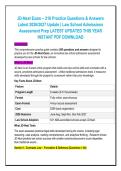
JD-Next Exam – 216 Practice Questions & Answers
Latest 2026/2027 Update | Law School Admissions
Assessment Prep LATEST UPDATED THIS YEAR
INSTANT PDF DOWNLOAD
Introduction
This comprehensive practice guide contains 200 questions and answers designed to
prepare you for the JD-Next Exam, an innovative law school admissions assessment
developed by law schools for law schools .
What is JD-Next?
JD-Next is an 8-week online program that builds core law school skills and concludes with a
secure, proctored admissions assessment . Unlike traditional admissions tests, it measures
skills developed through the program's coursework rather than prior knowledge .
Key Facts About JD-Next
Feature Details
Program Length 8 weeks (6-10 hours/week)
Format Fully online, asynchronous
Exam Format 4-hour secure assessment
Cost $399 (early registration)
2026 Sessions June-Aug, Sept-Nov, Dec-Feb 2027
Law School Adoption 63+ ABA-accredited schools accept JD-Next
What JD-Next Tests
The exam assesses practical legal skills developed during the course, including legal
reasoning, case analysis, reading comprehension, and analytical thinking . Research shows
JD-Next predicts law school success with smaller racial/socioeconomic score disparities
than traditional exams .
Section 1: Contracts Law – Formation & Defenses (Questions 1-40)
,1. On Monday, Seller offers in writing to sell Buyer a vintage car for $20,000, stating
"this offer will remain open until Friday." On Tuesday, Buyer calls Seller and says,
"I'll give you $18,000." Seller says nothing. On Wednesday, Buyer changes his mind
and calls Seller saying, "I accept your original offer of $20,000." Is there a contract?
A) Yes, because the original offer was irrevocable until Friday
B) Yes, because Buyer's $18,000 proposal was not a rejection but a mere inquiry
C) **No, because Buyer's $18,000 counteroffer terminated the original offer**
D) No, because the offer was not in a signed writing
Rationale: Under common law, a counteroffer operates as a rejection of the original offer
and terminates it . Buyer's statement "I'll give you $18,000" is a counteroffer, not a mere
inquiry. The original offer was not an option contract (no consideration given to keep it
open), so Seller was free to revoke or let it be terminated by counteroffer. Seller's silence
does not constitute acceptance.
2. A 16-year-old enters into a contract to buy a car from a dealer for $10,000. The
minor pays $2,000 down and drives the car for 6 months. The minor then seeks to
disaffirm the contract. What is the likely outcome?
A) The minor cannot disaffirm because the car is a necessity
B) The minor can disaffirm but must return the car and is entitled to full refund of the
$2,000
C) The minor can disaffirm but may be subject to a deduction for depreciation
D) The minor cannot disaffirm because 6 months is an unreasonable time
Rationale: Minors may disaffirm contracts at any time before reaching majority or within a
reasonable time thereafter. Upon disaffirmance, the minor must return any consideration still
in their possession, but is entitled to full refund of money paid, even if the goods have
depreciated .
3. A retailer advertises a new laptop for $299 in a newspaper circular. The ad states
"limited supply, first come first served." A customer arrives at the store at opening
time, but the retailer has sold out. The customer sues for breach of contract. What is
the likely outcome?
A) The customer wins because advertisements are offers
B) The customer wins because the ad specified "first come first served"
,C) The retailer wins because advertisements are generally invitations to make an
offer, not offers
D) The retailer wins because the customer did not pay consideration
Rationale: Generally, advertisements are invitations to bargain, not offers . An exception
exists for ads that are clear, definite, and leave nothing open for negotiation (e.g., reward
offers). Here, the ad specified limited supply, indicating it was not an offer to all but an
invitation for customers to make offers.
4. Seller offers to sell Buyer 100 shares of stock for $50/share. Buyer responds, "I
accept, but payment will be made in 60 days." Seller does not respond. Is there a
contract?
A) Yes, because Buyer's response was a definite acceptance
B) Yes, under the UCC because the additional term is not material
C) No, because Buyer's response added a term and thus is a counteroffer at common
law
D) No, because the offer was not in writing
Rationale: Under the common law (applicable to stock sale, not goods under UCC), the
mirror image rule requires acceptance to exactly match the offer . Any additional or different
term makes the response a counteroffer and rejects the original offer. Here, adding a 60-
day payment term is a counteroffer, and Seller's silence is not acceptance.
5. A painter contracts to paint a house for $5,000. After completing 90% of the work,
the painter quits. The homeowner hires another painter to finish for $800. The original
painter sues for the value of work performed. What can the original painter recover?
A) $5,000 (full contract price) because substantial performance
B) $4,500 (90% of contract price) minus $800 paid to second painter
C) Nothing, because the painter breached first
D) The reasonable value of work performed, minus any damages caused by the
breach
Rationale: For a material breach (quitting before completion is material), the non-breaching
party is discharged . The breaching party may recover in restitution (quantum meruit) the
reasonable value of work performed that benefited the homeowner, minus damages caused
by the breach.
, 6. A tenant with a 1-year lease at $1,000/month abandons the property after 6 months.
The landlord re-rents the property after 2 months for $900/month. What damages can
the landlord recover?
A) $6,000 (remaining rent under the lease)
B) **$2,400 ($2,000 for 2 months vacancy + $400 difference for 4 months)**
C) $2,000 (only the 2 months of vacancy)
D) Nothing, because the landlord mitigated
Rationale: Landlord has a duty to mitigate damages by making reasonable efforts to relet .
Damages = unpaid rent from date of breach until re-rental (2 months = $2,000) + difference
between original rent and new rent for remaining term (4 months x $100 = $400) = $2,400.
Landlord cannot recover rent for period after re-rental.
7. A car dealer and buyer sign a written contract for sale of a specific used car for
$15,000. The contract contains an integration clause. Buyer later claims the dealer
orally promised a 3-year warranty. Is the oral promise enforceable?
A) Yes, because oral promises are always admissible
B) Yes, because the UCC allows oral modifications
C) No, because the parol evidence rule bars evidence of prior or contemporaneous
oral agreements that contradict a fully integrated written contract
D) No, because the warranty period is unreasonable
Rationale: The parol evidence rule prohibits introduction of prior or contemporaneous oral or
written statements that contradict or vary the terms of a fully integrated written contract .
The integration clause indicates the writing is final and complete.
8. A supplier agrees to sell a manufacturer 1,000 widgets at $5 each. Before delivery,
the supplier's factory burns down, making performance impossible. The supplier had
no other source of widgets. What is the legal consequence?
A) The supplier is liable for breach of contract
B) The supplier is liable for consequential damages
C) The contract is discharged by impossibility
D) The supplier must find alternative widgets at any cost
Latest 2026/2027 Update | Law School Admissions
Assessment Prep LATEST UPDATED THIS YEAR
INSTANT PDF DOWNLOAD
Introduction
This comprehensive practice guide contains 200 questions and answers designed to
prepare you for the JD-Next Exam, an innovative law school admissions assessment
developed by law schools for law schools .
What is JD-Next?
JD-Next is an 8-week online program that builds core law school skills and concludes with a
secure, proctored admissions assessment . Unlike traditional admissions tests, it measures
skills developed through the program's coursework rather than prior knowledge .
Key Facts About JD-Next
Feature Details
Program Length 8 weeks (6-10 hours/week)
Format Fully online, asynchronous
Exam Format 4-hour secure assessment
Cost $399 (early registration)
2026 Sessions June-Aug, Sept-Nov, Dec-Feb 2027
Law School Adoption 63+ ABA-accredited schools accept JD-Next
What JD-Next Tests
The exam assesses practical legal skills developed during the course, including legal
reasoning, case analysis, reading comprehension, and analytical thinking . Research shows
JD-Next predicts law school success with smaller racial/socioeconomic score disparities
than traditional exams .
Section 1: Contracts Law – Formation & Defenses (Questions 1-40)
,1. On Monday, Seller offers in writing to sell Buyer a vintage car for $20,000, stating
"this offer will remain open until Friday." On Tuesday, Buyer calls Seller and says,
"I'll give you $18,000." Seller says nothing. On Wednesday, Buyer changes his mind
and calls Seller saying, "I accept your original offer of $20,000." Is there a contract?
A) Yes, because the original offer was irrevocable until Friday
B) Yes, because Buyer's $18,000 proposal was not a rejection but a mere inquiry
C) **No, because Buyer's $18,000 counteroffer terminated the original offer**
D) No, because the offer was not in a signed writing
Rationale: Under common law, a counteroffer operates as a rejection of the original offer
and terminates it . Buyer's statement "I'll give you $18,000" is a counteroffer, not a mere
inquiry. The original offer was not an option contract (no consideration given to keep it
open), so Seller was free to revoke or let it be terminated by counteroffer. Seller's silence
does not constitute acceptance.
2. A 16-year-old enters into a contract to buy a car from a dealer for $10,000. The
minor pays $2,000 down and drives the car for 6 months. The minor then seeks to
disaffirm the contract. What is the likely outcome?
A) The minor cannot disaffirm because the car is a necessity
B) The minor can disaffirm but must return the car and is entitled to full refund of the
$2,000
C) The minor can disaffirm but may be subject to a deduction for depreciation
D) The minor cannot disaffirm because 6 months is an unreasonable time
Rationale: Minors may disaffirm contracts at any time before reaching majority or within a
reasonable time thereafter. Upon disaffirmance, the minor must return any consideration still
in their possession, but is entitled to full refund of money paid, even if the goods have
depreciated .
3. A retailer advertises a new laptop for $299 in a newspaper circular. The ad states
"limited supply, first come first served." A customer arrives at the store at opening
time, but the retailer has sold out. The customer sues for breach of contract. What is
the likely outcome?
A) The customer wins because advertisements are offers
B) The customer wins because the ad specified "first come first served"
,C) The retailer wins because advertisements are generally invitations to make an
offer, not offers
D) The retailer wins because the customer did not pay consideration
Rationale: Generally, advertisements are invitations to bargain, not offers . An exception
exists for ads that are clear, definite, and leave nothing open for negotiation (e.g., reward
offers). Here, the ad specified limited supply, indicating it was not an offer to all but an
invitation for customers to make offers.
4. Seller offers to sell Buyer 100 shares of stock for $50/share. Buyer responds, "I
accept, but payment will be made in 60 days." Seller does not respond. Is there a
contract?
A) Yes, because Buyer's response was a definite acceptance
B) Yes, under the UCC because the additional term is not material
C) No, because Buyer's response added a term and thus is a counteroffer at common
law
D) No, because the offer was not in writing
Rationale: Under the common law (applicable to stock sale, not goods under UCC), the
mirror image rule requires acceptance to exactly match the offer . Any additional or different
term makes the response a counteroffer and rejects the original offer. Here, adding a 60-
day payment term is a counteroffer, and Seller's silence is not acceptance.
5. A painter contracts to paint a house for $5,000. After completing 90% of the work,
the painter quits. The homeowner hires another painter to finish for $800. The original
painter sues for the value of work performed. What can the original painter recover?
A) $5,000 (full contract price) because substantial performance
B) $4,500 (90% of contract price) minus $800 paid to second painter
C) Nothing, because the painter breached first
D) The reasonable value of work performed, minus any damages caused by the
breach
Rationale: For a material breach (quitting before completion is material), the non-breaching
party is discharged . The breaching party may recover in restitution (quantum meruit) the
reasonable value of work performed that benefited the homeowner, minus damages caused
by the breach.
, 6. A tenant with a 1-year lease at $1,000/month abandons the property after 6 months.
The landlord re-rents the property after 2 months for $900/month. What damages can
the landlord recover?
A) $6,000 (remaining rent under the lease)
B) **$2,400 ($2,000 for 2 months vacancy + $400 difference for 4 months)**
C) $2,000 (only the 2 months of vacancy)
D) Nothing, because the landlord mitigated
Rationale: Landlord has a duty to mitigate damages by making reasonable efforts to relet .
Damages = unpaid rent from date of breach until re-rental (2 months = $2,000) + difference
between original rent and new rent for remaining term (4 months x $100 = $400) = $2,400.
Landlord cannot recover rent for period after re-rental.
7. A car dealer and buyer sign a written contract for sale of a specific used car for
$15,000. The contract contains an integration clause. Buyer later claims the dealer
orally promised a 3-year warranty. Is the oral promise enforceable?
A) Yes, because oral promises are always admissible
B) Yes, because the UCC allows oral modifications
C) No, because the parol evidence rule bars evidence of prior or contemporaneous
oral agreements that contradict a fully integrated written contract
D) No, because the warranty period is unreasonable
Rationale: The parol evidence rule prohibits introduction of prior or contemporaneous oral or
written statements that contradict or vary the terms of a fully integrated written contract .
The integration clause indicates the writing is final and complete.
8. A supplier agrees to sell a manufacturer 1,000 widgets at $5 each. Before delivery,
the supplier's factory burns down, making performance impossible. The supplier had
no other source of widgets. What is the legal consequence?
A) The supplier is liable for breach of contract
B) The supplier is liable for consequential damages
C) The contract is discharged by impossibility
D) The supplier must find alternative widgets at any cost