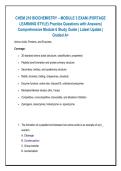
CHEM 210 BIOCHEMISTRY – MODULE 3 EXAM (PORTAGE
LEARNING STYLE) Practice Questions with Answers|
Comprehensive Module 6 Study Guide | Latest Update |
Graded A+
Amino Acids, Proteins, and Enzymes
Coverage:
20 standard amino acids (structure, classification, properties)
Peptide bond formation and protein primary structure
Secondary, tertiary, and quaternary structure
Motifs, domains, folding, chaperones, amyloids
Enzyme function, active site, induced fit, cofactors/coenzymes
Michaelis-Menten kinetics (Km, Vmax)
Competitive, noncompetitive, irreversible, and allosteric inhibition
Zymogens, isoenzymes, holoenzyme vs. apoenzyme
1. The formation of a peptide bond between two amino acids is an example of a(n) _
reaction.
A. Cleavage
B. Condensation
C. Group transfer
D. Isomerization
,2. How many standard amino acids are encoded by the genetic code?
A. 10
B. 15
C. 20
D. 22
3. Which amino acid contains a sulfur atom in its side chain?
A. Serine
B. Cysteine
C. Threonine
D. Tyrosine
4. TRUE or FALSE: All amino acids have both an amine and a carboxylic acid
functional group.
A. True
B. False
5. The primary structure of a protein refers to:
A. The overall 3D shape
B. The sequence of amino acids
C. Alpha helices and beta sheets
D. Interaction between multiple polypeptide chains
6. Which level of protein structure is stabilized primarily by hydrogen bonds between
backbone atoms?
A. Primary
B. Secondary
C. Tertiary
D. Quaternary
, 7. An alpha helix and a beta sheet are examples of:
A. Primary structure
B. Secondary structure
C. Tertiary structure
D. Quaternary structure
8. The overall 3-dimensional shape of a single folded polypeptide is termed:
A. Primary structure
B. Secondary structure
C. Tertiary structure
D. Quaternary structure
9. Quaternary structure is present only in proteins that:
A. Are single polypeptide chains
B. Have two or more polypeptide subunits
C. Contain only alpha helices
D. Are membrane-bound
10. A stable arrangement of secondary structure elements (e.g., helix-turn-helix) is
called a:
A. Domain
B. Motif
C. Cofactor
D. Active site
11. TRUE or FALSE: The amino acids serine and threonine both contain sulfur atoms.
A. True
B. False
LEARNING STYLE) Practice Questions with Answers|
Comprehensive Module 6 Study Guide | Latest Update |
Graded A+
Amino Acids, Proteins, and Enzymes
Coverage:
20 standard amino acids (structure, classification, properties)
Peptide bond formation and protein primary structure
Secondary, tertiary, and quaternary structure
Motifs, domains, folding, chaperones, amyloids
Enzyme function, active site, induced fit, cofactors/coenzymes
Michaelis-Menten kinetics (Km, Vmax)
Competitive, noncompetitive, irreversible, and allosteric inhibition
Zymogens, isoenzymes, holoenzyme vs. apoenzyme
1. The formation of a peptide bond between two amino acids is an example of a(n) _
reaction.
A. Cleavage
B. Condensation
C. Group transfer
D. Isomerization
,2. How many standard amino acids are encoded by the genetic code?
A. 10
B. 15
C. 20
D. 22
3. Which amino acid contains a sulfur atom in its side chain?
A. Serine
B. Cysteine
C. Threonine
D. Tyrosine
4. TRUE or FALSE: All amino acids have both an amine and a carboxylic acid
functional group.
A. True
B. False
5. The primary structure of a protein refers to:
A. The overall 3D shape
B. The sequence of amino acids
C. Alpha helices and beta sheets
D. Interaction between multiple polypeptide chains
6. Which level of protein structure is stabilized primarily by hydrogen bonds between
backbone atoms?
A. Primary
B. Secondary
C. Tertiary
D. Quaternary
, 7. An alpha helix and a beta sheet are examples of:
A. Primary structure
B. Secondary structure
C. Tertiary structure
D. Quaternary structure
8. The overall 3-dimensional shape of a single folded polypeptide is termed:
A. Primary structure
B. Secondary structure
C. Tertiary structure
D. Quaternary structure
9. Quaternary structure is present only in proteins that:
A. Are single polypeptide chains
B. Have two or more polypeptide subunits
C. Contain only alpha helices
D. Are membrane-bound
10. A stable arrangement of secondary structure elements (e.g., helix-turn-helix) is
called a:
A. Domain
B. Motif
C. Cofactor
D. Active site
11. TRUE or FALSE: The amino acids serine and threonine both contain sulfur atoms.
A. True
B. False