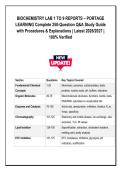
BIOCHEMISTRY LAB 1 TO 9 REPORTS – PORTAGE
LEARNING Complete 250-Question Q&A Study Guide
with Procedures & Explanations | Latest 2026/2027 |
100% Verified
Section Questions Key Topics Covered
Fundamental Chemical 1-25 Monomers, polymers, carbohydrates, lipids,
Concepts proteins, nucleic acids, pH, buffers, indicators
Organic Molecules 26-75 Macromolecule structures, functions, bonds, tests,
DNA/RNA, saturated vs unsaturated fats
Enzymes and Catalysis 76-100 Active site, denaturation, inhibition, kinetics, K_m,
Vmax, specificity
Chromatography 101-125 Stationary and mobile phases, ion-exchange, size-
exclusion, TLC, Rf values
Lipid Isolation 126-150 Saponification, extraction, cholesterol isolation,
melting point, purity analysis
ETC Inhibition 151-175 ETC complexes, inhibitors, glycolysis, pH
indicators, acidification
, Enzyme Kinetics and Lab 176-200 Lineweaver-Burk plots, inhibition types, controls,
Applications assays, spectrophotometry
Additional Concepts and 201-225 Catalysts, thermodynamics, nucleotides, protein
Lab Reports synthesis, DNA replication
Comprehensive Review 226-250 Central Dogma, mutations, electrophoresis, PCR,
sequencing, restriction enzymes
TOTAL 250 Complete Biochemistry Lab 1-9 Coverage
Questions
SECTION 1: FUNDAMENTAL CHEMICAL CONCEPTS (Lab 1) – Questions 1–25
1. A building block of a polymer is called a:
A) Monosaccharide
B) Monomer
C) Polymer
D) Dimer
Answer: B
Monomer is the building block of a polymer. Monomers link together through chemical
bonds to form larger macromolecules.
2. What is the monomer for carbohydrates?
A) Monosaccharides
B) Amino acids
C) Nucleotides
D) Fatty acids
,Answer: A
Carbohydrates are polymers made of monosaccharide monomers, such as glucose. The
bond linking them is a glycosidic linkage.
3. What are the building blocks for lipids?
A) Monosaccharides
B) Amino acids
C) Nucleotides
D) Fatty acids and glycerol
Answer: D
Lipids are not true polymers, but their building blocks are fatty acids and glycerol.
Triglycerides are formed from one glycerol and three fatty acid chains.
4. What is the monomer of proteins?
A) Monosaccharide
B) Amino acid
C) Nucleotide
D) Fatty acid
Answer: B
Amino acids are the monomers of proteins. They are linked together by peptide bonds to
form polypeptide chains.
5. What is the monomer of nucleic acids?
A) Monosaccharide
B) Amino acid
C) Nucleotide
D) Glycerol
, Answer: C
Nucleotides are the building blocks of nucleic acids (DNA and RNA). Each nucleotide
consists of a sugar, a phosphate group, and a nitrogenous base.
6. A chain of amino acids is called a:
A) Monomer chain
B) Polypeptide chain
C) Polynucleotide
D) Polysaccharide
Answer: B
A polypeptide chain is a sequence of amino acids joined by peptide bonds. Multiple
polypeptide chains can form a protein.
7. What are the functions of carbohydrates?
A) Long-term energy and insulation
B) Short-term energy and structure
C) Fight infection and movement
D) Store genetic information
Answer: B
Carbohydrates serve as short-term energy sources (e.g., glucose) and provide structural
support (e.g., cellulose in plant cell walls).
8. What are the functions of lipids?
A) Short-term energy and structure
B) Long-term energy, cell membrane structure, energy storage, and insulation
C) Lower activation energy and movement
D) Store and transmit genetic information
LEARNING Complete 250-Question Q&A Study Guide
with Procedures & Explanations | Latest 2026/2027 |
100% Verified
Section Questions Key Topics Covered
Fundamental Chemical 1-25 Monomers, polymers, carbohydrates, lipids,
Concepts proteins, nucleic acids, pH, buffers, indicators
Organic Molecules 26-75 Macromolecule structures, functions, bonds, tests,
DNA/RNA, saturated vs unsaturated fats
Enzymes and Catalysis 76-100 Active site, denaturation, inhibition, kinetics, K_m,
Vmax, specificity
Chromatography 101-125 Stationary and mobile phases, ion-exchange, size-
exclusion, TLC, Rf values
Lipid Isolation 126-150 Saponification, extraction, cholesterol isolation,
melting point, purity analysis
ETC Inhibition 151-175 ETC complexes, inhibitors, glycolysis, pH
indicators, acidification
, Enzyme Kinetics and Lab 176-200 Lineweaver-Burk plots, inhibition types, controls,
Applications assays, spectrophotometry
Additional Concepts and 201-225 Catalysts, thermodynamics, nucleotides, protein
Lab Reports synthesis, DNA replication
Comprehensive Review 226-250 Central Dogma, mutations, electrophoresis, PCR,
sequencing, restriction enzymes
TOTAL 250 Complete Biochemistry Lab 1-9 Coverage
Questions
SECTION 1: FUNDAMENTAL CHEMICAL CONCEPTS (Lab 1) – Questions 1–25
1. A building block of a polymer is called a:
A) Monosaccharide
B) Monomer
C) Polymer
D) Dimer
Answer: B
Monomer is the building block of a polymer. Monomers link together through chemical
bonds to form larger macromolecules.
2. What is the monomer for carbohydrates?
A) Monosaccharides
B) Amino acids
C) Nucleotides
D) Fatty acids
,Answer: A
Carbohydrates are polymers made of monosaccharide monomers, such as glucose. The
bond linking them is a glycosidic linkage.
3. What are the building blocks for lipids?
A) Monosaccharides
B) Amino acids
C) Nucleotides
D) Fatty acids and glycerol
Answer: D
Lipids are not true polymers, but their building blocks are fatty acids and glycerol.
Triglycerides are formed from one glycerol and three fatty acid chains.
4. What is the monomer of proteins?
A) Monosaccharide
B) Amino acid
C) Nucleotide
D) Fatty acid
Answer: B
Amino acids are the monomers of proteins. They are linked together by peptide bonds to
form polypeptide chains.
5. What is the monomer of nucleic acids?
A) Monosaccharide
B) Amino acid
C) Nucleotide
D) Glycerol
, Answer: C
Nucleotides are the building blocks of nucleic acids (DNA and RNA). Each nucleotide
consists of a sugar, a phosphate group, and a nitrogenous base.
6. A chain of amino acids is called a:
A) Monomer chain
B) Polypeptide chain
C) Polynucleotide
D) Polysaccharide
Answer: B
A polypeptide chain is a sequence of amino acids joined by peptide bonds. Multiple
polypeptide chains can form a protein.
7. What are the functions of carbohydrates?
A) Long-term energy and insulation
B) Short-term energy and structure
C) Fight infection and movement
D) Store genetic information
Answer: B
Carbohydrates serve as short-term energy sources (e.g., glucose) and provide structural
support (e.g., cellulose in plant cell walls).
8. What are the functions of lipids?
A) Short-term energy and structure
B) Long-term energy, cell membrane structure, energy storage, and insulation
C) Lower activation energy and movement
D) Store and transmit genetic information