

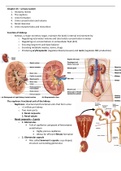
Chapter 25 – urinary system
1. Anatomy review
2. The nephron
3. Urine formation
4. Urine concentration and volume
5. Renal clearance
6. Urine characteristics and micturition
Function of kidneys
- Kidneys, a major excretory organ, maintain the body’s internal environment by:
o Regulating total water volume and total solute concentration in water
o Regulating ion concentrations in extracellular fluid (ECF)
o Ensuring long-term acid-base balance
o Excreting metabolic wastes, toxins, drugs
o Producing erythropoietin (regulates blood pressure) and renin (regulates RBC production)
The nephron: functional unit of the kidney
- Nephrons: structural and functional units that form urine
o >1 million per kidney
o Two main parts:
1. Renal corpuscle
2. Renal tubule
- Renal corpuscle – 2 parts
o 1. Glomerulus
▪ Tuft of capillaries composed of fenestrated
endothelium
• Highly porous capillaries
• Allows for efficient filtrate formation
o 2. Glomerular capsule
▪ Also called bowman’s capsule: cup-shaped,
structure surrounding glomerulus
, - renal tubule – 3 parts (about 3 cm)
o 1. Proximal convoluted tubule (PCT)
▪ Proximal, closest to renal corpuscle
▪ Cuboidal cells with dense microvilli
▪ Increase surface area/also have large
mitochondria
▪ Increase cells capacity to reabsorb water
o 2. Nephron loop
▪ “loop of Henle”
▪ U-shaped structure consisting of two
limbs
• 1. Descending limb
• 2. Ascending limb
o 3. Distal convoluted tubule
▪ Distal, fartest from renal corpuscle
▪ Function more in secretion than
reabsorption
▪ Confined to cartex
- Collecting ducts
Two major groups of nephrons
1. Cortical nephrons
o Make up 85% of nephrons
o Almost entirely in cortex
2. Juxtamedullary nephrons
o Long nephron loops deeply invade medulla
o Ascending limbs have thick and thin segments
o Important in production of concentrated urine
1. Anatomy review
2. The nephron
3. Urine formation
4. Urine concentration and volume
5. Renal clearance
6. Urine characteristics and micturition
Function of kidneys
- Kidneys, a major excretory organ, maintain the body’s internal environment by:
o Regulating total water volume and total solute concentration in water
o Regulating ion concentrations in extracellular fluid (ECF)
o Ensuring long-term acid-base balance
o Excreting metabolic wastes, toxins, drugs
o Producing erythropoietin (regulates blood pressure) and renin (regulates RBC production)
The nephron: functional unit of the kidney
- Nephrons: structural and functional units that form urine
o >1 million per kidney
o Two main parts:
1. Renal corpuscle
2. Renal tubule
- Renal corpuscle – 2 parts
o 1. Glomerulus
▪ Tuft of capillaries composed of fenestrated
endothelium
• Highly porous capillaries
• Allows for efficient filtrate formation
o 2. Glomerular capsule
▪ Also called bowman’s capsule: cup-shaped,
structure surrounding glomerulus
, - renal tubule – 3 parts (about 3 cm)
o 1. Proximal convoluted tubule (PCT)
▪ Proximal, closest to renal corpuscle
▪ Cuboidal cells with dense microvilli
▪ Increase surface area/also have large
mitochondria
▪ Increase cells capacity to reabsorb water
o 2. Nephron loop
▪ “loop of Henle”
▪ U-shaped structure consisting of two
limbs
• 1. Descending limb
• 2. Ascending limb
o 3. Distal convoluted tubule
▪ Distal, fartest from renal corpuscle
▪ Function more in secretion than
reabsorption
▪ Confined to cartex
- Collecting ducts
Two major groups of nephrons
1. Cortical nephrons
o Make up 85% of nephrons
o Almost entirely in cortex
2. Juxtamedullary nephrons
o Long nephron loops deeply invade medulla
o Ascending limbs have thick and thin segments
o Important in production of concentrated urine



