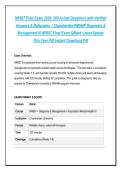
NR607 Final Exam 2026: 200 Actual Questions with Verified
Answers & Rationales – Chamberlain PMHNP Diagnosis &
Management III NR607 Final Exam QBank Latest Update
This Year.Pdf Instant Download Pdf
Exam Overview:
NR607 is a graduate-level nursing course focusing on advanced diagnosis and
management in psychiatric-mental health across the lifespan . The final exam is cumulative,
covering Weeks 1-8, and typically includes 100-200 multiple-choice and select-all-that-apply
questions, with 120 minutes allotted for completion . This guide is designed to help you
prepare for Chamberlain University's PMHNP program final exam.
EXAM FORMAT & SCOPE
Feature Detail
Course NR607 – Diagnosis & Management in Psychiatric-Mental Health III
Institution Chamberlain University
Format Multiple-choice, select-all-that-apply
Time 120 minutes
Coverage Cumulative (Weeks 1-8)
,SECTION 1: FOUNDATIONS OF CARE & ETHICAL-LEGAL CONCEPTS (Questions 1-
25)
Q1. A 20-year-old client is brought to the emergency department by a friend after
being found with superficial lacerations on her arms. The client is withdrawn and
repeats, "I don't know why this keeps happening." The PMHNP observes multiple
linear scars in various stages of healing on her forearms. What is the priority nursing
intervention?
Answer: Provide a medical evaluation of the wounds and a psychiatric assessment .
Rationale: Self-injurious behavior is a maladaptive coping mechanism that requires both
medical and psychiatric evaluation to ensure safety and identify underlying issues. A "no-
harm contract" is not a substitute for a comprehensive assessment .
Q2. A PMHNP is asked to speak at a school board meeting to advocate for expanded
mental health services for underserved students. This action best exemplifies which
ethical principle?
Answer: Promotion of the Nursing Profession .
Rationale: By participating in policy development to expand access to care, the PMHNP is
promoting the nursing profession and addressing systemic barriers to mental health
treatment .
Q3. A client with schizophrenia is being evaluated for capacity to refuse medication.
Which of the following is the most critical element in determining capacity?
, Answer: The client can verbalize an understanding of the risks and benefits of the
treatment .
Rationale: Capacity is decision-specific and requires that a patient can understand relevant
information, appreciate the situation, reason with the information, and communicate a
choice .
Q4. A client is brought to the emergency room by police after being found wandering
in traffic, disoriented, and yelling at unseen figures. The client refuses admission.
What is the most appropriate next step?
Answer: Initiate an involuntary hold based on danger to self/others or grave disability .
Rationale: When a client poses a danger to self/others or is unable to meet basic needs
(grave disability) due to a mental illness, an involuntary admission or emergency hold is
legally and ethically justified .
Q5. A client is voluntarily admitted to an inpatient psychiatric unit. After 24 hours, the
client demands to be discharged. The provider determines the client remains at high
risk for suicide. What is the appropriate action?
Answer: Initiate the process for an emergency involuntary hold .
Rationale: A client's status can change from voluntary to involuntary if they become a
danger to themselves or others. The provider can initiate a legal hold to ensure safety .
Answers & Rationales – Chamberlain PMHNP Diagnosis &
Management III NR607 Final Exam QBank Latest Update
This Year.Pdf Instant Download Pdf
Exam Overview:
NR607 is a graduate-level nursing course focusing on advanced diagnosis and
management in psychiatric-mental health across the lifespan . The final exam is cumulative,
covering Weeks 1-8, and typically includes 100-200 multiple-choice and select-all-that-apply
questions, with 120 minutes allotted for completion . This guide is designed to help you
prepare for Chamberlain University's PMHNP program final exam.
EXAM FORMAT & SCOPE
Feature Detail
Course NR607 – Diagnosis & Management in Psychiatric-Mental Health III
Institution Chamberlain University
Format Multiple-choice, select-all-that-apply
Time 120 minutes
Coverage Cumulative (Weeks 1-8)
,SECTION 1: FOUNDATIONS OF CARE & ETHICAL-LEGAL CONCEPTS (Questions 1-
25)
Q1. A 20-year-old client is brought to the emergency department by a friend after
being found with superficial lacerations on her arms. The client is withdrawn and
repeats, "I don't know why this keeps happening." The PMHNP observes multiple
linear scars in various stages of healing on her forearms. What is the priority nursing
intervention?
Answer: Provide a medical evaluation of the wounds and a psychiatric assessment .
Rationale: Self-injurious behavior is a maladaptive coping mechanism that requires both
medical and psychiatric evaluation to ensure safety and identify underlying issues. A "no-
harm contract" is not a substitute for a comprehensive assessment .
Q2. A PMHNP is asked to speak at a school board meeting to advocate for expanded
mental health services for underserved students. This action best exemplifies which
ethical principle?
Answer: Promotion of the Nursing Profession .
Rationale: By participating in policy development to expand access to care, the PMHNP is
promoting the nursing profession and addressing systemic barriers to mental health
treatment .
Q3. A client with schizophrenia is being evaluated for capacity to refuse medication.
Which of the following is the most critical element in determining capacity?
, Answer: The client can verbalize an understanding of the risks and benefits of the
treatment .
Rationale: Capacity is decision-specific and requires that a patient can understand relevant
information, appreciate the situation, reason with the information, and communicate a
choice .
Q4. A client is brought to the emergency room by police after being found wandering
in traffic, disoriented, and yelling at unseen figures. The client refuses admission.
What is the most appropriate next step?
Answer: Initiate an involuntary hold based on danger to self/others or grave disability .
Rationale: When a client poses a danger to self/others or is unable to meet basic needs
(grave disability) due to a mental illness, an involuntary admission or emergency hold is
legally and ethically justified .
Q5. A client is voluntarily admitted to an inpatient psychiatric unit. After 24 hours, the
client demands to be discharged. The provider determines the client remains at high
risk for suicide. What is the appropriate action?
Answer: Initiate the process for an emergency involuntary hold .
Rationale: A client's status can change from voluntary to involuntary if they become a
danger to themselves or others. The provider can initiate a legal hold to ensure safety .