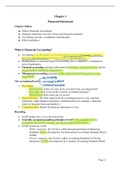
Chapter 1
Financial Statements
Chapter Outline
What is Financial Accounting?
Financial statements overview: Four main financial statements
Accounting concepts, assumptions and principles
Ethical guidelines
What is Financial Accounting?
• Accounting is an information system that measures and records business activities,
processes data into reports, and reports results to decision makers.
• Bookkeeping is a mechanical part of accounting, just as arithmetic is a mechanical
part of mathematics.
• Financial accounting: provides information for managers inside the business and for
decision makers outside the organization
• Management accounting: generates inside information for the managers of the
organization.
The Accounting Process:
1. Recording:
- Identification: Is this an event can be recorded in the accounting book?
- Recording: How to record this event by accounting language?
- Measurement: How much can we record?
2. Summarisation: The final output from the recording processes is the summary
statements, called financial statements. (Summarisation of a company’s financial
stories in financial terms and numbers.)
3. Communication: Report the financial statements to Users.
Recording
• GAAP defines how we record transactions.
• Generally accepted accounting principles (GAAP): The standards for how
accountants must record, measure, and report financial information.
• GAAP around the world:
- Public companies: the GAAP is called International Financial Reporting
Standards (IFRS), developed by the International Accounting Standards Board
(IASB).
- Private companies, the GAAP is called Accounting Standards for Private
Enterprises (ASPE), developed by the Canadian Accounting Standards Board.
Page | 1
,Public Vs. Private Company
• Public company: Corporations that issue shares to the general public and shares are
traded on public stock exchanges, such as Toronto Stock Exchange.
• Private company: Proprietorships, partnerships, and corporations that issue shares to
limited investors and shares are not traded on stock exchanges.
Proprietorship Partnership Corporation
Owner(s) Proprietor—one Partners—two or Shareholders—
owner more owners generally many
owners
Life of entity Limited by Limited by owners’ Limited by owners’
owner’s choice or choice or death choice, but not their
death death
Personal Proprietor is Partners are Shareholders are
liability of personally liable usually personally not personally liable
owner(s) for liable
business debts
Accounting Accounting entity Accounting entity is Accounting entity
status is separate from separate from is separate from
proprietor partners shareholders
• A proprietorship is an unincorporated business with a single owner, called the
proprietor.
• A partnership is an unincorporated business with two or more parties as co-owners,
and each owner is a partner.
• A corporation is an incorporated business owned by its shareholders, who
own shares representing partial ownership of the corporation.
Communication
• When to report financial statements
- Public companies are required by government security agencies to make and
report their financial statements to the public quarterly and annually.
- For internal use, the company may make financial statements monthly.
- An accounting period: is the span of time covered by a set of financial
statements. Depending on when the company makes the financial statements,
an accounting period can be one month, one quarter or one year.
- Fiscal year: one-year accounting time period covered by the annual report.
Page | 2
,Fiscal year end Vs. Calendar year end
• Calendar year: covers 12 months, ending on Dec 31st.
• Fiscal year end: the coverage ending date for each annual report. Dates covered by
annual statements are determined by fiscal rather than calendar year.
- The fiscal year ends are chosen by the company.
- Many companies choose to end their fiscal year when their inventory or
operating are at a low level so that they have a lot of time to prepare their
annual financial statements.
Where to find company’s financial statements?
• Company website (investor relations)
• Government agency website to search for companies’ filings:
- Sedar.com for Canadian firms
- Sec.gov for U.S. firms (For US firms, 10K refers to annual report, 10Q refers
to quarterly report).
Main users of Financial Statements
• Managers: Managers have to make many business decisions.
• Investors and creditors: Investors and creditors provide the money to finance a
business’s activities.
• Government and Regulatory bodies: income and sales taxes
• Individuals: To manage bank accounts and decide whether to rent an apartment or
buy a house.
• Not-For-Profit Organizations: accounting information is the basis of a not-for-
profit’s reporting on the organization’s stewardship of funds received and its
compliance with the reporting requirements of the Canada Revenue Agency.
Page | 3
, Financial statements overview: Four main financial statements
The Income Statement
• The income statement: the financial statement that measures a company’s operating
performance for a specified period of time. It reports income, expenses and net
income.
• Basic format: Revenues – Expenses = Net income
Operating income = Operating Revenues – Operating expenses
Income before tax = Operating income + Non-operating revenues – Non-operating exps
Net income = Income before tax – Income tax expense
Income
• A company’s income includes both revenue and gains
- Revenue: amounts earned from the sale of goods or the provision of services.
- Associated with increases in economic resources
▪ normally an increase in an asset (not necessarily cash)
▪ but sometimes a decrease in a liability.
- Gains represent other items that result in an increase in economic benefits to a
company and may, but usually do not, occur in the course of the company’s
ordinary business activities.
Expenses
• Expenses: costs of assets consumed or services used to generate revenues.
• Associated with decrease in economic resources;
- decrease in an asset or
- increase in a liability.
Page | 4
Financial Statements
Chapter Outline
What is Financial Accounting?
Financial statements overview: Four main financial statements
Accounting concepts, assumptions and principles
Ethical guidelines
What is Financial Accounting?
• Accounting is an information system that measures and records business activities,
processes data into reports, and reports results to decision makers.
• Bookkeeping is a mechanical part of accounting, just as arithmetic is a mechanical
part of mathematics.
• Financial accounting: provides information for managers inside the business and for
decision makers outside the organization
• Management accounting: generates inside information for the managers of the
organization.
The Accounting Process:
1. Recording:
- Identification: Is this an event can be recorded in the accounting book?
- Recording: How to record this event by accounting language?
- Measurement: How much can we record?
2. Summarisation: The final output from the recording processes is the summary
statements, called financial statements. (Summarisation of a company’s financial
stories in financial terms and numbers.)
3. Communication: Report the financial statements to Users.
Recording
• GAAP defines how we record transactions.
• Generally accepted accounting principles (GAAP): The standards for how
accountants must record, measure, and report financial information.
• GAAP around the world:
- Public companies: the GAAP is called International Financial Reporting
Standards (IFRS), developed by the International Accounting Standards Board
(IASB).
- Private companies, the GAAP is called Accounting Standards for Private
Enterprises (ASPE), developed by the Canadian Accounting Standards Board.
Page | 1
,Public Vs. Private Company
• Public company: Corporations that issue shares to the general public and shares are
traded on public stock exchanges, such as Toronto Stock Exchange.
• Private company: Proprietorships, partnerships, and corporations that issue shares to
limited investors and shares are not traded on stock exchanges.
Proprietorship Partnership Corporation
Owner(s) Proprietor—one Partners—two or Shareholders—
owner more owners generally many
owners
Life of entity Limited by Limited by owners’ Limited by owners’
owner’s choice or choice or death choice, but not their
death death
Personal Proprietor is Partners are Shareholders are
liability of personally liable usually personally not personally liable
owner(s) for liable
business debts
Accounting Accounting entity Accounting entity is Accounting entity
status is separate from separate from is separate from
proprietor partners shareholders
• A proprietorship is an unincorporated business with a single owner, called the
proprietor.
• A partnership is an unincorporated business with two or more parties as co-owners,
and each owner is a partner.
• A corporation is an incorporated business owned by its shareholders, who
own shares representing partial ownership of the corporation.
Communication
• When to report financial statements
- Public companies are required by government security agencies to make and
report their financial statements to the public quarterly and annually.
- For internal use, the company may make financial statements monthly.
- An accounting period: is the span of time covered by a set of financial
statements. Depending on when the company makes the financial statements,
an accounting period can be one month, one quarter or one year.
- Fiscal year: one-year accounting time period covered by the annual report.
Page | 2
,Fiscal year end Vs. Calendar year end
• Calendar year: covers 12 months, ending on Dec 31st.
• Fiscal year end: the coverage ending date for each annual report. Dates covered by
annual statements are determined by fiscal rather than calendar year.
- The fiscal year ends are chosen by the company.
- Many companies choose to end their fiscal year when their inventory or
operating are at a low level so that they have a lot of time to prepare their
annual financial statements.
Where to find company’s financial statements?
• Company website (investor relations)
• Government agency website to search for companies’ filings:
- Sedar.com for Canadian firms
- Sec.gov for U.S. firms (For US firms, 10K refers to annual report, 10Q refers
to quarterly report).
Main users of Financial Statements
• Managers: Managers have to make many business decisions.
• Investors and creditors: Investors and creditors provide the money to finance a
business’s activities.
• Government and Regulatory bodies: income and sales taxes
• Individuals: To manage bank accounts and decide whether to rent an apartment or
buy a house.
• Not-For-Profit Organizations: accounting information is the basis of a not-for-
profit’s reporting on the organization’s stewardship of funds received and its
compliance with the reporting requirements of the Canada Revenue Agency.
Page | 3
, Financial statements overview: Four main financial statements
The Income Statement
• The income statement: the financial statement that measures a company’s operating
performance for a specified period of time. It reports income, expenses and net
income.
• Basic format: Revenues – Expenses = Net income
Operating income = Operating Revenues – Operating expenses
Income before tax = Operating income + Non-operating revenues – Non-operating exps
Net income = Income before tax – Income tax expense
Income
• A company’s income includes both revenue and gains
- Revenue: amounts earned from the sale of goods or the provision of services.
- Associated with increases in economic resources
▪ normally an increase in an asset (not necessarily cash)
▪ but sometimes a decrease in a liability.
- Gains represent other items that result in an increase in economic benefits to a
company and may, but usually do not, occur in the course of the company’s
ordinary business activities.
Expenses
• Expenses: costs of assets consumed or services used to generate revenues.
• Associated with decrease in economic resources;
- decrease in an asset or
- increase in a liability.
Page | 4