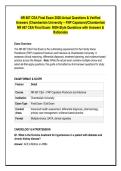
NR 667 CEA Final Exam 2026:Actual Questions & Verified
Answers (Chamberlain University – FNP Capstone)/Chamberlain
NR 667 CEA Final Exam: NGN-Style Questions with Answers &
Rationales
Exam Overview:
The NR 667 CEA Final Exam is the culminating assessment for the Family Nurse
Practitioner (FNP) Capstone Practicum and Intensive at Chamberlain University. It
assesses clinical reasoning, differential diagnosis, treatment planning, and evidence-based
practice across the lifespan . Note: While the actual exam contains multiple-choice and
select-all-that-apply questions, this guide is formatted as short-answer questions for study
purposes .
EXAM FORMAT & SCOPE
Feature Detail
Course NR 667 CEA – FNP Capstone Practicum and Intensive
Institution Chamberlain University
Exam Type Final Exam / Exit Exam
Content Advanced health assessment, differential diagnosis, pharmacology,
Areas primary care management, evidence-based practice
Format Multiple-choice, SATA, clinical vignettes
CARDIOLOGY & HYPERTENSION
Q1. What is the first-line treatment for hypertension in a patient with diabetes and
chronic kidney disease?
Answer: ACE inhibitors or ARBs
,Rationale: ACE inhibitors and ARBs are first-line for hypertension with diabetes and CKD
due to their reno-protective effects . For Black patients, initial therapy may also include
CCBs or thiazides.
Q2. What is the mechanism of action of carvedilol, and in which condition is it
preferred?
Answer: Non-selective beta-blocker with alpha-1 blocking activity; preferred for heart failure
with reduced ejection fraction (HFrEF)
Rationale: Carvedilol reduces myocardial oxygen demand and has demonstrated mortality
benefit in HFrEF .
Q3. A patient with HFrEF has an ejection fraction less than what percentage?
Answer: Less than 40%
Rationale: Heart failure with reduced ejection fraction is defined as EF <40%. These
patients require guideline-directed medical therapy including beta-blockers, ACE
inhibitors/ARBs, and diuretics .
Q4. What is the mechanism of action of Entresto (sacubitril/valsartan)?
Answer: Neprilysin inhibitor combined with an ARB; increases natriuretic peptides while
blocking angiotensin II
Rationale: Entresto improves outcomes in HFrEF but can cause hyperkalemia and
increased creatinine .
Q5. What is the difference between dihydropyridine and non-dihydropyridine calcium
channel blockers?
Answer: Dihydropyridines are vasodilating (e.g., amlodipine) and cause peripheral
edema/constipation; non-dihydropyridines are non-dilating and more negatively chronotropic
Rationale: Dihydropyridine CCBs cause peripheral edema due to vasodilation; non-
dihydropyridine CCBs (verapamil, diltiazem) are more cardioselective .
, Q6. What is the most common location for an abdominal aortic aneurysm?
Answer: Infrarenal and ascending aorta
Rationale: AAA most commonly occurs in the infrarenal abdominal aorta .
Q7. What medication class should be avoided in patients with a history of abdominal
aortic aneurysm?
Answer: Fluoroquinolones
Rationale: Fluoroquinolones can worsen or cause aortic dissection/aneurysm and should
be avoided .
Q8. Where would the S1 heart sound correlate with the electrocardiographic waves?
Answer: Peak of the R wave
Rationale: S1 corresponds to mitral and tricuspid valve closure, which coincides with the
peak of the R wave on ECG .
Q9. What is the significance of ST-segment depression during a stress test?
Answer: Indicates myocardial ischemia
Rationale: ST-segment depression during exercise stress testing is a positive finding for
ischemia requiring cardiology referral .
Q10. Aortic stenosis is characterized by what type of murmur and associated
symptoms?
Answer: Harsh, systolic, crescendo-decrescendo murmur heard best at the right upper
sternal border with radiation to the carotids; symptoms include syncope/near-syncope,
angina, and dyspnea
Rationale: Classic findings of aortic stenosis include a harsh systolic ejection murmur and
the symptom triad of syncope, angina, and heart failure .
Answers (Chamberlain University – FNP Capstone)/Chamberlain
NR 667 CEA Final Exam: NGN-Style Questions with Answers &
Rationales
Exam Overview:
The NR 667 CEA Final Exam is the culminating assessment for the Family Nurse
Practitioner (FNP) Capstone Practicum and Intensive at Chamberlain University. It
assesses clinical reasoning, differential diagnosis, treatment planning, and evidence-based
practice across the lifespan . Note: While the actual exam contains multiple-choice and
select-all-that-apply questions, this guide is formatted as short-answer questions for study
purposes .
EXAM FORMAT & SCOPE
Feature Detail
Course NR 667 CEA – FNP Capstone Practicum and Intensive
Institution Chamberlain University
Exam Type Final Exam / Exit Exam
Content Advanced health assessment, differential diagnosis, pharmacology,
Areas primary care management, evidence-based practice
Format Multiple-choice, SATA, clinical vignettes
CARDIOLOGY & HYPERTENSION
Q1. What is the first-line treatment for hypertension in a patient with diabetes and
chronic kidney disease?
Answer: ACE inhibitors or ARBs
,Rationale: ACE inhibitors and ARBs are first-line for hypertension with diabetes and CKD
due to their reno-protective effects . For Black patients, initial therapy may also include
CCBs or thiazides.
Q2. What is the mechanism of action of carvedilol, and in which condition is it
preferred?
Answer: Non-selective beta-blocker with alpha-1 blocking activity; preferred for heart failure
with reduced ejection fraction (HFrEF)
Rationale: Carvedilol reduces myocardial oxygen demand and has demonstrated mortality
benefit in HFrEF .
Q3. A patient with HFrEF has an ejection fraction less than what percentage?
Answer: Less than 40%
Rationale: Heart failure with reduced ejection fraction is defined as EF <40%. These
patients require guideline-directed medical therapy including beta-blockers, ACE
inhibitors/ARBs, and diuretics .
Q4. What is the mechanism of action of Entresto (sacubitril/valsartan)?
Answer: Neprilysin inhibitor combined with an ARB; increases natriuretic peptides while
blocking angiotensin II
Rationale: Entresto improves outcomes in HFrEF but can cause hyperkalemia and
increased creatinine .
Q5. What is the difference between dihydropyridine and non-dihydropyridine calcium
channel blockers?
Answer: Dihydropyridines are vasodilating (e.g., amlodipine) and cause peripheral
edema/constipation; non-dihydropyridines are non-dilating and more negatively chronotropic
Rationale: Dihydropyridine CCBs cause peripheral edema due to vasodilation; non-
dihydropyridine CCBs (verapamil, diltiazem) are more cardioselective .
, Q6. What is the most common location for an abdominal aortic aneurysm?
Answer: Infrarenal and ascending aorta
Rationale: AAA most commonly occurs in the infrarenal abdominal aorta .
Q7. What medication class should be avoided in patients with a history of abdominal
aortic aneurysm?
Answer: Fluoroquinolones
Rationale: Fluoroquinolones can worsen or cause aortic dissection/aneurysm and should
be avoided .
Q8. Where would the S1 heart sound correlate with the electrocardiographic waves?
Answer: Peak of the R wave
Rationale: S1 corresponds to mitral and tricuspid valve closure, which coincides with the
peak of the R wave on ECG .
Q9. What is the significance of ST-segment depression during a stress test?
Answer: Indicates myocardial ischemia
Rationale: ST-segment depression during exercise stress testing is a positive finding for
ischemia requiring cardiology referral .
Q10. Aortic stenosis is characterized by what type of murmur and associated
symptoms?
Answer: Harsh, systolic, crescendo-decrescendo murmur heard best at the right upper
sternal border with radiation to the carotids; symptoms include syncope/near-syncope,
angina, and dyspnea
Rationale: Classic findings of aortic stenosis include a harsh systolic ejection murmur and
the symptom triad of syncope, angina, and heart failure .